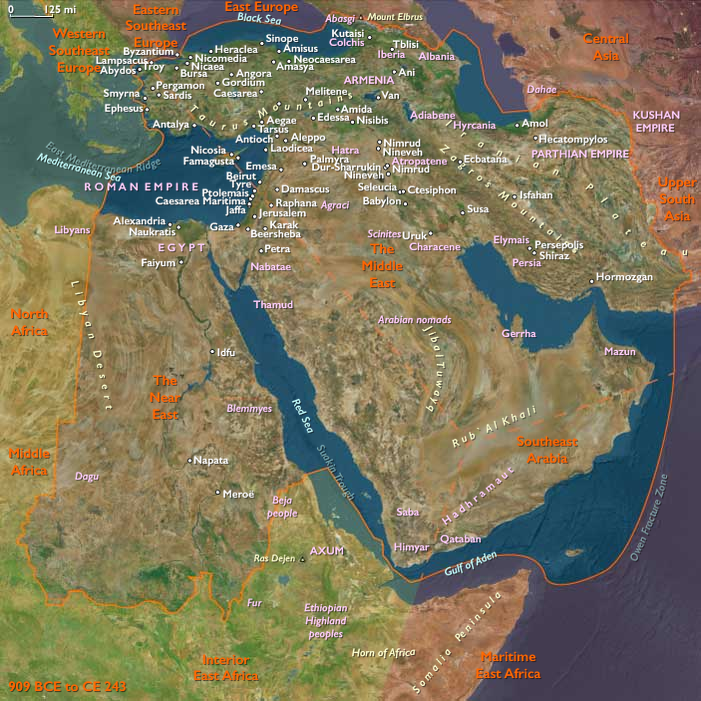
Septimius Severus, contending for the imperial throne …
Years: 193 - 193
July
Septimius Severus, contending for the imperial throne in the Year of the Five Emperors, receives support from Jewish communities in his war against Pescennius Niger, governor of Syria, who had once told a Jewish delegation that he was sorry he could not tax the air they breathed.
Locations
People
Groups
- Jews
- Syria Palæstina, Roman province of (Judea, Samaria, and Idumea)
- Roman Empire (Rome): Severan dynasty
Topics
- Classical antiquity
- Roman Age Optimum
- Roman Civil War of 193-97
- Year of the Five Emperors, or Roman Civil War of 193
Commodoties
Subjects
Regions
Subregions
Related Events
Filter results
Showing 10 events out of 60865 total
Pertinax, who is serving as urban prefect at this time, is hurried to the Praetorian Camp and proclaimed emperor the morning after Commodus’ assassination had been carried out.
The Senate declares Commodus a public enemy (a de facto damnatio memoriae) and restores the original name to the city of Rome and its institutions.
Commodus' statues are thrown down and his body buried in the Mausoleum of Hadrian.
Ancient writers detail how the Praetorian Guard expected a generous donativum on the ascension of Pertinax, and when they were disappointed, agitated until he produced the money, selling off Commodus' property, including the concubines and youths Commodus kept for his sexual pleasures.
Pertinax attempts to emulate the restrained practices of Marcus Aurelius, and makes an effort to reform the alimenta, but he faces antagonism from many quarters.
He revalues the Roman currency dramatically, increasing the silver purity of the denarius from 74% to 87%—the actual silver weight increasing from 2.22 grams to 2.75 grams.
His currency reform is far-sighted, but will not survive his death.
He attempts to impose stricter military discipline upon the pampered Praetorians.
Pertinax narrowly averts one conspiracy by a group to replace him with the consul Quintus Sosius Falco while he is in Ostia inspecting the arrangements for grain shipments.
The plot is betrayed in early March; Falco himself is pardoned but several of the officers behind the coup are executed.
Pertinax is at his palace on March 28, 193, when, according to the Historia Augusta, a contingent of some three hundred soldiers of the Praetorian Guard rushes the gates (two hundred according to Cassius Dio).
Ancient sources suggest that they had received only half their promised pay.
Neither the guards on duty nor the palace officials choose to resist them.
Pertinax sends Laetus to meet them, but he chooses to side with the insurgents instead and deserts the emperor.
Although advised to flee, Pertinax then attempts to reason with them, and is almost successful before being struck down by one of the soldiers.
Pertinax must have been aware of the danger he faced by assuming the purple, for he refused to use imperial titles for either his wife or son, thus protecting them from the aftermath of his own assassination.
Immediately after the murder of Pertinax, the Praetorian assassins announce that the throne is to be sold to the man who will pay the highest price.
Titus Flavius Sulpicianus, prefect of the city, father-in-law of the murdered emperor, being at this moment in the camp to which he had been sent to calm the troops, begins making offers when Didius Julianus, having been roused from a banquet by his wife and daughter, arrives in all haste, and being unable to gain admission, stands before the gate, and with a loud voice competes or the prize.
Julianus, consul in 175 along with Pertinax, had further distinguished himself in a campaign against the Chatti, ruled Dalmatia and Germania Inferior, and then was made prefect charged with distributing money to the poor of Italy.
It was around this time that he had been charged with having conspired against the life of Commodus, but he had had the good fortune to be acquitted and to witness the punishment of his accuser.
After governing Bithynia, he had succeeded Pertinax in 190 as the proconsul of Africa.
As the bidding goes on, the soldiers report to each of the two competitors, the one within the fortifications, the other outside the rampart, the sum offered by his rival.
Eventually Sulpicianus promises 20,000 sesterces to every soldier; Julianus, fearing that Sulpicianus will gain the throne, then offers 25,000.
The guards immediately close with the offer of Julianus, throw open the gates, salute him by the name of Commodus, and proclaim him emperor.
Threatened by the military, the Senate declares him emperor.
His wife and his daughter both receive the title Augusta.
Julianus immediately devalues the Roman currency upon his accession, decreasing the silver purity of the denarius from 87% to 81.5%—the actual silver weight dropping from 2.75 grams to 2.40 grams.
After the initial confusion subsides, the population does not tamely submit to the dishonor brought upon Rome.
Whenever Julianus appears in public he is saluted with groans, imprecations, and shouts of "robber and parricide."
The mob tries to obstruct his progress to the Capitol, and even throws stones.
When news of the public anger in Rome spreads across the Empire, the generals Pescennius Niger in Syria, Septimius Severus in Pannonia, and Clodius Albinus in Britain and Gaul, each having three legions under his command, refuses to recognize the authority of Julianus.
Clodius Albinus, born into an aristocratic family at Hadrumetum in Africa had, according to his father, received the name of Albinus because of the extraordinary whiteness of his body.
Showing great disposition for a military life, he had entered the army at an early age and served with great distinction, especially during the rebellion of Avidius Cassius against the Emperor Marcus Aurelius in 175.
His merits were acknowledged by the Emperor in two letters in which he calls Albinus an African, who resembled his countrymen but little, and who was praiseworthy for his military experience and the gravity of his character.
The Emperor likewise declared that without Albinus the legions (in Bithynia) would have gone over to Avidius Cassius, and that he intended to have him chosen consul.
Commodus had given Albinus a command in Gallia Belgica and afterwards in Britain.
A false rumor having been spread that Commodus had died, Albinus denounced the man before his soldiers in Britain, calling Commodus a tyrant, and maintaining that it would be useful to the Roman Empire to restore to the senate its ancient dignity and power.
The Senate was very pleased with these sentiments, but not so the Emperor, who sent Junius Severus to relieve Albinus of his command.
Some time before, Commodus had offered him the title of Caesar, which he declined.
Notwithstanding the appointment of Junius Severus as his successor, Albinus has kept his command.
Although Pescennius Niger had been born into an old Italian equestrian family, he is the first member of his family to achieve the rank of Roman senator.
Not much is known of his early career; it is possible that he held an administrative position in Egypt, and that he served in a military campaign in Dacia early in Commodus’ reign.
During the late 180s, Niger was elected as a Suffect consul, after which Commodus made him imperial legate of Syria in 191.
He is still serving in Syria when news comes through firstly of the murder of Pertinax, followed by the auctioning off of the imperial title to Didius Julianus.
Niger is a well regarded public figure in Rome and soon a popular demonstration against Didius Julianus breaks out, during which the citizens call out for Niger to come to Rome and claim the imperial title for himself.
As a consequence, it is alleged that Julianus dispatched a centurion to the east with orders to assassinate Niger at Antioch.
The result of the unrest in Rome sees Niger proclaimed Emperor by the eastern legions by the end of April 193.
On his accession, Niger takes the additional cognomen Justus, or "the Just".
Although imperial propaganda issued on behalf of Septimius Severus later claims that Niger was the first to rebel against Didius Julianus, it is Severus who beats Niger to it, claiming the imperial title on April 9.
Although Niger sends envoys to Rome to announce his elevation to the imperial throne, his messengers are intercepted by Severus.
Septimius Severus, whose Romanized North African family is not politically prominent, has nevertheless held a number of important posts, and had received from the Emperor Commodus the command of the legions in Pannonia.
In response to the murder of Pertinax, Severus' soldiers proclaim him Emperor at Carnuntum, whereupon he hurries to Italy.

Julianus declares Severus a public enemy because he is the nearest of the three rival claimants and, therefore, the most dangerous foe.
Deputies are sent from the Senate to persuade the soldiers to abandon him; a new general is nominated to supersede him, and a centurion dispatched to take his life.
The Praetorian Guard, long strangers to active military operations, are marched into the Campus Martius, regularly drilled, and trained in the construction of fortifications and field works.
Severus, however, having secured the support of Albinus by—deceitfully—declaring him Caesar, which implies some claim to succession, progresses towards the city, makes himself master of the fleet at Ravenna, defeats Tullius Crispinus, the Praetorian Prefect, who had been sent to halt his progress, and gains over to his cause the ambassadors sent to seduce his troops.The Praetorian Guard, lacking discipline and sunk in debauchery and sloth, are incapable of offering any effectual resistance.
Matters being desperate, Julianus now attempts negotiation and offers to share the empire with his rival, but Severus ignores these overtures and presses forward, all Italy declaring for him as he advances.
At last the Praetorians, having received assurances that they will suffer no punishment—provided they surrender the actual murderers of Pertinax—seize the ringleaders of the conspiracy and report what they have done to Silius Messala, the consul, by whom the Senate is summoned and informed of the proceedings.
The Senate passes a motion proclaiming Severus emperor, awarding divine honors to Pertinax, and sentencing Julianus to death.
Julianus is deserted by all except one of the prefects and his son-in-law, Repentinus.
Julianus is killed in the palace by a soldier in the third month of his reign (June 1, 193).
According to Cassius Dio, who lived in Rome during the period, Julianus's last words were "But what evil have I done?
Whom have I killed?"
His body is given to his wife and daughter, who bury it in his great-grandfather's tomb by the fifth milestone on the Via Labicana.
After his entry to Rome, Severus dismisses the Praetorian Guard and executes the soldiers who had killed Pertinax.
The surviving guardsmen are stripped of their ceremonial armor and ordered to remove themselves within one hundred miles of the city on pain of death.
Severus now raises a new Guard composed of fifty thousand loyal soldiers mainly camped at Albanum, near Rome (also probably to grant the emperor a kind of centralized reserve).
He recognizes Pertinax as a legitimate emperor and not only pressures the Senate to deify him and provide for him a state funeral, but also adopts his cognomen of Pertinax as part of his name, and also for some time will hold games on the anniversary of Pertinax's ascension and his birthday.
Severus’s rearguard in the northwest is now protected by his offer of the rank of Caesar to Clodius Albinus, the powerful governor of Britannia who had probably supported Didius Julianus against him.
The imperial contender advances with his legions east into the empire against Pescennius Niger, the Roman governor of Syria who had been acclaimed Emperor by his troops, like Severus, following the death of Pertinax.
Severus wins victories over his Syrian rival Niger at the battles of Cyzicus and …
…Nicaea in 193, whereupon Niger's army successfully withdraws to the Taurus mountains, where it fiercely defends the Cilician pass.
At this time the commander of the Severan troops, Tiberius Claudius Candidus, is replaced by Publius Cornelius Anullinus, perhaps due to the failure of the former to prevent the withdrawal of the rival army.
A locust plague causes a major famine across China in 194.
According to the Records of the Three Kingdoms, the people ate each other out of desperation.
Without food, many armies are defeated without fighting.
From this experience, Cao Cao sees the importance of an ample food supply in building a strong military.
He begins a series of agricultural programs in cities such as Xuchang and Chenliu.
Refugees are recruited and given wasteland to cultivate.
Later, encampments not faced with imminent danger of war are also made to farm.
This system will be continued and spreads to all regions under Cao as his realm expands.
Although Cao's primary intention is to build a powerful army, the agricultural program also improves the living standards of the people, especially war refugees.
Yuan Shao's ally, Cao Cao, launches a campaign against Tao Qian in Xu Province in 194.
At this time, there are two opposing alliances—Yuan Shu, Tao Qian, and Gongsun Zan on one side, Yuan Shao, Cao Cao, and Liu Biao the other.
In face of strong pressure from Cao Cao's invading force, Tao Qian appeals to Tian Kai for help.
Tian Kai and Liu Bei led their armies to support Tao Qian.
Despite the initial success of the invasion, Cao Cao's subordinate Zhang Miao rebels and allows Lü Bu to take over Cao's base in Yan Province (present day western Shandong), forcing Cao to retreat from Xu Province.
Tao Qian asks Liu Bei to station his army in nearby Xiaopei (present day Pei County, Jiangsu) and give him four thousand more troops, in addition to one thousand or so troops and some Wuhuan cavalry already under his command.
Thus, Liu Bei deserts his supervisor Tian Kai for Tao Qian.
Meantime, Liu Bei raises troops around the area, and actively builds up connections with influential clans and people of the region.
In a rather short period of time, he has gained the support of the two most powerful families in Xu Province: the Mi clan led by Mi Zhu and Mi Fang, and the Chen clan led by Chen Gui and Chen Deng.
Liu Bei also marries Mi Zhu's younger sister to draw support from the Mi clan.
Upon Tao Qian's death shortly afterwards, Liu Bei secures his position around the area by building up connections and an army.
The Mi clan strongly advocates the governorship be passed on to Liu Bei instead of Tao Qian's sons.
Liu Bei is hesitant and apprehensive about taking the post when Chen Qun tells him that Yuan Shu would contest the control of the province with him.
Liu Bei then consults Kong Rong and Chen Deng, who advise him to switch allegiances and seek confirmation from the leading warlord, Yuan Shao.
Liu Bei finally takes over Xu Province after Yuan Shao recognizes his "succession".
Years: 193 - 193
July
Locations
People
Groups
- Jews
- Syria Palæstina, Roman province of (Judea, Samaria, and Idumea)
- Roman Empire (Rome): Severan dynasty
Topics
- Classical antiquity
- Roman Age Optimum
- Roman Civil War of 193-97
- Year of the Five Emperors, or Roman Civil War of 193