
Sher Khan defeats Humayun at the Battle …
Years: 1539 - 1539
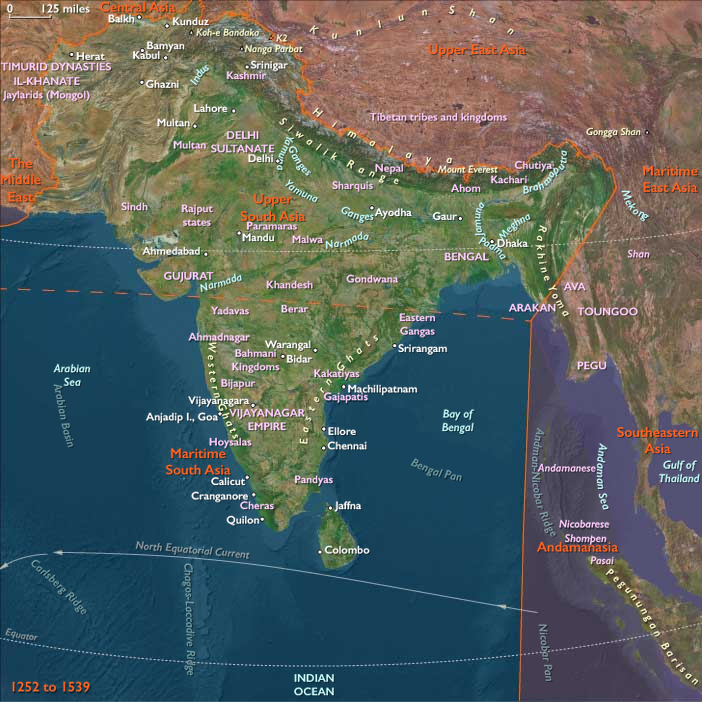
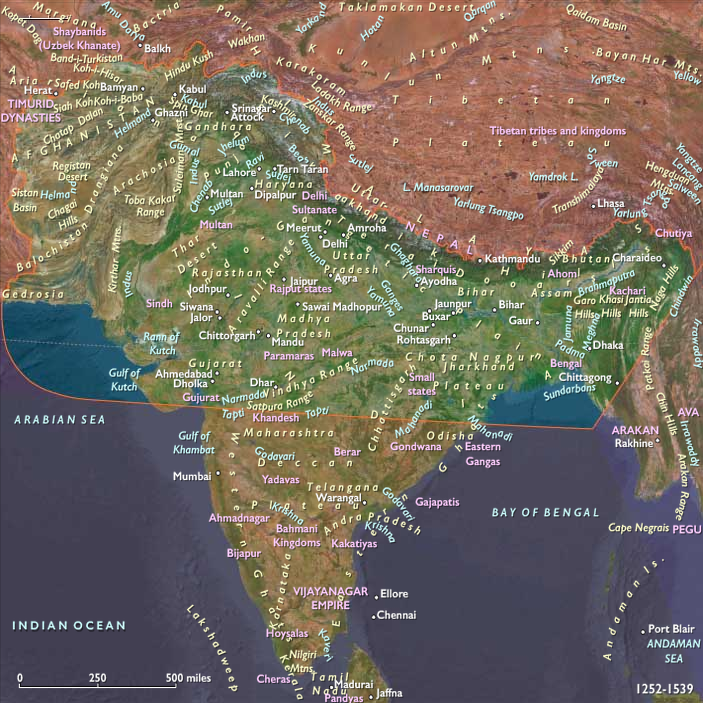
Sher Khan defeats Humayun at the Battle of Chausa on June 26, 1539; Humayun escapes to Agra.
Locations
People
Groups
Topics
Commodoties
Subjects
Regions
Subregions
Related Events
Filter results
Showing 10 events out of 38 total
The King had then appointed Lord Shelburne to replace him
Charles James Fox, however, had refused to serve under Shelburne, and demanded the appointment of the Duke of Portland.
In 1783, the House of Commons forces Shelburne from office and his government is replaced by the Fox–North Coalition.
The Duke of Portland becomes Prime Minister, with Fox and Lord North as Foreign Secretary and Home Secretary, respectively.
The King dislikes Fox intensely, for his politics as well as his character; he thinks Fox is unprincipled and a bad influence on the Prince of Wales.
George III is distressed at having to appoint ministers not of his liking, but the Portland ministry quickly builds up a majority in the House of Commons, and n be displaced easily.
He was further dismayed when the government introduces the India Bill, which proposes to reform the government of India by transferring political power from the East India Company to Parliamentary commissioners.
Although the King actually favors greater control over the Company, the proposed commissioners are all political allies of Fox.
Immediately after the House of Commons passes it, George authorizes Lord Temple to inform the House of Lords that he will regard any peer who votes for the bill as his enemy.
The bill is rejected by the Lords; three days later, the Portland ministry is dismissed, and William Pitt the Younger is appointed Prime Minister, with Temple as his Secretary of State.
On December 17, 1783, Parliament votes in favor of a motion condemning the influence of the monarch in parliamentary voting as a "high crime" and Temple is forced to resign.
Temple's departure destabilizes the government, and three months later the government will lose its majority and Parliament was dissolved; the subsequent election will give Pitt a firm mandate.
By now a devout Christian, he writes work informed by this religion.
His writing calls for the abolition of slavery and immediate emancipation of all slaves.
It argues that the slave's duty is to escape from slavery, and that force should be used to prevent further enslavement.
The narrative is sent to King George III, the Prince of Wales and to Edmund Burke, a leading politician.
George III, along with much of the royal family, remains opposed to abolition of the slave trade.
It had proved that he was able to appoint Prime Ministers on the basis of his own interpretation of the public mood without having to follow the choice of the current majority in the House of Commons.
Throughout Pitt's ministry, George has supported many of Pitt's political aims and created new peers at an unprecedented rate to increase the number of Pitt's supporters in the House of Lords.
During and after Pitt's ministry, George III is extremely popular in Britain.
The British people admire him for his piety, and for remaining faithful to his wife.
He is fond of his children, and had been devastated at the death of two of his sons in infancy in 1782 and 1783 respectively.
Nevertheless, he sets his children a strict regimen.
They are expected to attend rigorous lessons from seven in the morning, and to lead lives of religious observance and virtue.
When his children stray from George's own principles of righteousness, as his sons do as young adults, he is dismayed and disappointed.
By this time George's health is deteriorating.
He has a mental illness, characterized by acute mania, which is possibly a symptom of the genetic disease porphyria, although this has been questioned.
A study of samples of the King's hair published in 2005 will reveal high levels of arsenic, a possible trigger for the disease.
The source of the arsenic is not known, but it could have been a component of medicines or cosmetics.
The King may have had a brief episode of disease in 1765, but a longer episode begins in the summer of 1788.
At the end of the parliamentary session, he goes to Cheltenham Spa to recuperate.
It is the furthest he has ever been from London—just short of one hundred miles (one hundred and fifty kilometers)—but his condition worsens.
In November he becomes seriously deranged, sometimes speaking for many hours without pause, causing him to foam at the mouth and making his voice hoarse.
His doctors are largely at a loss to explain his illness, and spurious stories about his condition spread, such as the claim that he shook hands with a tree in the mistaken belief that it was the King of Prussia.
Treatment for mental illness is primitive by modern standards, and the King's doctors, who include Francis Willis, treat the King by forcibly restraining him until he is calm, or applying caustic poultices to draw out "evil humours".
While both had agreed that it would be most reasonable for George III's eldest son and heir apparent, the Prince of Wales, to act as regent, to Pitt’s consternation Fox had suggested that it is the Prince of Wales's absolute right to act on his ill father's behalf with full powers.
Pitt, fearing he would be removed from office if the Prince of Wales were empowered, had argued that it is for Parliament to nominate a regent, and had wanted to restrict the regent's authority.
In February 1789, the Regency Bill, authorizing the Prince of Wales to act as regent, is introduced and passed in the House of Commons, but before the House of Lords can pass the bill, George III recovers.
His humane and understanding treatment of two insane assailants, Margaret Nicholson in 1786 and John Frith in 1790, contribute to his popularity.
Her father, Charles William Ferdinand, is the ruler of Brunswick-Wolfenbüttel in Germany, and her mother, Augusta, is the sister of George III.
George and Caroline marry on April 8, 1795, and nine months later Caroline will bear her only child, Princess Charlotte of Wales.
Northwest Europe (1804–1815): Napoleonic Wars, Industrial Consolidation, and Cultural Refinement
The Napoleonic Wars and Britain’s Maritime Supremacy
Between 1804 and 1815, Northwest Europe was dramatically reshaped by the Napoleonic Wars, triggered when Napoleon Bonaparte crowned himself Emperor of France in 1804. Britain, Napoleon’s most persistent adversary, relied heavily on naval supremacy to counter French dominance. This maritime power was decisively demonstrated at the Battle of Trafalgar (1805), where Admiral Horatio Nelson secured British naval superiority at the cost of his life. Britain's maritime blockade severely constrained French trade, contributing significantly to Napoleon’s eventual downfall.
The wars culminated in 1815 at the Battle of Waterloo, where British forces under the Duke of Wellington, alongside Prussian troops under Marshal Blücher, defeated Napoleon decisively, ending French dominance and affirming Britain's strategic primacy in Europe.
Industrial Expansion and Technological Refinement
The British Industrial Revolution accelerated dramatically during this era. Innovators such as Richard Trevithick, whose successful railway steam locomotive debuted in 1804, transformed transportation and industry. Coal mining, iron production, and textile manufacturing thrived, elevating living standards and promoting rapid urbanization.
Edmund Cartwright’s Power Loom and Textile Mechanization
Textile mechanization advanced significantly, building upon earlier developments by Edmund Cartwright. By 1803, critical improvements from William Radcliffe and Thomas Johnson solved earlier technical challenges, making power looms commercially viable. Cartwright received parliamentary recognition in 1809 with a £10,000 grant, acknowledging his contributions. The resulting factory-scale weaving dramatically increased textile productivity, reinforcing Britain's global dominance in textile manufacturing.
Marine Chronometers: Revolutionizing Navigation
Marine chronometers became essential to maritime trade during this period. Initially expensive—early chronometers costing nearly 30% of a ship’s value—their affordability increased dramatically by the early 1800s. Innovations by makers like John Arnold and Thomas Earnshaw significantly reduced costs, bringing chronometers within reach of the merchant marine. By this period, prices ranged from £25 to £100, representing approximately half a year's to two years' wages for skilled workers.
Though production volumes remained relatively modest, the exceptional durability of chronometers allowed few replacements to meet growing demand. Lower-cost deck chronometers, slightly less accurate but sufficiently reliable for merchant use, became common. By the early nineteenth century, navigating without a chronometer was considered irresponsible, significantly reducing maritime accidents and boosting global trade and insurance confidence.
James Watt’s Steam Engine Legacy
Steam engine innovations by James Watt became deeply embedded in British industry. Watt’s inventions—double-acting engines, parallel-motion mechanisms, centrifugal governors, and throttle valves—dramatically improved efficiency and reliability. Although Watt restricted steam pressures due to safety concerns, subsequent improvements gradually overcame limitations, making steam engines central to Britain's factories, mines, and mills.
Economic Liberalism and the Influence of Adam Smith
The economic philosophies articulated by Adam Smith in The Wealth of Nations (1776) remained influential. Smith’s ideas of free trade and limited government intervention underpinned Britain’s wartime economic strategies, sustaining industrial growth and enabling wartime prosperity. British prosperity was thus increasingly built upon these liberal economic principles.
Cultural Elegance and the Rise of Beau Brummell
In early nineteenth-century Britain, cultural sophistication and fashion reached new heights, epitomized by Beau Brummell, the celebrated dandy and recognized arbiter of style. A bachelor residing in Mayfair, Brummell set the standard as the best-dressed, best-mannered English gentleman in Europe, influencing fashion and manners profoundly. His sartorial meticulousness became legendary: coats, waistcoats, and breeches were each crafted by different specialist tailors, ensuring impeccable fit. His elaborate neckcloths required hours of attention by his valet, reflecting a level of elegance and precision never before seen.
Brummell's unmatched influence extended into the highest circles, notably shaping the attire of his close associate George, Prince of Wales (Regent from 1811, later King George IV), who emulated Brummell’s style. However, Brummell's extravagant lifestyle—marked by excessive gambling and relentless spending—exhausted his inherited fortune. Additionally, his acerbic wit eventually alienated even his royal patron. A decisive quarrel with the Prince Regent in 1812 signaled the beginning of Brummell’s decline. Although he initially retained social standing, mounting debts marked the decline of his influence.
East India Company: Global Economic Peak
The East India Company reached peak influence during this era, driven by the insatiable British demand for raw materials and commodities necessary for its industrial economy and wartime efforts. The Company's vast trade networks sustained Britain's global economic dominance, supplying critical resources such as textiles, spices, cotton, and indigo, and underpinning Britain's wartime finances.
Romantic Movement and Artistic Flourishing
Britain’s cultural scene flourished with Romantic literature, including influential works by William Wordsworth, Samuel Taylor Coleridge, Lord Byron, Percy Bysshe Shelley, and John Keats. Artists such as Thomas Lawrence succeeded earlier masters like Reynolds and Gainsborough, capturing the refined elegance of Britain’s ruling class.
Ireland: Union and Persistent Tensions
Ireland remained unsettled following the Acts of Union (1801), with economic hardships exacerbated by war. Tensions continued to simmer, driven by political disenfranchisement and poverty, sowing seeds for future unrest.
Denmark-Norway: Neutrality Shattered
Denmark-Norway’s cautious neutrality ended abruptly in 1807 when Britain bombarded Copenhagen to prevent its fleet from falling into French hands. Forced into an alliance with France, Denmark-Norway suffered economically from British blockades, ultimately leading to Denmark’s cession of Norway to Sweden in 1814, reshaping the geopolitical landscape.
Financial Innovations
British financial services continued to evolve, with robust actuarial methods securing the growing life insurance industry, underpinning middle-class financial security and investments in Britain's expanding industrial and economic sectors.
Maritime Exploration and Strategic Mapping
Britain continued maritime exploration and improved navigation methods during this era, driven by accurate chronometer-based longitude measurements. Admiralty charts facilitated safer maritime trade routes and strengthened Britain's strategic global dominance.
From 1804 to 1815, Northwest Europe experienced transformative changes driven by the Napoleonic Wars, industrial innovations in steam power, textile mechanization, and maritime navigation, as well as the rise of cultural refinement exemplified by figures such as Beau Brummell. Britain's victories at Trafalgar and Waterloo, combined with cultural and economic developments, secured its position as the leading global power, setting the stage for continued nineteenth-century expansion and influence.
The English gentleman becomes established as the best dressed, best mannered in Europe, the lead being set by such dandies as Mayfair bachelor Beau Brummell, deemed the leader of fashion at the beginning of the nineteenth century.
His friend George, Prince of Wales (regent from 1811 and later King George IV), copies his clothes.
Brummell is so concerned with fit that he has his coat made by one tailor, his waistcoat by another, and his breeches by a third.
The neckcloth is so elaborate and voluminous that Brummell's valet sometimes spends a whole morning getting it to sit properly.
As the recognized arbiter of fashion and a frequenter of all society's gatherings, Brummell's influence is unchallenged, but eventually gambling and extravagance exhaust his inherited fortune, while his tongue proves too sharp for his royal patron.
They quarrel in 1812, and, although the thirty-four-year-old Brummell does not immediately lose his place in society, his debts increase.
George III had become dangerously ill in late 1810, at the height of his popularity, already virtually blind with cataracts and in pain from rheumatism.
In his view the malady had been triggered by stress over the death of his youngest and favorite daughter, Princess Amelia.
He accepted the need for the Regency Act of 1811, and the Prince of Wales will act as Regent for the remainder of George III's life.
Despite signs of a recovery in May 1811, by the end of the year George will have become permanently insane and will live in seclusion at Windsor Castle until his death.
Years: 1539 - 1539
Locations
People
Groups
Topics
Commodoties
Subjects
Regions
Subregions