
Simeon arrives at Constantinople in the summer …
Years: 924 - 924
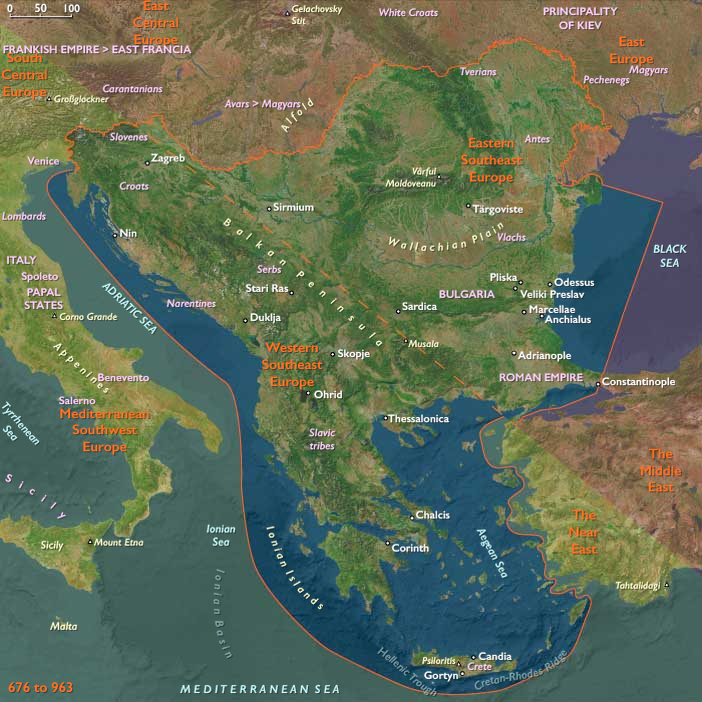
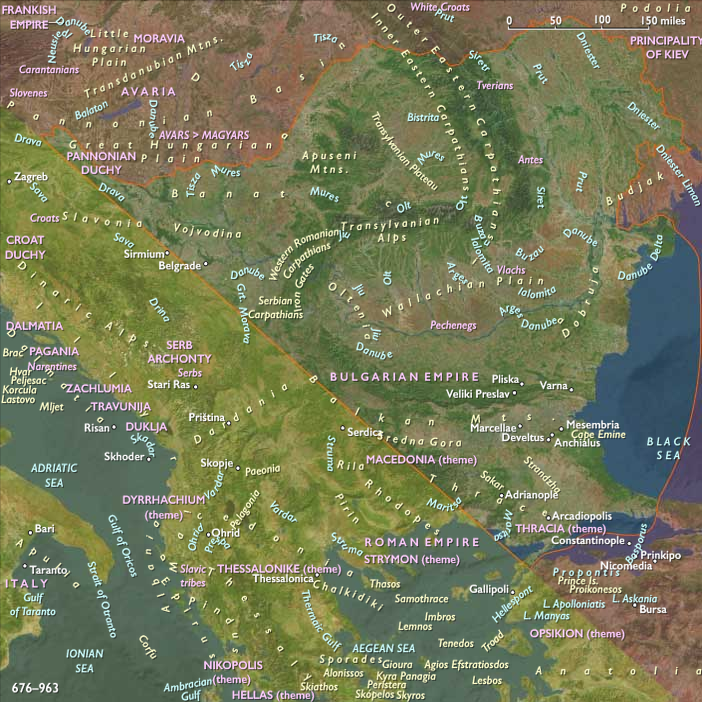
Simeon arrives at Constantinople in the summer of 924 and demands to see the patriarch and the emperor.
He converses with Romanos on the Golden Horn on September 9, 924 and arranges a truce, according to which Constantinople will pay Bulgaria an annual tax, but will be ceded back some cities on the Black Sea coast.
During the interview of the two monarchs, two eagles are said to have met in the skies above and then to have parted, one of them flying over Constantinople and the other heading to Thrace, as a sign of the irreconcilability of the two rulers.
In his description of this meeting, Theophanes Continuatus mentions that "the two emperors... conversed", which may indicate renewed Constantinople’s recognition of Simeon's imperial claims.
Locations
People
- Abdullah al-Mahdi Billah
- Constantine VII
- Pavle of Serbia
- Romanos I Lekapenos
- Simeon I of Bulgaria
- Zaharija of Serbia
Groups
- Arab people
- Christianity, Chalcedonian
- Greeks, Medieval (Byzantines)
- Bulgarians (South Slavs)
- Serbian Principality
- Roman Empire, Eastern: Macedonian dynasty
- Bulgarian Empire (First)
- Ifriqiya, Fatimid Caliphate of
- Longobardia, Theme of
Topics
- Arab-Byzantine Wars
- Byzantine-Bulgarian Wars
- Bulgarian-Serbian Wars
- Bulgarian-Byzantine War of 913-27
Commodoties
Subjects
Regions
Subregions
Related Events
Filter results
Showing 6 events out of 6 total
Christine de Pizan and Her Landmark Feminist Works (1405)
By 1405, Christine de Pizan, the first professional female writer in Europe, had completed her two most influential works:
- The Book of the City of Ladies (Le Livre de la Cité des Dames)
- The Treasure of the City of Ladies, or The Book of the Three Virtues (Le Livre des Trois Vertus)
These texts challenged the misogynistic literary tradition of the Middle Ages, celebrated women’s contributions to history and society, and provided practical guidance for women of all social classes.
I. The Book of the City of Ladies: A Defense of Women
- Written in response to the prevailing anti-female sentiment in medieval literature, especially Jean de Meun’s Romance of the Rose.
- In an allegorical framework, Christine constructs an imaginary city populated by great women from history, mythology, and religion.
- The book argues that women are intelligent, virtuous, and capable contributors to society, refuting the belief that they are naturally inferior to men.
- It features conversations with three allegorical figures—Reason, Rectitude, and Justice—who help Christine build her “City of Ladies” as a safe haven for women’s achievements.
II. The Treasure of the City of Ladies: A Guide to Women’s Conduct
- Intended as a practical companion to The Book of the City of Ladies.
- Provides guidance to women of all estates—from queens and noblewomen to merchants’ wives and peasants—on how to navigate society while cultivating useful virtues.
- Encourages women to:
- Pursue education and moral integrity.
- Support each other rather than succumb to societal divisions.
- Exercise diplomacy and prudence in dealing with men.
- The book ultimately teaches women how to counteract the misogyny that permeates medieval societythrough wisdom, self-respect, and strategic action.
III. Legacy and Influence
- Christine de Pizan is regarded as one of the first European feminists, paving the way for later discussions on women’s rights and intellectual equality.
- Her works had a lasting impact on Renaissance literature and beyond, influencing writers such as Marguerite de Navarre and later early modern feminists.
- By establishing herself as a successful female intellectual in a male-dominated literary world, Christine set a precedent for women’s participation in scholarly discourse.
Christine de Pizan’s completion of The Book of the City of Ladies and The Treasure of the City of Ladies in 1405was a landmark moment in medieval feminist thought, providing both a defense of women’s dignity and a guide for female empowerment in a restrictive society.
John the Fearless and the Struggle for Power at the French Court (1405)
Following the death of his father, Philip the Bold (1404), John the Fearless, Duke of Burgundy, sought to continue Burgundian dominance at the French royal court, taking advantage of the mental instability of King Charles VI. However, his position was challenged by his rival, Louis of Orléans, the king’s younger brother, who was amassing wealth and influence at Burgundy’s expense.
I. John the Fearless: Duke of Burgundy and Count of Flanders
- In 1405, John became Count of Flanders upon the death of his mother, Marguerite of Flanders, making him the most powerful prince in the Low Countries.
- His new title further strengthened his economic base, as Flanders was one of Europe’s wealthiest regions, but he still needed French royal patronage to maintain his influence.
II. The Financial Disadvantage of Burgundy vs. Orléans
- Unlike his father, John struggled to secure the same financial support from the crown.
- Philip the Bold had received 200,000 livres annually from the royal treasury, but John now had to settle for just 37,000 livres, limiting his ability to fund his political ambitions.
- Meanwhile, Louis of Orléans controlled 90% of his income from royal finances, allowing him to:
- Buy lands and fortresses along the eastern borders of France, a region Burgundy viewed as its natural sphere of influence.
- Expand his influence at court, gaining favor from Queen Isabeau of Bavaria and her allies.
III. The Intensifying Burgundian-Orléanist Rivalry
- John, lacking the charisma and fiery reputation of his father, saw his court influence wane, as the king’s largesse favored Orléans instead.
- With tensions rising, John began seeking alternative ways to reclaim dominance, leading him toward increasingly aggressive tactics.
- This financial and territorial struggle set the stage for open hostilities, culminating in the assassination of Louis of Orléans in 1407, orchestrated by John himself.
IV. Consequences and the Road to Civil War
- The rivalry between Burgundy and Orléans soon escalated into full-scale civil war between the Armagnacs (Orléanist faction) and Burgundians, plunging France into decades of internal strife.
- With John’s control over the royal court weakening, he resorted to direct action, which would ultimately destabilize the entire French monarchy during the ongoing Hundred Years’ War.
By 1405, John the Fearless found himself politically and financially outmaneuvered by Louis of Orléans, forcing him to abandon diplomacy in favor of ruthless power struggles, leading to one of the most destructive civil wars in French history.
The Fall of the Cabochiens and the Return of the Armagnacs to Power (September 1413)
By late August 1413, the Armagnac-Burgundian conflict in Paris had reached a turning point. While university leaders remained aligned with John the Fearless, Duke of Burgundy, the Parisian haute bourgeoisie, led by lawyer Jean Jouvenel des Ursins, began favoring the return of the Armagnacs. In response, Bernard VII, Count of Armagnac, acting on behalf of his son-in-law, Charles, Duke of Orléans, seized control of Paris, crushing the Cabochien movement and overturning the reforms imposed by the Burgundians.
I. The Fall of the Cabochiens and the Overturning of the Ordinance
- The Cabochiens, having terrorized Paris for months, lost popular support as their radical methods alienated the city's elite and bourgeoisie.
- The Armagnacs, led by Bernard VII, entered Paris and swiftly took control.
- On September 5, 1413, the Cabochienne Ordinance was officially overturned, restoring royal authority over taxation and administration.
II. The Execution and Exile of the Cabochiens
- Many Cabochiens who could not escape were executed, their reign of terror brought to an end.
- Simon Caboche, the leader of the movement, managed to escape alongside John the Fearless, who fled Paris to avoid retaliation.
III. Bernard VII’s Reward: Appointed Constable of France
- In gratitude for his decisive role in restoring Armagnac rule, Queen Isabeau of Bavaria, head of the regency council, appointed Bernard VII as Constable of France.
- This appointment cemented the Armagnacs’ dominance over the French court, though the conflict with the Burgundians was far from over.
IV. Consequences and the Continued Civil War
- The expulsion of John the Fearless from Paris in 1413 did not end the conflict—it merely intensified hostilities between the two factions.
- John would later return to power, and the Armagnac-Burgundian rivalry would escalate into open warfare.
- The internal divisions weakened France further, making it more vulnerable to English intervention, leading to Henry V’s invasion in 1415 and the disastrous French defeat at Agincourt.
The overthrow of the Cabochiens on September 5, 1413, marked a temporary victory for the Armagnacs, but the factional struggle for control of France continued, ultimately tearing the kingdom apart and paving the way for English dominance in the coming years.
Henry V and the Restoration of English as an Official Language (1415–1417)
During his military campaigns in France, King Henry V of England (r. 1413–1422) began using English in official correspondence—a significant linguistic shift that marked the revival of English as an official language for the first time since the Norman Conquest (1066), over 350 years earlier.
I. The Use of English in Henry V’s Correspondence
- While on campaign in France (1415–1420), Henry wrote letters back to England in English, rather than in Latin or Anglo-Norman French, which had been the dominant languages of government and administration.
- This was a deliberate political and cultural statement, emphasizing national unity and reinforcing the legitimacy of the English monarchy.
- His use of English signified a turning point in the gradual decline of French as the language of English governance.
II. The Long Decline of French in England (1066–1415)
- After the Norman Conquest (1066), Anglo-Norman French became the dominant language of the English court, law, and government.
- Latin remained the language of the Church and formal records, while English was largely confined to the lower classes.
- By the 14th century, English was slowly re-emerging:
- The Statute of Pleading (1362) allowed English to be spoken in courts, though legal documents remained in French or Latin.
- Geoffrey Chaucer (c. 1343–1400) had popularized Middle English in literature, demonstrating its richness and adaptability.
III. The Lasting Impact of Henry V’s Use of English
- By the end of Henry V’s reign, English had become the primary language of administration and government, replacing French in royal and official documents.
- This shift laid the foundation for:
- The first official use of English in Parliament.
- The transition to Middle English as the standard written language.
- The eventual translation of legal and governmental records into English.
IV. Conclusion: The Restoration of English in Official Use
Henry V’s use of English in correspondence marked a major turning point in England’s linguistic history, restoring English as the primary language of governance for the first time since 1066. His efforts helped solidify English national identity, ensuring its permanent place in royal administration, law, and diplomacy.
Charles, Dauphin of France (1417) and the Reunification of Poitou
By 1417, Charles, the fifth son of Isabella of Bavaria and King Charles VI of France, became Dauphin and heir to the French throne following the deaths of his elder brothers. His position, however, was far from secure, as France was embroiled in the Armagnac-Burgundian Civil War and facing renewed English aggression under Henry V.
At the same time, Poitou was formally reunited with the French crown, reinforcing royal control over a strategic region in western France.
I. The Deaths of Charles’ Brothers and His Rise as Dauphin (1417)
- Charles was the fifth son of Charles VI and Queen Isabella of Bavaria, born in 1403.
- His four elder brothers all predeceased him, making him the last surviving male heir:
- Louis, Dauphin of France (d. 1415)
- Jean, Dauphin of France (d. 1417)
- Two other brothers had died in infancy.
- Upon Jean de Touraine’s death in April 1417, Charles, at just 14 years old, became Dauphin and heir to the French throne.
II. Poitou Reunited with the French Crown
- Poitou, a historically contested region, had seen fluctuating control between France and its vassals over the centuries.
- By 1417, Poitou was firmly reunited with the French Crown, reinforcing royal authority in western France.
- This strengthened Charles' position, providing a key base of support in the ongoing war against England and Burgundy.
III. Charles’ Struggle as Heir in a Divided Kingdom
- Despite being the rightful heir, Charles faced serious challenges to his authority:
- The English, under Henry V, had invaded Normandy and were advancing into France.
- John the Fearless, Duke of Burgundy, controlled Paris and was allied with the English, limiting Charles’ influence.
- The Armagnac-Burgundian Civil War weakened the monarchy, as Charles' own authority was contested by rival factions.
- In 1418, the Burgundians seized Paris, forcing Charles to flee south to Bourges, where he would remain a disputed Dauphin, controlling only part of France.
IV. Consequences and Legacy
- Charles’ position as heir to the throne remained precarious until:
- The Treaty of Troyes (1420) disinherited him in favor of Henry V of England, leading to further conflict.
- His later alliance with Joan of Arc (1429) helped restore his legitimacy and secure his eventual coronation as Charles VII.
The death of his elder brothers in 1417 made Charles the Dauphin of France, but his claim was contested, and he faced enormous political and military challenges, setting the stage for the final phase of the Hundred Years’ War.
The Hundred Years' War and the Crisis of the French Monarchy (1337–1420)
By 1420, the Hundred Years’ War—which had begun in 1337 as an inheritance dispute over the French throne—had reached a critical stage. England, led by Henry V, had taken full advantage of France’s internal divisions, and the Treaty of Troyes had effectively placed the French crown in English hands. France, devastated by war, civil conflict, and economic ruin, faced its greatest crisis yet.
I. The Devastation of France and the English Advance
- Nearly all the fighting had taken place in France, leading to the widespread destruction of towns, farmlands, and infrastructure.
- The English had used chevauchée tactics—scorched-earth raids designed to economically cripple the French countryside, depriving the enemy of resources.
- The French economy was in tatters:
- The population had never fully recovered from the Black Death (1347–1351).
- Merchants were isolated from foreign trade markets.
- The kingdom was politically fragmented due to the Armagnac-Burgundian Civil War.
II. Civil War: The Armagnacs vs. the Burgundians
- King Charles VI, suffering from bouts of insanity, was frequently unable to rule, leading to a power struggle between two noble factions:
- The Armagnacs, led by Louis, Duke of Orléans, and later by the Count of Armagnac.
- The Burgundians, led by John the Fearless, Duke of Burgundy.
- Their rivalry was intensified by personal accusations:
- Louis of Orléans was rumored to have had an affair with Queen Isabeau of Bavaria.
- John the Fearless was accused of kidnapping the royal children.
- The murder of Louis of Orléans in 1407, ordered by John the Fearless, escalated tensions into all-out civil war.
III. English Intervention and the Victory at Agincourt (1415)
- Seizing the opportunity created by France’s internal divisions, Henry V of England invaded France in 1415.
- His victory at Agincourt (October 25, 1415) was one of the most decisive English victories in the war, leading to:
- The capture of key northern French towns.
- The weakening of the French nobility, many of whom died or were captured in battle.
IV. The Fall of Paris and the Assassination of John the Fearless (1418–1419)
- In 1418, Paris was taken by the Burgundians, who massacred the Count of Armagnac and 2,500 of his followers.
- The future Charles VII, who had assumed the title of Dauphin (heir to the throne) after the deaths of his four older brothers, sought reconciliation with Burgundy.
- However, Armagnac loyalists assassinated John the Fearless during a meeting with the Dauphin in 1419, shattering any hope of unity.
- The new Duke of Burgundy, Philip the Good, blamed Charles for the murder and formally allied himself with England.
V. The Treaty of Troyes (1420) and the Disinheritance of Charles VII
- With the French monarchy in chaos, Queen Isabeau of Bavaria signed the Treaty of Troyes (1420), granting:
- The French throne to Henry V of England and his heirs.
- The disinheritance of the Dauphin Charles, further weakening his claim.
- The treaty revived rumors that Charles VII was illegitimate, stemming from:
- Isabeau’s alleged affair with the late Louis of Orléans.
- The Armagnac-Burgundian propaganda war, which sought to undermine his legitimacy.
VI. Consequences and the Fate of France
- The Treaty of Troyes effectively made Henry V the heir to both the English and French crowns, paving the way for an Anglo-French dual monarchy.
- However, Henry V’s unexpected death in 1422 would complicate English ambitions, as his infant son, Henry VI, would inherit both thrones at just nine months old.
- The Dauphin Charles, though disinherited, refused to concede defeat, retreating to southern France and preparing for resistance—a struggle that would eventually culminate in the rise of Joan of Arc and the reconquest of France.
The Hundred Years’ War, originally an inheritance dispute, had by 1420 evolved into a desperate battle for French sovereignty, with the Treaty of Troyes placing England in control of the French throne—a situation that would soon be challenged by Charles VII and his supporters.
Years: 924 - 924
Locations
People
- Abdullah al-Mahdi Billah
- Constantine VII
- Pavle of Serbia
- Romanos I Lekapenos
- Simeon I of Bulgaria
- Zaharija of Serbia
Groups
- Arab people
- Christianity, Chalcedonian
- Greeks, Medieval (Byzantines)
- Bulgarians (South Slavs)
- Serbian Principality
- Roman Empire, Eastern: Macedonian dynasty
- Bulgarian Empire (First)
- Ifriqiya, Fatimid Caliphate of
- Longobardia, Theme of
Topics
- Arab-Byzantine Wars
- Byzantine-Bulgarian Wars
- Bulgarian-Serbian Wars
- Bulgarian-Byzantine War of 913-27
