
Alfred Sisley, forty-seven and chronically broke, has…
June 1886 CE
Alfred Sisley, forty-seven and chronically broke, has remained outside of Paris, choosing instead the city's suburbs where he can support his family on less money.
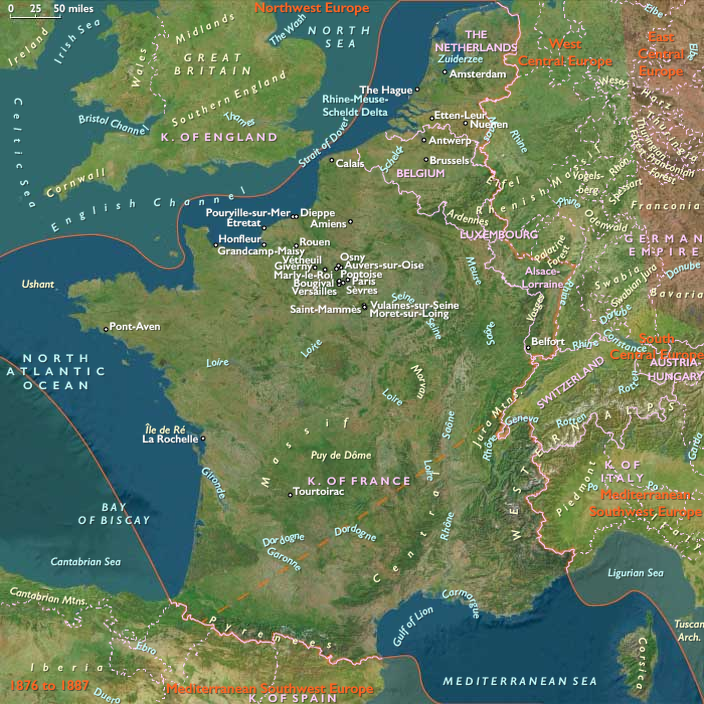
Having painted the views of the regions outside Paris such as Argenteuil, Marly, Louveciennes and Bougival in the 1870's, Sisley has moved southward in the 1880s to landscapes around Moret-sur-Loing, south of the Forest of Fontainebleau: the point at which the Seine is joined by the Loing, thereby forming a larger river which flows along the eastern edge of the forest of Fontainebleau north towards Paris.
Its woodlands, popular for decades and yet unspoiled, are convenient for artists who journey there by train from the capital.
From the early 1880s, Sisley had begun to record the changes in the area wrought by the construction of the canal at Saint-Mammés with trees cut down, banks straightened and a transformation of this side of the town of Moret, as in his Canal at St-Mammés (1886).
Like Pissarro, Sisley is becoming increasingly constrained by a preoccupation with technique.
Images

Alfred Sisley: Canal at Saint-Mammes (1886 )
Subjects
Regions
West Europe
View →Subregions
