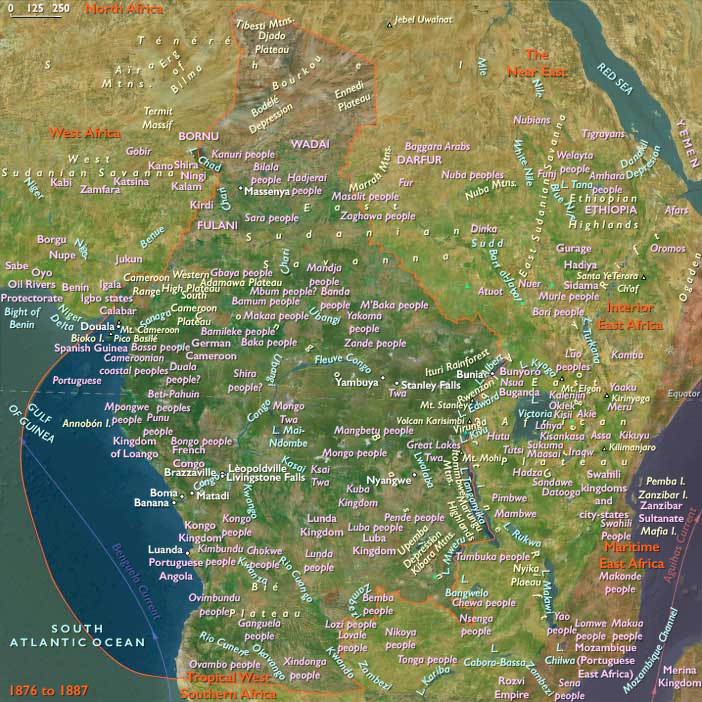
Bandia-Nzakara peoples had established the Bangassou Kingdom…
1876 CE to 1887 CE
Population migration in the eighteenth and nineteenth centuries has brought new migrants into the area, including the Zande, Banda, and Baya-Mandjia (Gbaya).
The Bandia people originally ruled over the Vungara and the two groups had become the Zande, or Azande, people.
They live in the savannas of what is now the southeastern part of Central African Republic.
After the death of a king, the king's sons fight for succession.
The losing son will often establish kingdoms in neighboring regions, making the Azande kingdom spread eastward and northward.
Sudanese raids halted some of northward expansion later in the nineteenth century.
The Azande will become divided by Belgium, France, and Anglo-Egyptian Sudan.
The Banda people had been severely affected by slave raids from the north, particularly from Wadai and Darfur, in the early nineteenth century, and later by Khartoumers led by Rabih al-Zubayr.
These capture and sell the Banda people into slavery.
Many migrate south and west along the Ubangi River.
According to Ann Brower Stahl, a professor of Anthropology specializing in Africa studies, the medieval towns of Banda people such as Begho were probably a source of slaves between CE 1400 and 1600, with slaves going to Islamic North Africa, the primary trade being in women and children before 1500.
By the sixteenth century, slaves from the Banda regions were in use as production labor in Sudanese Islamic states, and this trade in slaves has remained fairly steady in the ensuing centuries.
Dennis Cordell, a professor of history specializing on Africa, places the slave raiding and trade practices earlier to the eleventh- and twelfth-century raids in southern Libya, then to Lake Chad area, which he states thereafter expanded south into the Banda people's region.
The killing, enslavement and carrying away of the Banda people by slave raiders from regions that are now part of Chad, South Sudan and southeastern Central African Republic has led to their depopulation, a situation further worsened when European colonialists give weapons to the slave-raiding states.
In the late nineteenth century, they are raided by "slave hunters" from the south by armies of the Zande states now part of Congo and South Sudan, led by Arab traders who have set up Zariba (slave trading centers).
The slave raiding of the Banda people will be suppressed when the French Ubangi-Shari colony is established in this region.
People
Groups
Topics
Commodities
Subjects
Regions

Middle Africa
View →Subregions