Brazil's so-called Golden Law of May 13,…
1888 CE to 1899 CE
Brazil's so-called Golden Law of May 13, 1888, which ends slavery in the empire, is not an act of great bravery but a recognition that slavery is no longer viable.
The economy revives rapidly after a few lost harvests, and only a small number of planters go bankrupt.
Slavery ends, but the plantation survives and so do the basic attitudes of a class society.
The abolitionists quickly abandon those they had struggled to free.
Many former slaves stay on the plantations in the same quarters, receiving paltry wages.
They are joined by waves of immigrants, who often find conditions so unbearable that they soon move to the cities or return to Europe.
No freedmen's bureaus or schools are established to improve the lives of the former slaves; they are left at the bottom of the socioeconomic scale, where their descendants remain in the early twenty-first century.
New prisons built after 1888 are soon filled with former slaves as society imposer other forms of social control, in part by redeining crime.
Groups
Commodities
Subjects
Regions
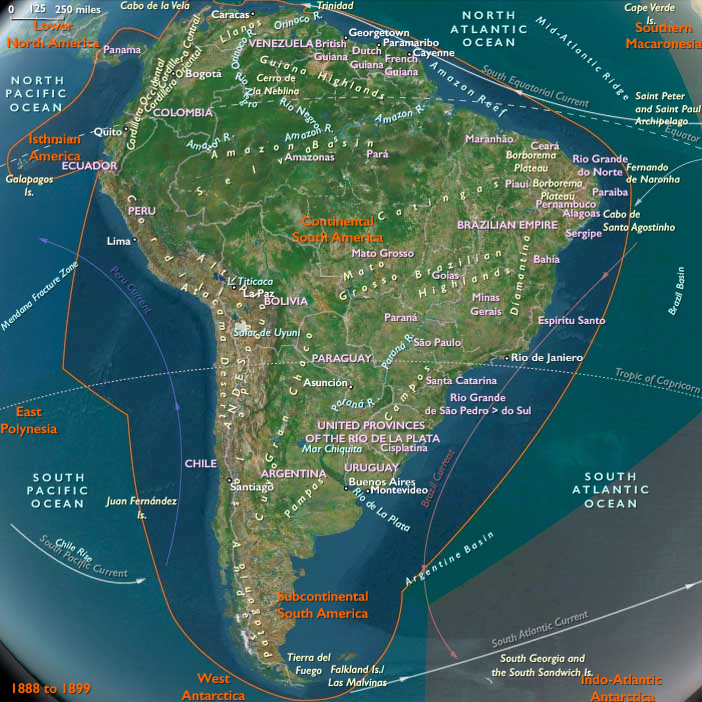
South America
View →Subregions