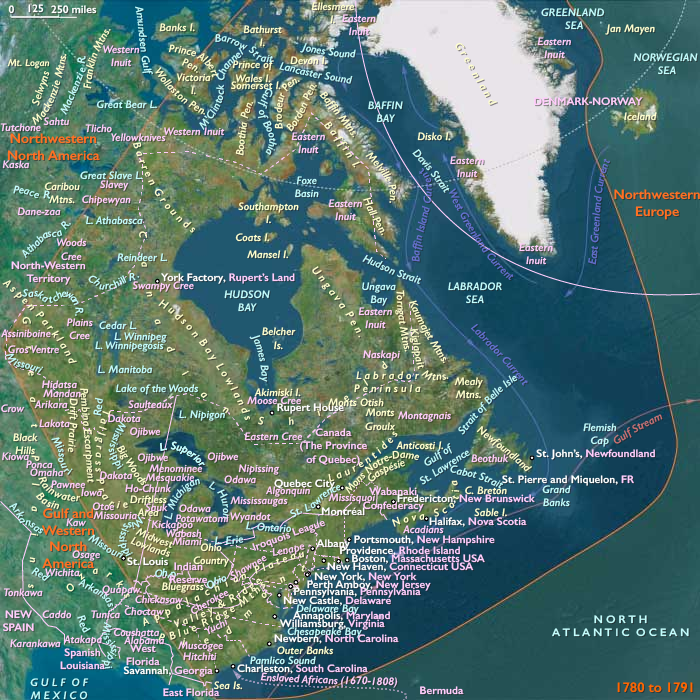
The Munsee- and Unami-speaking Lenni Lenape (also…
April 1781 CE
The Munsee are generally northern bands from around the Hudson River and upper Delaware River originally.
The Unami are from the southern reaches of the Delaware.
Years earlier, many Lenape had migrated west to Ohio from their territory on the mid-Atlantic coast to try to escape colonial encroachment, as well as pressure from Iroquois tribes from the north based around the Great Lakes and western New York.
They had resettled in present-day Ohio, with bands in several villages around their main village of Coshocton.
These villages are named Schoenbrunn, Gnadenhutten, and Salem, and located on what is at this time called the Muskingum River.
Modern geography places Coshocton on the Muskingum River and the three smaller villages on the Tuscarawas River.
By the time of the Revolutionary War, the Lenape villages lay between the opposing interests, which have western frontier strongholds on either side: the rebel American colonists' military outpost at Fort Pitt (Pittsburgh) and the British with native allies around Fort Detroit, Michigan.
Some Lenape had decided to take up arms against the American colonials and moved to the northwest, closer to Fort Detroit, where they settled on the Scioto and Sandusky rivers.
Those Lenape sympathetic to the United States had remained at Coshocton, and leaders, including White Eyes, had signed the Treaty of Fort Pitt with the Americans in 1778.
Through this treaty, White Eyes intended to secure the Ohio Country as a state to be inhabited exclusively by natives, as part of the new United States.
A third group of Lenape, many of them converted Christian Munsee and Unami, live in several mission villages in Ohio led by David Zeisberger and other Moravian Christian missionaries.
From the mid-Atlantic area, they speak the Munsee and the Unami dialects of Delaware, an Algonquian language.
White Eyes, a Lenape chief and Speaker of the Delaware Head Council, had negotiated the treaty.
When he died in 1778, reportedly of smallpox, the treaty had not yet been ratified by Congress.
United States officials have never pursued it, and the native state is dropped.
Years later, George Morgan, a colonial diplomat to the Lenape and Shawnee during the American Revolution, will write to Congress that White Eyes had been murdered by American militia in Michigan.
Many Lenape at Coshocton had eventually joined the war against the Americans, in part because of American raids against even their friendly bands
In response, Colonel Daniel Brodhead leads an expedition out of Fort Pitt and on April 19, 1781, destroys Coshocton.
Surviving residents flee to the north.
Colonel Brodhead persuades the militia to leave the Lenape at the Moravian mission villages unmolested since they are peaceful and neutral.
Brodhead's having to restrain the militia from attacking the Moravian villages is a reflection of the brutal nature of frontier warfare.
Violence has escalated on both sides.
Relations between regular Continental Army officers from the East, such as Brodhead, and western militia are frequently strained.
The tensions are worsened by the American government's policy of recruiting some native tribes as allies in the war.
Western militiamen, many of whom have lost friends and family in native raids against settlers' encroachment, blame all natives for the acts of some and do not distinguish between friendly and hostile tribes or bands.
People
Groups
Iroquois (Haudenosaunee, also known as the League of Peace and Power, Five Nations, or Six Nations)
View →
Unity of the Brethren (Moravians)
View →
Lenape or Lenni-Lenape (later named Delaware Indians by Europeans)
View →
Ohio Country
View →
Britain, Kingdom of Great
View →
United States of America (US, USA) (Philadelphia PA)
View →
Americans
View →
Topics
Regions
Northern North America
View →Subregions