The Regeneration proposed by President Núñez has…
1876 CE to 1887 CE
The Regeneration proposed by President Núñez has much in common with the positivist program of order and progress in evidence elsewhere in Latin America during the late nineteenth century.
Núñez is not a military man and avoids overt dictatorship, but he is prepared to make arbitrary arrests or close opposition newspapers when he feels the cause of order required such action.
Above all, after declaring the constitution of 1863 null and void, he convokes a national council of delegates to draft a very different replacement, which is formally adopted in 1886 and will last more than one hundred years—an exceptionally long life for any Latin American constitution.
It exchanges the ultrafederalism of the 1863 charter for an equally extreme centralism, under which the president names the governors of the departments (as the former federal states are now called), and the governors in turn name all the mayors.
Whatever party controls the national presidency can thus control every departmental and municipal executive position in the country.
The departments do have elected assemblies, but with very limited power.
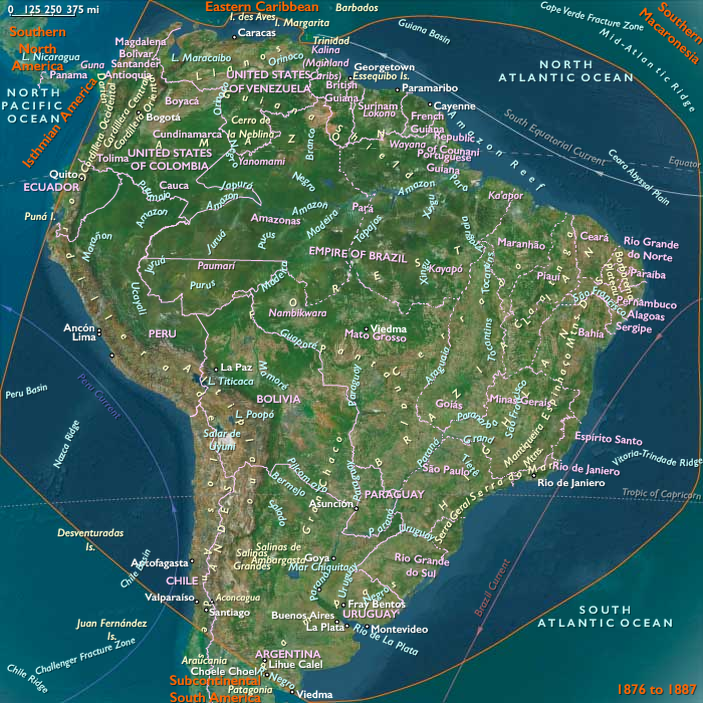
Naturally, the country can no longer be called the United States of Colombia but is now once again simply the Republic of Colombia, as it had been in the days of Bolivar.
In addition, the sweeping definitions of individual rights in the old constitution are replaced by carefully restrictive wording in the new.
The death penalty, abolished in 1863 as incompatible with the right to life, is reinstituted.
Suffrage requirements are unified on a nationwide basis, and literacy is again required for national (not local) elections.
The presidential term is lengthened, too, and with immediate reelection permitted.
Nunez himself will take advantage of these electoral changes to enjoy two more consecutive terms, one by vote of the constitutional convention and the other by popular election, but immediate reelection will be subsequently forbidden again and will be unavailable to any president until Alvaro Uribe Velez (president, 2002-6, 2006-10) in 2006.
Locations
People
Subjects
Regions
South America
View →Subregions