
Sokollu, having made a number of enemies,…
1579 CE
Sokollu, having made a number of enemies, is assassinated on October 11/12, 1579.
Real power now passes into the grasp of the chief Janissary officers, the agas.
Groups
Subjects
Regions
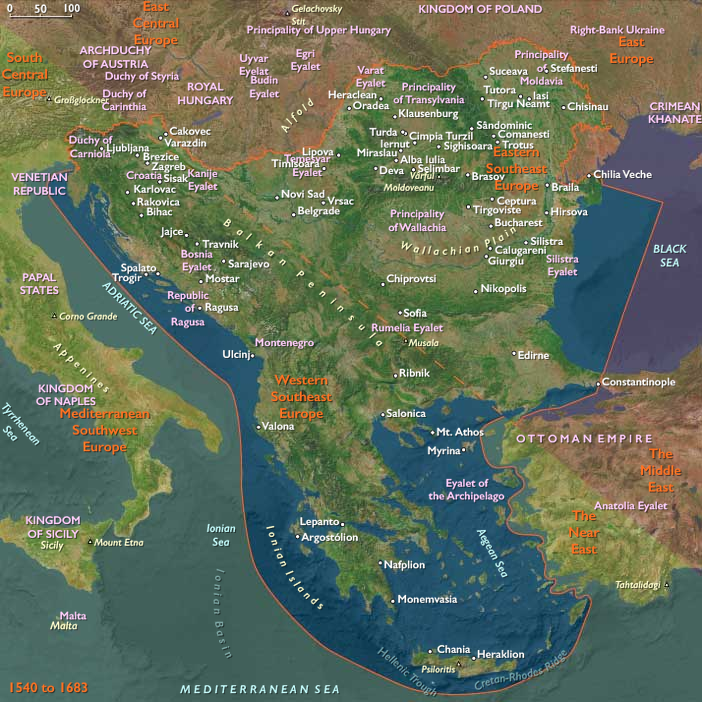
Southeast Europe
View →Subregions
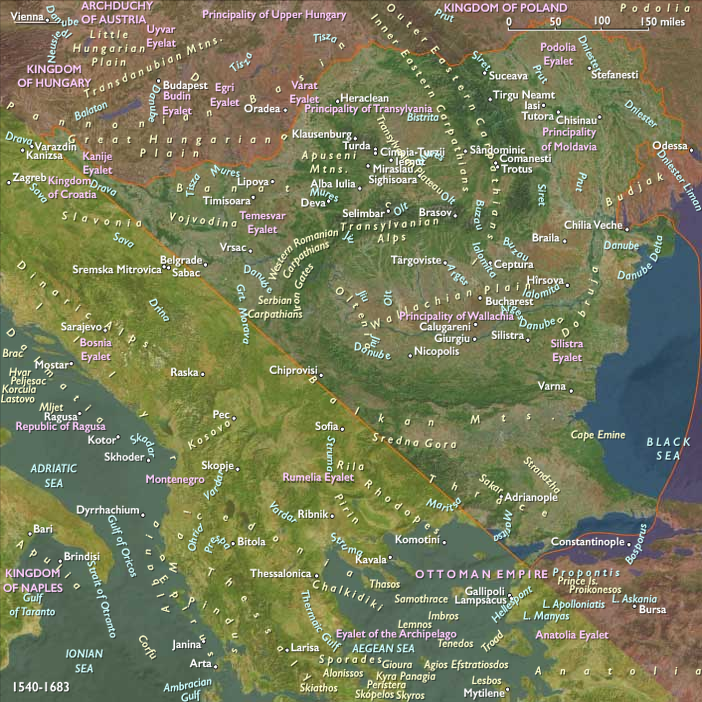
Eastern Southeast Europe
View →Related Events
No active filters.
Showing 10 events out of 35024 total
Francis Drake had sailed west across the Pacific in July 1579.
After sixty-eight days, he sights a line of islands (probably the remote Palau group).
Francis Drake, continuing his circumnavigation of the earth, arrives in the Philippines, where he waters ship before sailing to ...
...the Moluccas.
Here he is well received by a local sultan, becomes involved in some intrigues with the Portuguese, and succeeds in buying spices.
Drake's deep-sea navigation and pilotage have always been excellent, but in these totally uncharted waters his ship strikes a reef.
After three days of waiting for expedient tides and dumping cargo, the bark is miraculously freed without any great damage, and, ...
...after calling at Java, Drake sets his course across the Indian Ocean for the Cape of Good Hope.
Báthory now turns to face Poland's major enemy, Muscovy, which is attempting to seize an outlet on the Baltic Sea. The king secures a truce with Turkey and strengthens the Polish army by enrolling Cossacks on a regular basis.
The Polish forces, reorganized under his leadership, are able to carry the Livonian War onto Russian territory in 1579 while the Swedes recapture parts of Livonia.
The victories for the Reformation in the Polish-Lithuanian Commonwealth have been gradually canceled by the Catholic Counter-Reformation under the leadership of Stanislaw Cardinal Hozjusz (Stanislaus Hosius), a Prince-Bishop of the Bishopric of Warmia, who dies in Capranica, in the Papal States, in 1579, described by St. Peter Canisius as the most brilliant writer, the most eminent theologian, and the best bishop of his time.
The Jesuits, having arrived in Poland in the 1560s, are developing a network of schools and colleges.
Their greatest preacher, Piotr Skarga, becomes the first rector of the Wilno Academy, the future University of Wilno (now Vilnius, Lithuania), founded in 1579.
Reichenberg, or Liberec, now in the northern Czech Republic and situated in the valley of the Luzická Nisa (German: Lausitzer Neisse) River amid the Giant (Krkonoše) Mountains, had been founded in the thirteenth century.
First mentioned in a document from 1348, chartered in 1577, the city begins in 1579 to host the cloth-making industry.
It will soon become an important textile center, manufacturing chiefly broadcloth, rugs, tapestries, and cotton and silk fabrics.
Báthory, though personally tolerant of differing religious views, is a strong-willed man and a Roman Catholic; he encounters considerable resistance from his subjects in his attempts to promote the Counter-Reformation and to strengthen his royal power.
Because the monarch has forbidden further innovations (changes in doctrine from beliefs held during Sigismund's reign), Ferenc Dávid's nonadorantist innovation has thus endangered the Unitarians' legal status.
Traveling to Transylvania, Socinus tries unsuccessfully from 1578 to 1579 to dissuade Dávid from his controversial renunciation of the worship of Christ.
Dávid’s attitude conflicts with the teachings of Blandrata, who has allied himself with Báthory and tried, with Socinus, to influence Dávid to moderate his position.
All reconciliation efforts fail, and Dávid's supporters separate themselves from the movement as Dávidists, or Old Unitarians, in opposition to Blandrata's New Unitarian faction.
Dávid, whose followers are also known as Nonadorantes, is charged with introducing Judaizing tendencies, partly because his refusal to accord adoration to Christ resembles the rejection by Judaism of Christ as a Messiah.
Dávid is brought to trial in 1579 as a blasphemous innovator and condemned to life in prison, where he dies on November 15.
The early Ottoman momentum does not last as the Persians begin to resist more successfully.
Furthermore, much effort is spent on securing Georgia, and taking the great fortress of Kars in 1579.
Akbar, ruling over a society that is predominantly non-Muslim, needs not simply to maintain his status as a Muslim ruler but also to be liberal enough to elicit active support from non-Muslims.
For this purpose, he must deal first with the Muslim theologians who, in the face of Brahmanic resilience, are rightly concerned with the community's identity and resist any effort that could encourage a broader notion of political participation.
Akbar begins his drive by abolishing both the jizya, the per capita tax imposed on free non-Muslim adult males who are neither old nor sick nor monks, and the practice of forcibly converting prisoners of war to Islam, and by encouraging Hindus as his principal confidants and policy makers.
To legitimize his nonsectarian policies, he issues in 1579 a public edict (mahzar) declaring his right to be the supreme arbiter in Muslim religious matters—above the body of religious scholars and jurists.
He has by now also undertaken a number of stern measures to reform the administration of religious grants, which are now available to learned and pious men of all religions, not just Islam.