Solomon, credited by the Bible with the…
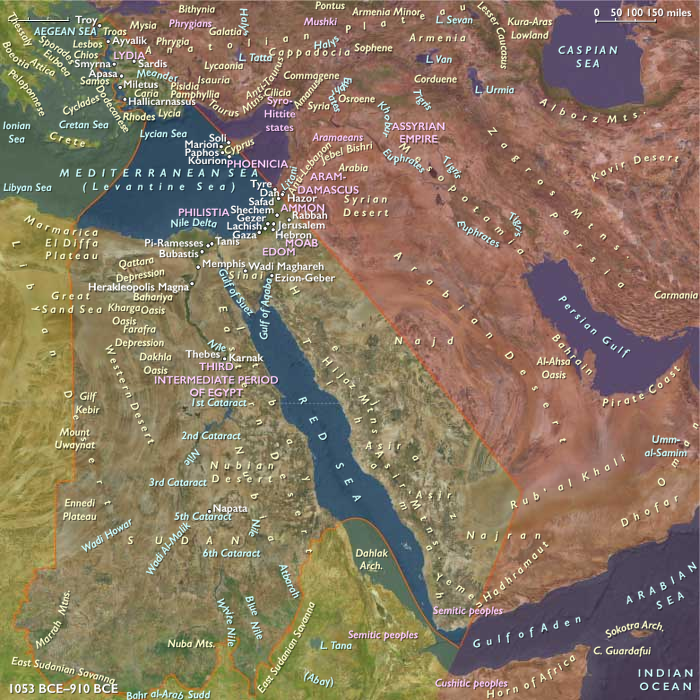
1053 BCE to 910 BCE
Solomon, credited by the Bible with the creation of the seaport of Ezion-Geber, on the northern extremity of the Gulf of Aqaba, is additionally described as having amassed a thousand and four hundred chariots and twelve thousand horsemen.
Ezion-Geber, according to the Book of Numbers, was one of the first places where the Israelites camped after the Exodus from Egypt.
The ships of Solomon and Hiram started on their voyage to Ophir from this port, presented in the Bible as the main port for Israel's commerce with the countries bordering on the Red Sea and Indian Ocean.
The location of Solomon's port of Ezion-Geber, mentioned six times in the Tanakh, is known, but no remains from this period have ever been found.
Ruins at Tell el-Kheleifeh were identified with Ezion-Geber by the German explorer F. Frank and later excavated by Nelson Glueck, who thought he had confirmed the identification, but a later reevaluation dates them to a period between the eighth and sixth centuries BCE with occupation continuing possibly into the fourth century BCE.
Some archaeologists believe that the Hebrews inhabiting the areas later known as Judah and Israel, and who spoke a Canaanite dialect, simply arose as a subculture within Canaanite society.
The extent of the distinction between the culture of the Canaanites and the Hebrews is a matter of great debate, touching as it does on strong religious sensibilities.
Jerusalem, according to archaeologists Israel Finkelstein and Neil Silberman, at the time of what the Bible refers to as the Davidic and Solomonic kingdoms, may have been unpopulated, or at most possessed a few hundred residents.
They consider this insufficient to have ruled an empire stretching from the Euphrates to Eilath.
Finkelstein and Silberman in a later book do accept that David and Solomon were real kings of Judah about the tenth century BCE, but they cite that the earliest independent reference to the Kingdom of Israel is about 890 BCE, while for that of Judah is about 750 BCE.
They, along with biblical minimalists, claim that the Kingdom of Judah invented the United Monarchy to back up territorial claims to the Kingdom of Israel, during the reign of Hezekiah and Josiah.
In The Bible Unearthed: Archaeology's New Vision of Ancient Israel and the Origin of Its Sacred Texts, they write that the idea of a United Monarchy is not accurate history but rather "creative expressions of a powerful religious reform movement," possibly "based on certain historical kernels."
Locations
Groups
Commodities
Subjects
Regions
The Near and Middle East
View →Subregions