Some twenty-five Confederate agents based in Canada…
October 1864 CE
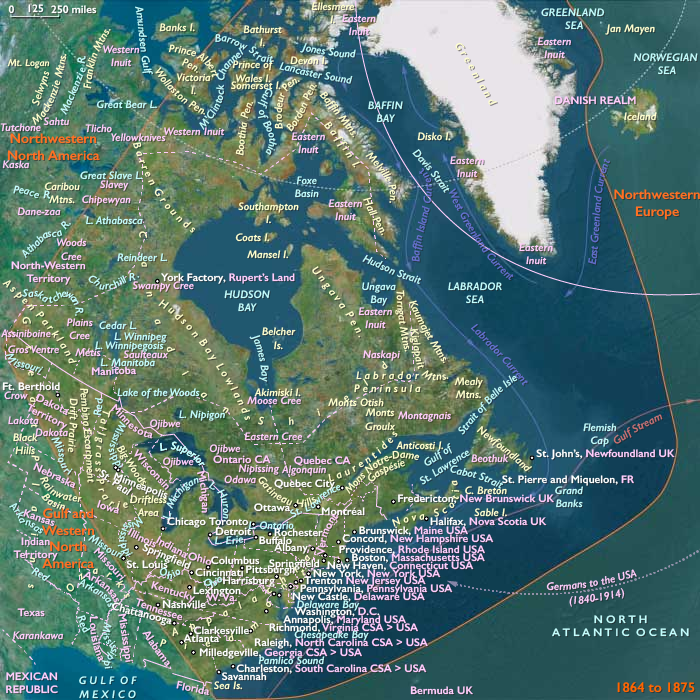
Some twenty-five Confederate agents based in Canada cross the border into Union territory on October 19, 1864, and attack the town of Saint Albans, Vermont.
In this unusual incident, Bennett H. Young leads Confederate States Army forces.
Young, born in Nicholasville, Kentucky, was eightyeen years old when he enlisted as a private in the Confederate 8th Kentucky Cavalry, a unit that became a part of General John Hunt Morgan's cavalry command.
He had become a prisoner of war after the Battle of Salineville in Ohio ended Morgan's Raid the year before, and had later escaped to Canada (at this time the Province of Canada, part of the British Empire).
He had returned to the South, where he had proposed raids on the Union from the Canadian border to build the Confederate treasury and force the Union Army to protect the northern border and divert troops from the South.
Commissioned as a lieutenant, Young had returned to Canada, where he recruited other escaped rebels to participate in a raid on St. Albans, Vermont, a quiet town 15 miles (25 km) from the Canadian border.
Young and two others check into a local hotel on October 10, saying that they had come from St. John's in Canada East for a "sporting vacation."
Every day, two or three more young men arrive.
By October 19, there are twenty-one cavalrymen assembled.
Just before 3 p.m. the group simultaneously stages a robbery of the three banks in the town.
They announce that they are Confederate soldiers and steal a total of $208,000.
As the banks are being robbed, eight or nine of the Confederates hold the townspeople prisoner on the village green as their horses are stolen.
One townsperson is killed and another wounded.
Young orders his men to burn the town down, but the four-ounce bottles of Greek fire they have brought fail to work, and only one shed is destroyed.
The raiders flee with the money into Canada.
A U. S. posse pursues them into Canada and catches several, but are forced to hand them over to Canadian officials.
A Canadian court will subsequently decide that the soldiers had been under military orders and that the officially neutral Canada cannot extradite them to the United States.
The Canadian court's ruling that the soldiers were legitimate military belligerents and not criminals, as argued by American authorities, will be interpreted as a tacit British recognition of the Confederate States of America, sparking renewed talk in the United States of war with Britain.
The raiders will be freed, but the $88,000 the raiders had on their person will be returned to Vermont.
Five of the raiders will be re-arrested and held for breaking Canadian neutrality. (The war scare will continue to grow, however, leading to the stationing of two thousand Canadian militiamen along the border in early 1865. Canadian fears of an attack from the United States will provide an impetus for the formation, in 1867, of a federal union of all British North America.)
Groups
Topics
Regions
Northern North America
View →Subregions