Some traces remain of the presence of …
Years: 48 - 48
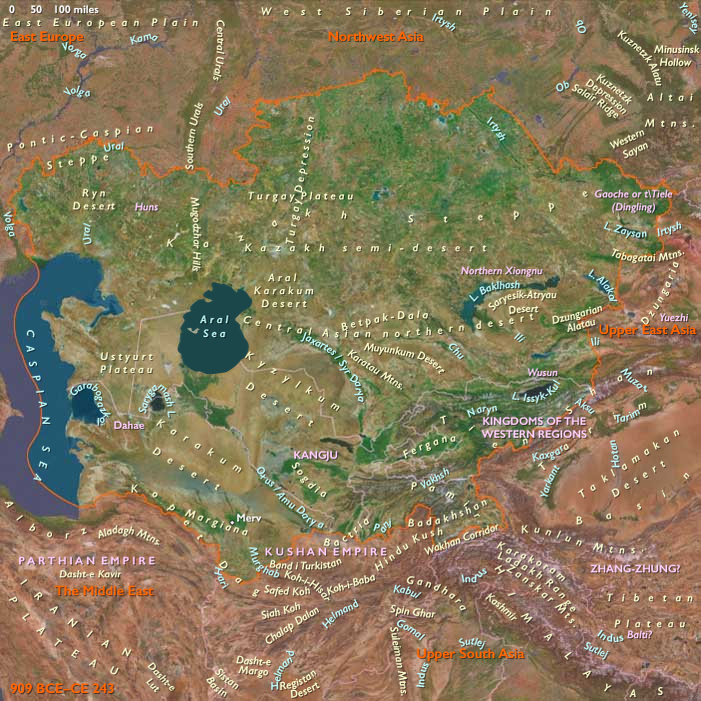
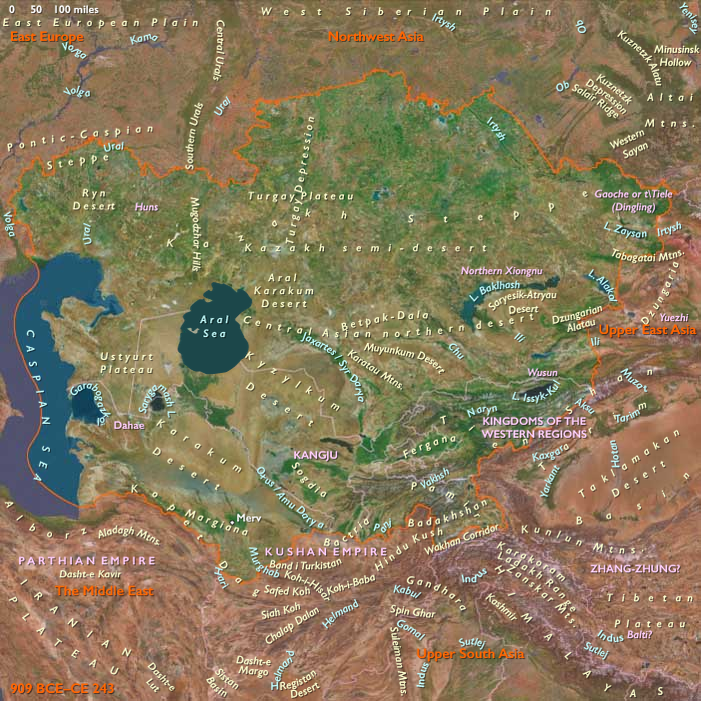
Some traces remain of the presence of the Kushans in the area of Sogdiana.
Khalchayan (also Khaltchaïan) is an archaeological site, thought to be a small palace or a reception hall, located near the modern town of Denov in Surxondaryo Province of southern Uzbekistan.
It is located in the valley of the Surkhan Darya, a northern tributary of the Oxus (modern Amu Darya).
The site is usually attributed to the early Kushans, or their ancestors the Yuezhi.
It was excavated by Galina Pugachenkova between 1959 and 1963.
The interior walls are decorated with clay sculptures and paintings dated to the mid-first century BCE.
Various panels depict scenes of Kushan life: battles, feasts, portraits of rulers.
Various sculptures and friezes are known, representing horse-riding archers and, significantly, men with artificially deformed skulls, such as the Kushan prince of Khalchayan (a practice well attested in nomadic Central Asia).
Locations
Groups
Topics
Commodoties
Subjects
Regions
Subregions
Related Events
Filter results
Showing 10 events out of 61777 total
Bi also claims the title of chanyu in 48 and submits to Emperor Guangwu's authority.
Punu also submits, in response, and the divided Xiongnu stop waging war against the Eastern Han.
Gandhara falls to the Kushans in 48.
The conquest of northwest India led by Kujula Kadphises lays the basis for the Kushan Empire which will be rapidly expanded by his descendants.
The origins of Kujula Kadphises are obscure, and it is usually considered he was a descendant of the Kushan ruler Heraios, or even identical with him.
Interestingly however, Kujula shares his name (on some of his "Hermaeus" coins, or on his "Augustus" coins) with some of the last Indo-Scythian rulers, such as Liaka Kusulaka, or his son Patika Kusulaka, which might suggest some family connection.
In the process of their expansion eastward, Kujula Kadphises and his son Vima Takto seem to have displaced the Indo-Parthian kingdom, established in northwestern India by the Parthian Gondophares since around CE 20.
This invasion of Kujula Kadphises is thought to have occurred during the reign of Abdagases and Sases, the successors of Gondophares, after 45 CE.
Most of Kujula's coins are Hellenic or Roman in inspiration.
Some coins use the portrait, name and title of the Indo-Greek king Hermaeus on the obverse, indicating Kujula's wish to relate himself to the Indo-Greek king.
Since the Kushans and their predecessors the Yuezhi were conversant with the Greek language and Greek coinage, the adoption of Hermaeus cannot have been accidental: it either expresses a filiation of Kujula Kadphises to Hermaeus by alliance (possibly through Sapadbizes or Heraios), or simply a wish to show himself as heir to the Indo-Greek tradition and prestige, possibly to accommodate Greek populations.
These coins bear the name of Kujula Kadphises with representations of the Greek demi-god Heracles on the back, and titles ("Yavugasa") presenting Kujula as a "ruler" (not actual king), and a probable Buddhist ("Dharmathidasa", follower of the Dharma).
Later coins, possibly posthumous, do describe Kujula as "Maharajasa", or "Great King.
Some fewer coins of Kujula Kadphises also adopted a Roman style, with effigies closely resembling Caesar Augustus, although all the legends were then associated with Kujula himself.
Such influences are linked to exchanges with the Roman Empire around that date.
Agrippa II, while at Rome, has voiced his support for the Jews to Claudius, and against the Samaritans and the new procurator, Ventidius Cumanus, who was lately thought to have been the cause of some disturbances there.
On the death of Herod of Chalkis in 48 his small principality (Chalcis, Syria) is given to Agrippa, with the right of superintending the Temple in Jerusalem and appointing its high priest.
The province of Iudaea under Tiberias Julius Alexander had enjoyed a period of relative peace, but that proves to be transient, as the term of his successor Cumanus, which begins in 48, is marked by a series of serious public disturbances.
Trouble starts while Jewish pilgrims are gathered in Jerusalem for the Passover feast.
Following the precedent set by earlier governors, Cumanus assembles a detachment of Roman soldiers on the roof of the Temple portico to maintain order among the crowds, but one causes chaos by exposing himself to the Jews in the courtyard while calling out insults.
Some of the Jews bring their complaints to Cumanus, but others begin to retaliate by hurling stones at the soldiers.
Some openly accuse Cumanus of being responsible for the provocation—a sign that relations between governor and provincials may already have been poor.
Finding himself unable to calm the angry crowd, Cumanus calls for fully armed reinforcements, who assemble either in the Temple courtyard or on the roof of the Antonia Fortress, overlooking the Temple.
In the ensuing stampede, according to Josephus' estimates, between twenty and thirty thousand people are crushed to death.
These numbers may be exaggerated, but the loss of life is substantial; the feast, says Josephus, "became the cause of mourning to the whole nation". (Josephus, The Jewish War 2.223-247)
The robbery of an Imperial slave named Stephanus while he is traveling near Beth-horon triggers further unrest in Judea.
Troops sent by Cumanus to arrest the leading men of the nearby villages begin plundering the area.
One of them, finding a copy of the Torah, destroys it in view of the villagers while shouting blasphemies.
A crowd of Jews, angered by this insult to God and to the Jewish religion, confronts Cumanus at Caesarea Maritima, demanding that the guilty party should be punished.
The governor this time acts decisively and orders that the soldier responsible should be beheaded in front of his accusers, temporarily restoring the calm.
Cornelius, a centurion stationed in Caesarea with the Cohors II Italica Civium Romanorum, mentioned as Cohors Italica in the Vulgate, is depicted in the New Testament as a God-fearing man who always prayed and was full of good works and deeds of alms.
Cornelius receives a vision in which an angel of God tells him that his prayers have been heard.
The angel then instructs Cornelius to send the men of his household to Joppa, where they will find Simon Peter, who is residing with a tanner by the name of Simon.
The conversion of Cornelius only comes after yet another vision given to Simon Peter (Acts 10:10-16) himself.
In the vision, Simon Peter sees all manner of four-footed beasts and birds of the air being lowered from Heaven in a sheet.
A voice commands Simon Peter to eat.
When he objects to eating those animals that are unclean to Mosaic Law, the voice tells him not to call unclean that which God has cleansed or purified.
When Cornelius' men arrive, Simon Peter understands that the vision permits the conversion of the Gentiles.
When Cornelius himself meets Simon Peter, Cornelius falls at his feet in adoration.
Simon Peter, picking Cornelius up, welcomes him.
After the two men share their visions, and Simon Peter tells of Jesus' ministry and the Resurrection, the Holy Spirit falls on everyone at the gathering.
The Jews among the group (presumably they were all Jews if Cornelius was the first gentile convert) are amazed that Cornelius and other uncircumcised should begin speaking in tongues, praising God.
Simon Peter thereupon orders that Cornelius and his followers be baptized.
The controversial aspect of Gentile conversion will taken up later at the Council of Jerusalem (Acts 15), but has its roots in the concept of "proselytes" in the Septuagint (the Greek translation of the Hebrew Bible) and Jewish Noahide Law.
Claudius conducts a census in 48 that finds 5,984,072 Roman citizens, an increase of around a million since the census conducted at Augustus' death.
He has helped increase this number through the foundation of Roman colonies that were granted blanket citizenship.
These colonies are often made out of existing communities, especially those with elites who could rally the populace to the Roman cause.
Several colonies are placed in new provinces or on the border of the Empire in order to secure Roman holdings as quickly as possible.
Some years after divorcing Aelia Paetina, in 38 or early 39, Claudius had married Valeria Messalina, who was his first cousin once removed and closely allied with Caligula's circle.
The ancient historians allege that Messalina was a nymphomaniac who was regularly unfaithful to Claudius—Tacitus states she went so far as to compete with a prostitute to see who could have the most sexual partners in a night—and manipulated his policies in order to amass wealth.
Messalina in 48 marries her lover Gaius Silius in a public ceremony while Claudius is at Ostia.
Sources disagree as to whether or not she divorced the Emperor first, and whether the intention was to usurp the throne.
Vincent Scramuzza, in his biography (The Emperor Claudius Cambridge: Harvard University Press [1940]), suggests that Silius may have persuaded Messalina that Claudius was doomed, and the union was her only hope of retaining rank and protecting her children.
The historian Tacitus suggests that Claudius's ongoing term as Censor may have prevented him from noticing the affair before it reached such a critical point.
Whatever the case, the result is the execution of Silius, Messalina, and most of her circle.
After the downfall of his mother, Britannicus' youth becomes a liability for Claudius.
The lack of an adult heir makes the emperor vulnerable to conspiracies aimed at overthrowing the dynasty, especially those by other Julio-Claudians.
Around this time, his niece Agrippina the Younger becomes the mistress to one of Claudius’ advisers, the former Greek Freedman Marcus Antonius Pallas.
At this time, Claudius’ advisers are discussing which noblewoman Claudius should marry.
Claudius has a reputation that he is easily controlled by his wives and freedmen.
His freedmen, according to legend, presents him three possible candidates.
The freedman Tiberius Claudius Narcissus suggests Claudius remarry his second wife Aelia Paetina, with whom he has a daughter, Claudia Antonia.
Narcissus also states that Paetina will cherish Claudia Octavia and Britannicus, Claudius's children with Messalina.
Another freedman, Gaius Julius Callistus, is against Claudius remarrying Paetina and states to Claudius that he divorced her before and that remarrying Paetina would make her more arrogant.
Callistus suggests Lollia Paulina, Caligula's third wife and Agrippina's former sister-in-law instead.
Pallas advises Claudius that he should marry Agrippina, stating to the emperor that as Lucius was the grandson to Claudius's late brother Germanicus, by marrying Agrippina, Claudius would ally the two branches of the Claudian house and imperial family.
In more recent times, it has been suggested that the Senate may have pushed for the marriage between Agrippina and Claudius to end the feud between the Julian and Claudian branches.
This feud dates back to Agrippina's mother's actions against Tiberius after the death of Germanicus, actions that Tiberius had gladly punished.
Regardless, for Agrippina’s seduction, it is a help that she has the niece’s privilege of kissing and caressing her paternal uncle.
Seduced by her passions, Claudius makes references to her in his speeches: "my daughter and foster child, born and bred, in my lap, so to speak".
When Claudius decides to marry her, he persuades a group of senators that the marriage should be arranged in the public interest.
In Roman society, an uncle (Claudius) marrying his niece (Agrippina) is considered incestuous, and obviously immoral.

Ostorius, after putting down the Iceni rebellion, launches expeditions beyond the frontier, beginning in 48 with a productive campaign against the Deceangli tribe in north Wales and the Cheshire Gap.
This is an astute move as it divides the tribes of North Britain from those in Wales.
Ostorius is recalled east, however, after a new rebellion by a faction of the Brigantes.
This is quickly suppressed but reveals the dangers in the Romans' client kingdom system of which the Brigantes are a part; troops from the Legio XIV Gemina are stationed in the area to keep the Brigantian peace.
The Legio II Augusta at this time holds the command in the southeast, …
…the Legio IX Hispana is campaigning the north east beyond the Trent, …
…the Legio XIV is based at Wroxeter and …