Event
South America Major (7,821–6,094 BCE): Managed Forests,…
South America Major (7,821–6,094 BCE): Managed Forests, Maritime Foragers, and the Diversifying Early Holocene Continent.
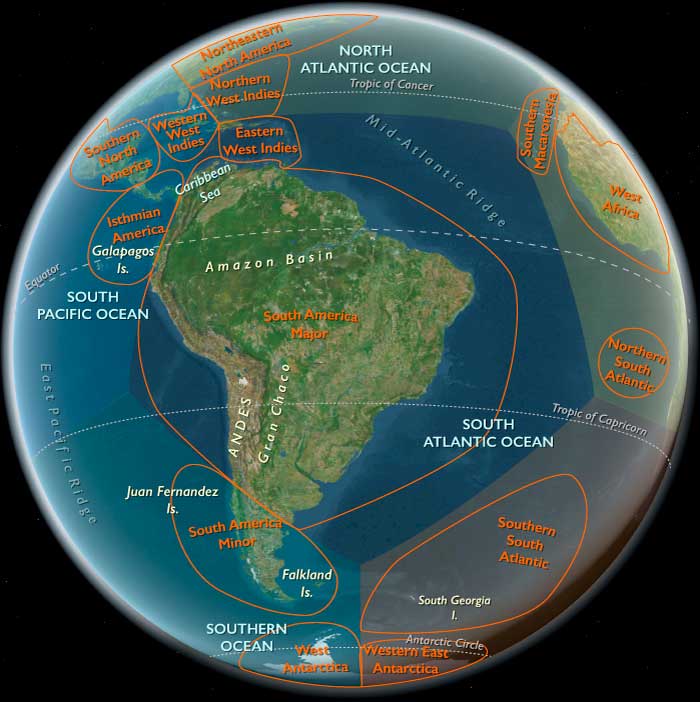
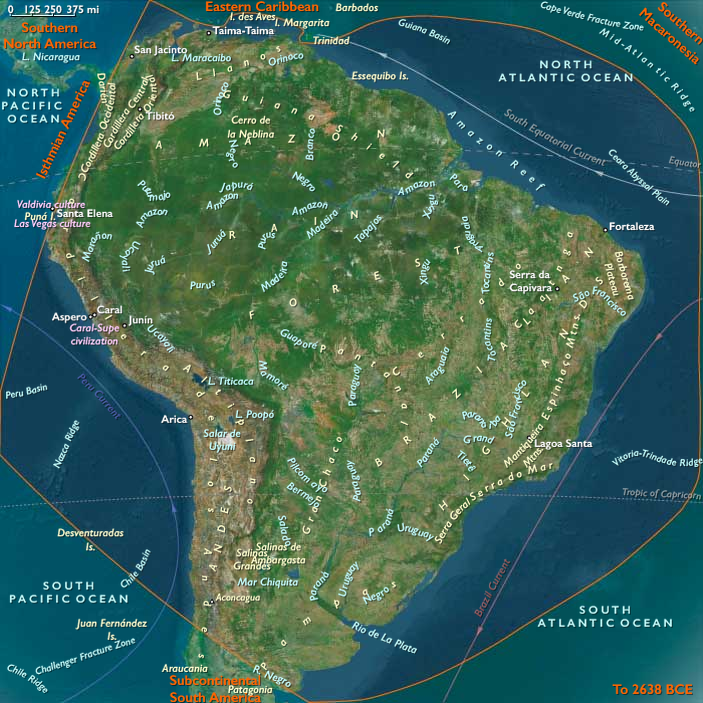
During the Early Holocene, South America Major extended across the tropical forests and northern Andes of Colombia and Venezuela, the Guianas and Brazil, the Pacific and Andean worlds of Ecuador, Peru and Bolivia, and the grasslands, river systems and drylands of Paraguay, Uruguay, northern Argentina and northern Chile. Human communities were already established across all of these environments. The history of the age therefore lay not in first settlement but in the growing regional diversity of ways people used forests, coasts, rivers, mountains and wild plants.
Across Colombia, warmer and wetter Early Holocene conditions encouraged rainforest expansion through lowlands and onto Andean slopes. Hunter-gatherer communities moved through forest, valley and upland environments while increasingly favoring useful plants around camps and recurring resource zones.
Plant use extended beyond simple gathering. In several Colombian regions, people selectively managed forests, tended useful species and created small disturbances that encouraged edible palms, fruits, tubers and other resources. These practices remained embedded within broad hunting-and-gathering economies rather than forming permanent agricultural landscapes.
Farther south along the Pacific coast of Ecuador, the Las Vegas tradition provides one of the clearest examples of this mixed economy. Coastal communities exploited fish, shellfish, estuarine foods, terrestrial animals and wild plants while also cultivating squash and gourds during the Early Holocene.
Such cultivation remained small-scale. Tended plants supplemented rather than replaced wild foods, and camps remained integrated into broad coastal and terrestrial foraging territories. There were no extensive fields, irrigation systems or farming villages.
The Pacific coast of Peru supported increasingly intensive maritime economies. The Humboldt Current and productive river mouths supplied fish, shellfish, seabirds and other marine resources, while nearby valleys and seasonal vegetation provided gathered plants and opportunities for localized cultivation.
Some communities returned repeatedly to particularly productive stretches of coast and river mouth, creating more persistent settlements than highly mobile inland foragers. Yet monumental architecture, irrigation systems and the dense ceremonial centers of later Peruvian history still lay far ahead.
Across the Andean highlands, people moved among puna grasslands, lakes, wetlands and sheltered valleys. Wild vicuña, guanaco and deer remained important prey, while tubers, seeds and other highland plants broadened subsistence. Early tending or cultivation of useful plants may already have begun locally, but domestic camelid herding had not yet appeared.
In northern Chile and the adjacent high Andes, communities exploited sharply contrasting Pacific and interior environments. Marine foods supported coastal camps, while springs, wetlands and highland grasslands sustained inland hunting and gathering. Llama pastoralism and oasis agriculture remained thousands of years in the future.
Amazonia contained another vast set of Early Holocene adaptations. Human populations occupied major rivers, floodplains, forest margins and interior forests, taking fish, turtles, terrestrial animals, palms, tree fruits and underground tubers.
These communities were already capable of altering the distribution of useful species. Repeated harvest, protection, selective clearing and small-scale cultivation began to create localized human-influenced forest landscapes. Such management represented the early stages of plant and landscape domestication without producing the large settled villages, dark-earth soils or engineered landscapes characteristic of much later Amazonian history.
Across Brazil outside the Amazon, hunter-gatherer lifeways varied among Atlantic forest, cerrado, dry interior, wetland and coastal environments. Riverine groups exploited fish and aquatic resources, while woodland communities gathered fruits, nuts and tubers and hunted regional fauna. Coastal populations used shellfish and marine resources, though the great shell-mound systems of later millennia had not yet become the dominant coastal pattern.
Farther south and inland, Paraguay, Uruguay and northern Argentina contained grasslands, woodland patches, rivers and seasonal wetlands occupied by mobile foragers. Hunting, fishing and plant gathering remained the basis of subsistence, without the mound-building, horticultural or ceramic traditions of later periods.
Across the subregion, no single technological package unified these communities. Stone tools, bone and wooden implements, baskets, cordage and other organic technologies varied regionally. Pottery had not yet become a widespread South American technology, and domestic animals remained absent apart from dogs already associated with human populations.
The physical landscapes continued changing around them. Forests expanded in tropical regions, Andean glaciers retreated, Pacific and Atlantic shorelines shifted inland, and river and wetland systems stabilized into increasingly productive Holocene environments. Communities responded by intensifying use of particular places and resources rather than converging on one economic system.
Legacy of the Age
By 6,094 BCE, South America Major had become a continent of highly differentiated human lifeways. Coastal communities in Ecuador and Peru combined rich marine economies with early cultivation, while Colombian and Amazonian foragers increasingly managed useful plants and altered local forest composition. Highland groups remained mobile hunters and gatherers without domestic camelids, and vast portions of Brazil, Paraguay, Uruguay, northern Argentina and northern Chile supported equally regionalized riverine, forest, grassland and desert adaptations. Pottery, monumental architecture, large-scale agriculture, pastoralism and later complex societies remained in the future. The defining history of the age was the increasing intensity with which human communities shaped and specialized within particular Early Holocene environments while remaining overwhelmingly dependent on mixed foraging economies.

-
{# Image navigates to the detail page; the magnifying-glass chip is the only Fancybox lightbox trigger (kept a separate sibling — anchors can't nest). #}
 South America and The Eastern Isles
World
-
{# Image navigates to the detail page; the magnifying-glass chip is the only Fancybox lightbox trigger (kept a separate sibling — anchors can't nest). #}
 South America
Region
-
{# Image navigates to the detail page; the magnifying-glass chip is the only Fancybox lightbox trigger (kept a separate sibling — anchors can't nest). #}
 South America Major
Subregion