South Central Europe (4,365 – 2,638 BCE)…
4365 BCE to 2638 BCE
South Central Europe
(4,365 – 2,638 BCE) Late Neolithic/Chalcolithic — Pile-Dwelling Fluorescence, Copper Trails, and Alpine Clearances
Geographic and Environmental Context
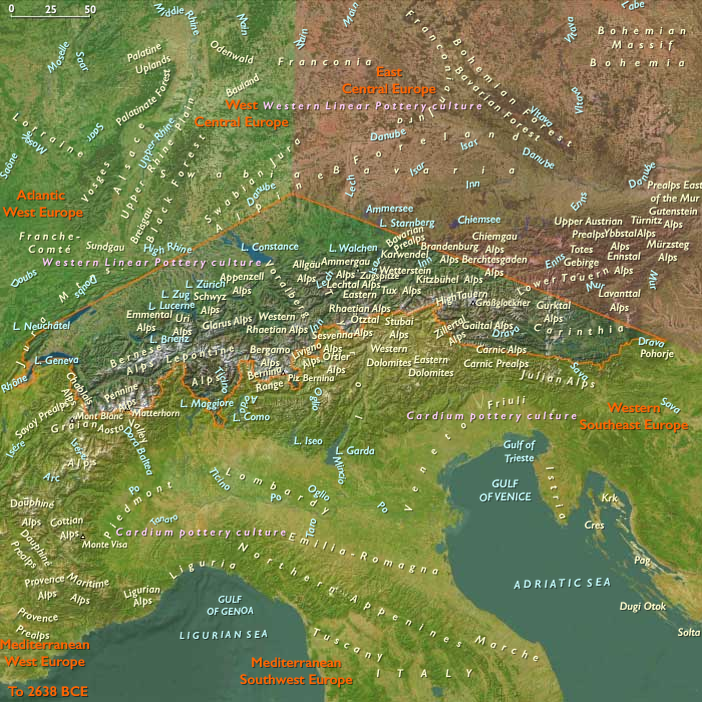
South Central Europe includes southern and western Austria (including Carinthia; excluding Salzburg), Liechtenstein, Switzerland (excluding Basel and the eastern Jura), southeastern Swabia (southeastern Baden-Württemberg), and southwestern Bavaria.-
Anchors: Cortaillod–Pfyn–Horgen lake villages; Valais copper nodes; Inn–Tyrol upland clearances; Carinthia alpine forelands.
Climate & Environmental Shifts
-
Stable with cool pulses; wetlands expanded/contracted with lake-level swings.
Subsistence & Settlement
-
Pile-dwellings proliferated with orchards/gardens; dairying intensified; upland summer pastures (transhumance).
-
Copper exploited in Valais–Grisons–Tyrol; exchange reached the plateau.
Technology & Material Culture
-
Corded wares and Bell Beaker influences late; copper pins, daggers; flint mining/trade; fiber/textile advances.
Movement & Interaction Corridors
-
Pass traffic in copper and prestige goods (amber, axes) increased; Rheintal–Gotthard–Brenner triad integrated north–south.
Cultural & Symbolic Expressions
-
Wetland votives (antler, ceramics); burial differentiation suggests rank.
Images

South Central Europe in the Late Holocene
Groups
Topics
Subjects
Regions
Central Europe
View →Subregions