
Charles II of Spain, the product of …
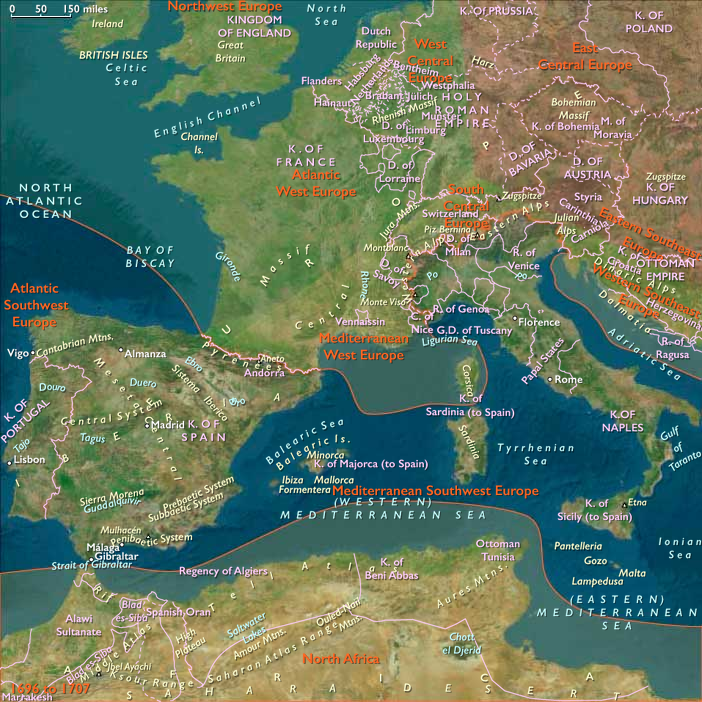
Years: 1696 - 1707
Charles II of Spain, the product of generations of inbreeding, is unable to rule and remains childless.
The line of Spanish Habsburgs comes to an end at his death in 1700.
Habsburg partisans argue for allocating succession to the Austrian branch of the Habsburg dynasty, but Charles II, in one of his last official acts, leaves Spain to his nephew, Philip of Anjou, a Bourbon and the grandson of Louis XIV.
This solution appeals to Castilian legitimists because it complies with the principle of succession to the next in the bloodline.
Spanish officials have been concerned with providing for the succession in such a way as to guarantee an integral, independent Spanish state that, along with its possessions in the Netherlands and in Italy, would not become part of either a pan-Bourbon or a pan-Habsburg empire.
''The Pyrenees are no more," Louis XIV rejoices at his grandson's accession as Philip V (r. 1700-46).
The prospect of the Spanish Netherlands falling into French hands, however, alarms the British and the Dutch.
The acceptance of the Spanish crown by Philip V in the face of counterclaims by Archduke Charles of Austria, who is supported by Britain and the Netherlands, is the proximate cause of the War of the Spanish Succession (1702-14), the first "world war" fought by European powers.
In 1705 an Anglo-Austrian force lands in Spain.
A Franco-Castilian army halts its advance on Madrid, but the invaders occupy Catalonia.
Castile enthusiastically receives the Bourbon dynasty, but the Catalans oppose it, not so much out of loyalty to the Habsburgs as in defense of their fueros against the feared imposition of French-style centralization by a Castilian regime.
Locations
People
- Charles II of Spain
- Charles VI, Holy Roman Emperor, King of the Romans (King of Germany)
- Louis XIV of France
- Philip V of Spain
Groups
- Habsburg, House of
- Austria, Archduchy of
- Spain, Habsburg Kingdom of
- Netherlands, United Provinces of the (Dutch Republic)
- France, (Bourbon) Kingdom of
- Habsburg Monarchy, or Empire
- Spain, Bourbon Kingdom of
- Britain, Kingdom of Great
Topics
Subjects
Regions
Subregions
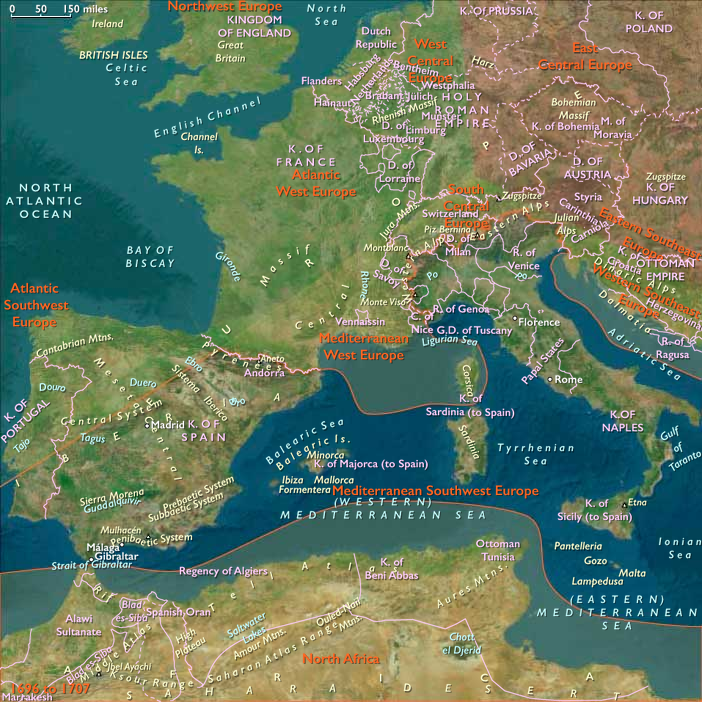
Years: 1696 - 1707
Locations
People
- Charles II of Spain
- Charles VI, Holy Roman Emperor, King of the Romans (King of Germany)
- Louis XIV of France
- Philip V of Spain
Groups
- Habsburg, House of
- Austria, Archduchy of
- Spain, Habsburg Kingdom of
- Netherlands, United Provinces of the (Dutch Republic)
- France, (Bourbon) Kingdom of
- Habsburg Monarchy, or Empire
- Spain, Bourbon Kingdom of
- Britain, Kingdom of Great
Topics
Subjects
Regions
Subregions