Sparta has already, in the Dark Age,…
765 BCE to 622 BCE
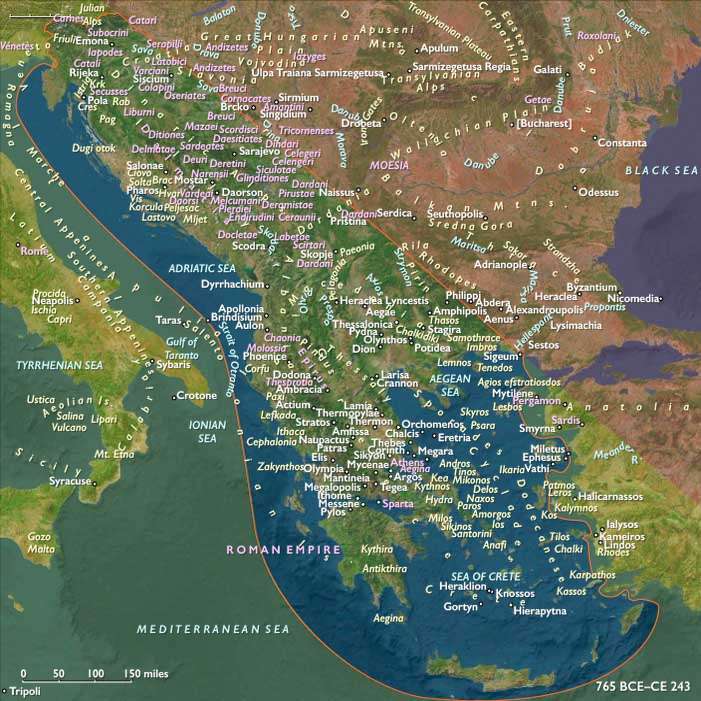
Sparta has already, in the Dark Age, coerced into semisubject, or “perioikic,” status a number of its immediate neighbors, having gradually conquered Laconia, the southeastern quarter of the Peloponnesus.
Many of the conquered pre-Dorians became helots, or serfs; the Spartans grant members of various neighboring groups in Laconia the semiautonomous status of “perioikoi,” but require them to serve in the army.
It undertakes the wholesale conquest of Messenia in the second half of the eighth century, from about 735 BCE to 715 BCE.
One consequence is the export of an unwanted group, the Partheniai, to Taras in southeastern Italy.
These are sons of Spartan mothers and non-Spartan fathers, procreated during the absence in Messenia of the Spartan warrior elite.
A still more important consequence of the conquest of Messenia, “good to plow and good to hoe” as the seventh-century Spartan poet Tyrtaeus puts it, is the acquisition of a large tract of fertile land and the creation of a permanently servile labor force, the “helots,” as the conquered Messenians are now called.
The helots are state slaves, held down by force and fear, bound to the soil and assigned to individual Spartans to till their holdings; their masters can neither free them nor sell them, and the helots have a limited right to accumulate property, after paying to their masters a fixed proportion of the produce of the holding.
Owing to their own numerical inferiority, the Spartans are always preoccupied with the fear of a helot revolt.
Sparta begins to develop as a militant polis in the eighth century and early seventh century BCE, with a rigid social structure and a government that includes an assembly representing all citizens.
Archidamus, the twelfth king of Sparta of the Eurypontid line, and the son of Anaxidamus, rules shortly after the close of the second Messenian War in about 660 BCE and toward the outset of the long war between Sparta and Tegea (the Tegean War).
The geographer Pausanias describes his reign as quiet and peaceful.
Locations
Groups
Topics
Commodities
Subjects
Regions
Southeast Europe
View →Subregions