Stephen Kotroman, a vassal of the Hungarian …
Years: 1322 - 1322
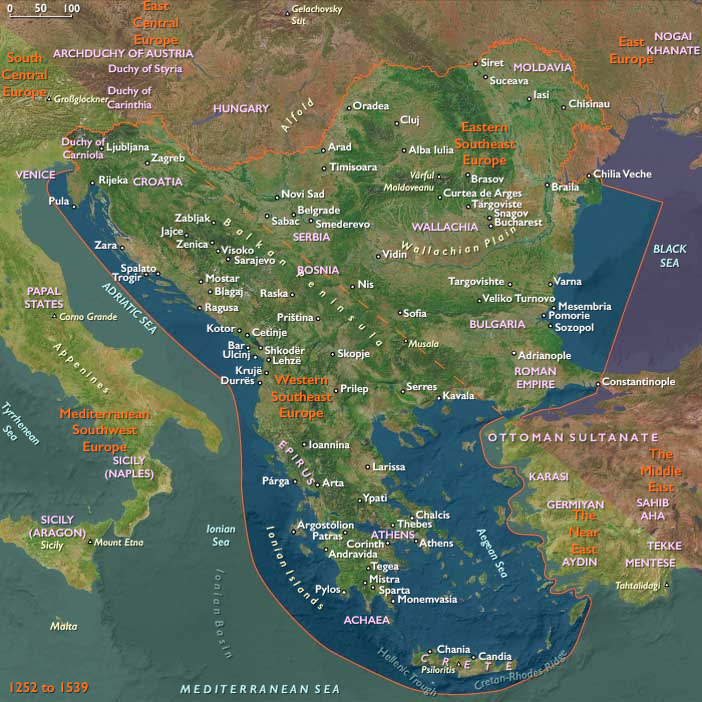
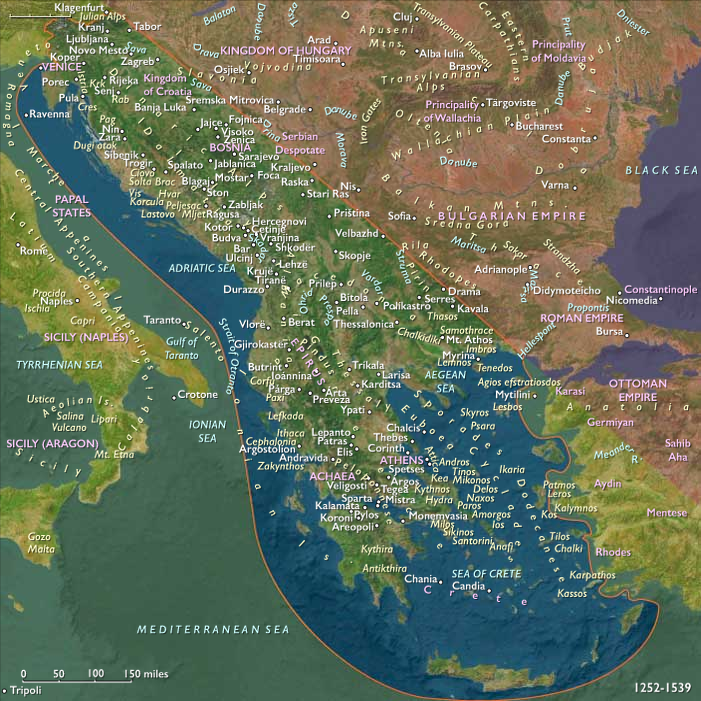
Stephen Kotroman, a vassal of the Hungarian king, had from 1287 to 1316 ruled a portion of Bosnia.
His son Stephen (Stjepan) Kotromanic in 1322 becomes the independent lord of all Bosnia.
Locations
People
Groups
Subjects
Regions
Subregions
Related Events
Filter results
Showing 10 events out of 44720 total
Louis finally wins the long, bitter German civil war with a decisive victory in the Battle of Mühldorf in 1322.
Frederick is captured there and imprisoned, but Pope John XXII, living in Avignon, intervenes, claiming the right to veto Louis’s election.
When Louis denies this right, John excommunicates him.
Guido II da Polenta, the nephew of Lamberto I da Polenta, had acquired the lordship of Ravenna after the latter's death.
In 1316–1321 he was host of Dante Alighieri.
In 1322 he is named capitano del popolo of Bologna and leaves the government of Ravenna to his brother Rinaldo, who was archbishop of the city though without the Papal confirmation.
Ostasio I da Polenta, from the family line of Cervia, profited of the situation to kill Rinaldo and seize the power for himself.
Thomas, Earl of Lancaster—the son of Edmund Crouchback and Blanche of Artois— having led the baronial opposition to his cousin Edward II, had become England’s effective ruler by the time of Edward's decisive defeat at Bannockburn.
Edward recovers power, however, with the help of a new favorite, his chamberlain Hugh le Despenser.
Despenser, who has married a Clare and thereby gained control of Glamorgan on the Welsh border, becomes a target of the Marcher lords’ ire.
The Earl of Lancaster unites opposition against Despenser and maneuvers his exile.
Edward, furious, sends royal troops against the Marcher lords at Boroughbridge in 1322, defeating the rebel cavalry with dismounted men-at-arms and archers and afterwards executing Lancaster—whose title passes to his brother, Henry—and several of his associates.
Despenser returns to Edward’s side, and his allies help him to repeal the 1311 laws on the basis that they had been passed only by the nobles.
Robert the Bruce, in the eight years since his victory at Bannockburn, has avoided any major battle with the English.
Edward II invades Scotland in 1322, but Bruce’s forces engage the English at the Battle of Byland, winning a victory by a surprise attack and routing Edward from the battlefield to retreat into Yorkshire.
The Accession of Charles IV ("the Fair") (1322)
On January 3, 1322, Philip V of France died, and he was succeeded by his younger brother, Charles IV, who, like his father Philip IV, was also known as "the Fair" (le Bel).
The Last Direct Capetian King
- Charles IV was the third and last son of Philip IV to rule France, following the short reigns of his elder brothers:
- Louis X (r. 1314–1316)
- Philip V (r. 1316–1322)
- His reign marked the final chapter of the direct Capetian dynasty, as he died without a male heir in 1328, leading to the succession crisis that resulted in the rise of the Valois dynasty.
Continuity of Capetian Rule
- Charles IV maintained his family's centralized royal authority and continued Philip IV’s policies of taxation, administration, and ecclesiastical control.
- Like his brother Philip V, he sought to assert Capetian dominance over the nobility and feudal territories.
The Implications of His Accession
- With no surviving sons from any of Philip IV’s three sons, Charles IV’s death in 1328 would trigger a major succession dispute, ultimately leading to:
- The establishment of the House of Valois, as Philip VI took the throne.
- Edward III of England’s claim to the French crown, setting the stage for the Hundred Years’ War (1337–1453).
Legacy
The accession of Charles IV in 1322 was a continuation of Capetian rule, but his failure to produce a male heir marked the end of the direct Capetian line, paving the way for the dynastic struggles that would reshape France and Europe.
Vilnius, located on the Neris River and settled during the tenth century, becomes in 1323 the capital of the Grand Duchy of Lithuania.
William of Ockham employs his powerful logical faculty to elaborate an influential theology in his Quodlibeta septem (“Seven Miscellaneous Questions”) and his Summa totius logicae (“Sum of All Logic”).
Adopting a nominalist solution to the problem of universals, William maintains that all existing things are individuals and that universality exists only in concepts or names.
It logically follows, therefore, that God, unhampered by any universal essences, is free to create every individual unconnected with every other, and that subsequent causal connections among such individuals are unnecessary.
Accepting the Aristotelian dictum that science is demonstration based on certain, secure premises, William rejects the Thomistic view that theology is a proper science and therefore rejects rational demonstrations of God's existence, of divine attributes, and of the immortality of the soul.
He counters the philosophical explanations of others with the logical principle of parsimony, sometimes called Occam's razor (but used by some scholastic philosophers before him): "A plurality (of reasons) should not be posited without necessity."
Ockham, whose nominalist views in law and ethics lead him to voluntarism and emphasis on the divine command, concludes that the ultimate source of value and obligation lies not in any "natures" of things but in the free will of God.
He views the rightness or wrongness of human acts as a function of their being commanded or forbidden by divine authority.

The chief of the Kakatiya neglects to send tribute to Delhi in 1323, resulting in his swift deposition by a Muslim force from Madurai.
King James II of Aragon, lord of Corsica and Sardinia by the 1295 Treaty of Anagni, sends a fleet in 1323 under the commanded by his son, the Crown Prince, to pacify the Pisans and the Genoese, who have long had interests here, particularly in the cities of Cagliari and Iglesias, which the Pisans control.
The city of Sassari surrenders in 1323, but will rebel three more times and be contested by Genoa.
The Cathedral of San Gennaro, the foremost of Naples’s churches, is completed in 1323.