
The Cathedral of San Gennaro, the foremost…
1323 CE
The Cathedral of San Gennaro, the foremost of Naples’s churches, is completed in 1323.
Locations
Regions
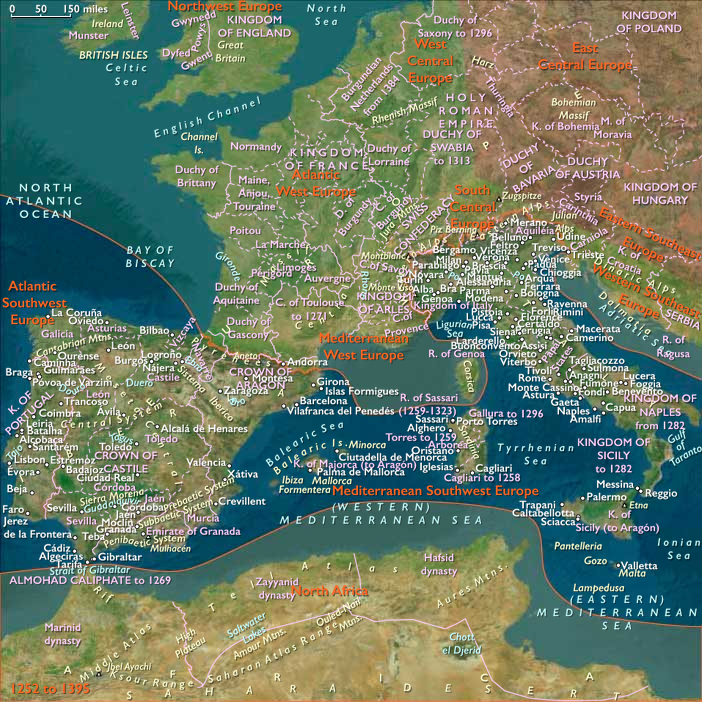
Southwest Europe
View →Subregions
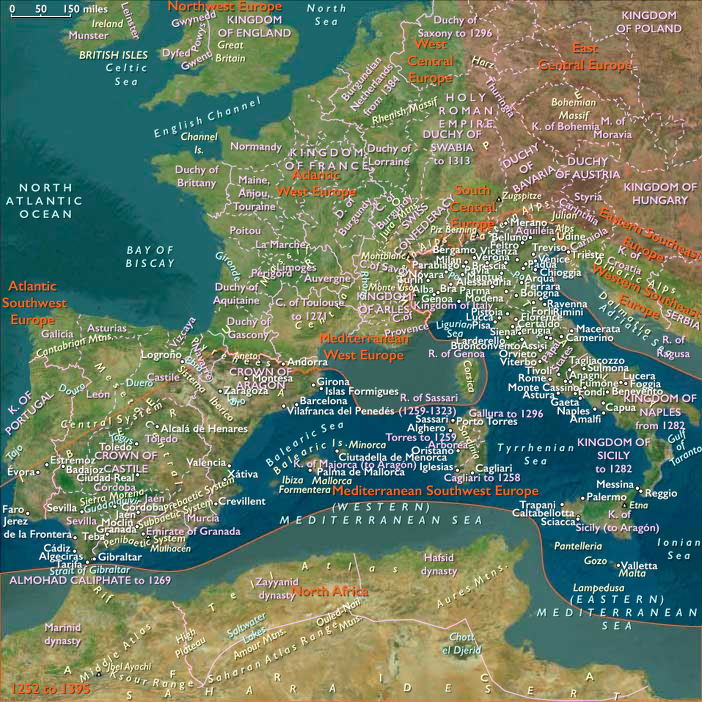
Mediterranean Southwest Europe
View →Related Events
No active filters.
Showing 10 events out of 44727 total
Vilnius, located on the Neris River and settled during the tenth century, becomes in 1323 the capital of the Grand Duchy of Lithuania.
William of Ockham employs his powerful logical faculty to elaborate an influential theology in his Quodlibeta septem (“Seven Miscellaneous Questions”) and his Summa totius logicae (“Sum of All Logic”).
Adopting a nominalist solution to the problem of universals, William maintains that all existing things are individuals and that universality exists only in concepts or names.
It logically follows, therefore, that God, unhampered by any universal essences, is free to create every individual unconnected with every other, and that subsequent causal connections among such individuals are unnecessary.
Accepting the Aristotelian dictum that science is demonstration based on certain, secure premises, William rejects the Thomistic view that theology is a proper science and therefore rejects rational demonstrations of God's existence, of divine attributes, and of the immortality of the soul.
He counters the philosophical explanations of others with the logical principle of parsimony, sometimes called Occam's razor (but used by some scholastic philosophers before him): "A plurality (of reasons) should not be posited without necessity."
Ockham, whose nominalist views in law and ethics lead him to voluntarism and emphasis on the divine command, concludes that the ultimate source of value and obligation lies not in any "natures" of things but in the free will of God.
He views the rightness or wrongness of human acts as a function of their being commanded or forbidden by divine authority.
The chief of the Kakatiya neglects to send tribute to Delhi in 1323, resulting in his swift deposition by a Muslim force from Madurai.
King James II of Aragon, lord of Corsica and Sardinia by the 1295 Treaty of Anagni, sends a fleet in 1323 under the commanded by his son, the Crown Prince, to pacify the Pisans and the Genoese, who have long had interests here, particularly in the cities of Cagliari and Iglesias, which the Pisans control.
The city of Sassari surrenders in 1323, but will rebel three more times and be contested by Genoa.
The thought of Tommaso d’Aquino becomes more or less the official doctrine of the Roman Catholic church with his canonization, as Saint Thomas Aquinas, in 1323.
The continuous shaft furnace, developed in Germany in about 1323, produces a high-carbon product that becomes known as cast iron and serves to broaden considerably the use of iron castings.
Edward finally signs a truce with Robert in 1323, but border incursions continue.
The central Italian city of Lucca, a commune since the twelfth century and a prosperous commercial and artistic center, comes under the rule of the ambitious mercenary Castruccio Castracani, a Ghibelline leader.
By 1320, Castracani had openly declared war on the Guelphs of Florence, dispatching Luccan troops to pillage Florentine territory.
After fresh Florentine troops finally check the Luccans, Castruccio allies himself with Pistoia; by mid-June of 1323, Luccan troops ravaging the Florentine countryside advance to within ten miles of the city.
A desperate Florence negotiates and raises a new army to keep the Luccans at bay.
Sweden, beginning in the twelfth century, has gradually conquered Finland and introduced Christianity to the Finns.
The Treaty of Nöteborg, also known as the Treaty of Oreshek (Finnish: Pähkinäsaaren rauha), a conventional name for the peace treaty signed at Orekhovets (Swedish: Nöteborg, Finnish: Pähkinäsaari) on 1 August 12, 1323, is the first settlement between Sweden and the Novgorod Republic, the Russian power to the east, regulating their border.
Che Anan’s insurgent Cham forces, aided by the Mongols, finally defeat their Vietnamese overlords in 1326, ending Champa’s forces vassalage to Dai Viet.
Che Anan becomes king of Champa, and peace obtains between the two nations.