George Stephenson, aware of the explosions often…
December 1815 CE
George Stephenson, aware of the explosions often caused in mines by naked flames, begins in 1815 to experiment with a safety lamp that will burn without causing an explosion.
At the same time, the eminent Cornish scientist Humphry Davy is also looking at the problem.
Despite his lack of any scientific knowledge, Stephenson, by trial and error, devises a lamp in which the air enters via tiny holes.
Stephenson demonstrates the lamp himself to two witnesses by taking it down to Killingworth colliery and holding it directly in front of a fissure from which fire damp is issuing.
This is a month before Davy presents his design to the Royal Society.
The two designs differ in that Davy's lamp is surrounded by a screen of gauze, whereas Stephenson's lamp is contained in a glass cylinder.
For his invention, Davy will be awarded £2,000, whilst Stephenson is accused of stealing the idea from Davy.
A local committee of enquiry will soon exonerates Stephenson, proving that he had been working separately, and award him £1,000, but Davy and his supporters refuse to accept this.
They cannot see how an uneducated man such as Stephenson could come up with the solution that he has.
(In 1833 a House of Commons committee will find that Stephenson had equal claim to having invented the safety lamp. Davy will go to his grave believing that Stephenson had stolen his idea. The Stephenson lamp is used exclusively in the North East, whereas the Davy lamp is used everywhere else.)
The experience with Davy gives Stephenson a lifelong distrust of London-based, theoretical, scientific experts.
There is a theory that it was Stephenson who indirectly gave the name of Geordies to the people of Tyneside.
By this theory, the name of the Geordie lamp attached to the pit men themselves.
By 1866, any native of Tyneside could be called a Geordie.
Regions
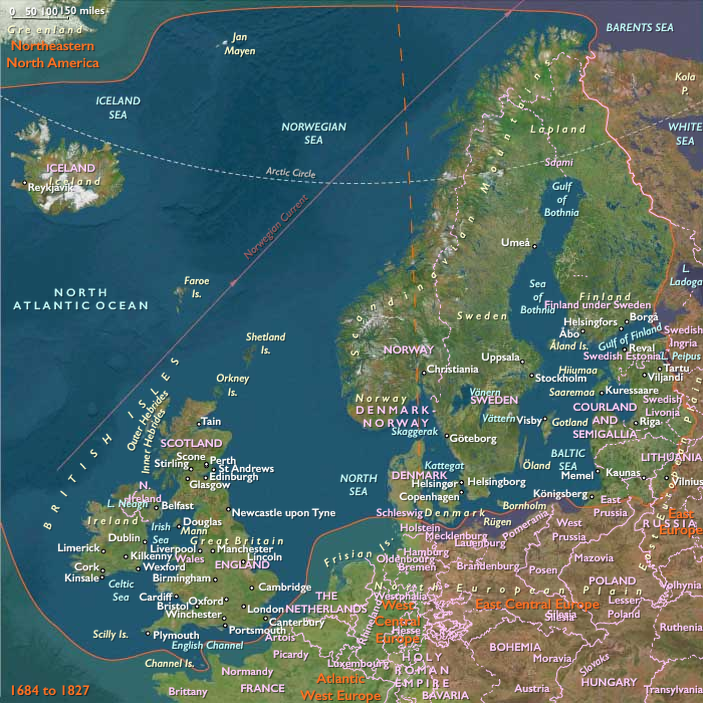
North Europe
View →Subregions