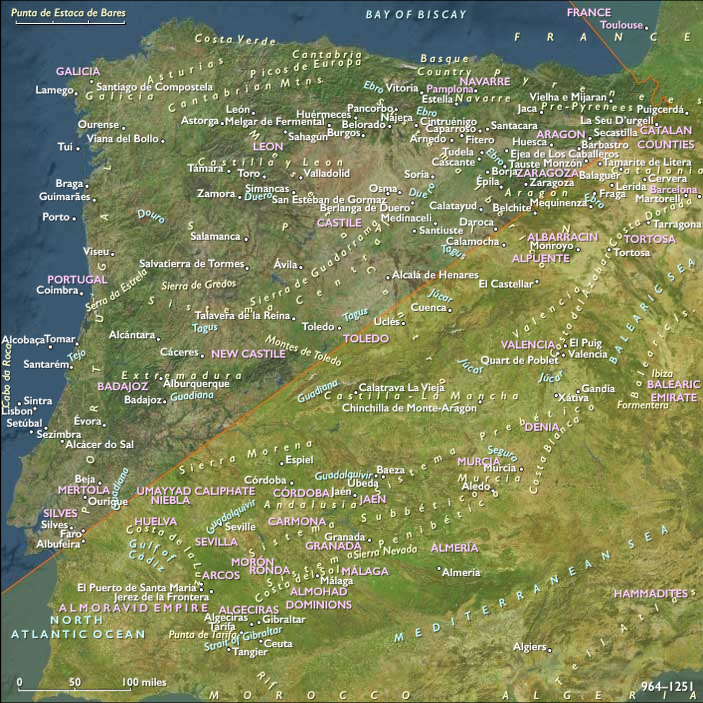
The Rise of Castile: From Frontier Buffer…
1108 CE to 1251 CE
The Rise of Castile: From Frontier Buffer to Kingdom (10th–13th Century)
In the 10th century, the Kingdom of León establishes a series of strongholds along the upper Ebro River to serve as a buffer zone against Muslim incursions. This region, known as Castile ("land of castles"), is settled by border warriors and free peasants willing to defend it.
To encourage settlement and fortify the frontier, the kings of León grant fueros (special privileges and immunities) to the inhabitants, making Castile virtually autonomous. Over time, Castile develops into a distinct society, shaped by:
- A unique dialect and customs,
- A warrior culture, where all men are considered equals in battle, and
- A hereditary military caste, which is "democratized" by the frontier conditions—all warriors are equals, and all men are warriors.
The Emergence of the Kingdom of Castile
- In 981, Castile becomes an independent county under Count García Fernández.
- In 1004, it is elevated to a kingdom, marking its full emergence as a sovereign entity.
The Unification of Castile and León
Throughout the 11th and 12th centuries, Castile and León are periodically reunited through dynastic marriages but repeatedly divided among heirs, preventing lasting unity.
However, in 1230, King Ferdinand III of Castile (d. 1252) permanently unites the two kingdoms, forming a single political entity. This marks a turning point in the Reconquista, as the unified kingdom becomes the dominant Christian power in Iberia, paving the way for the eventual conquest of Muslim-held territories.
Locations
Groups
Topics
Regions
Southwest Europe
View →Subregions