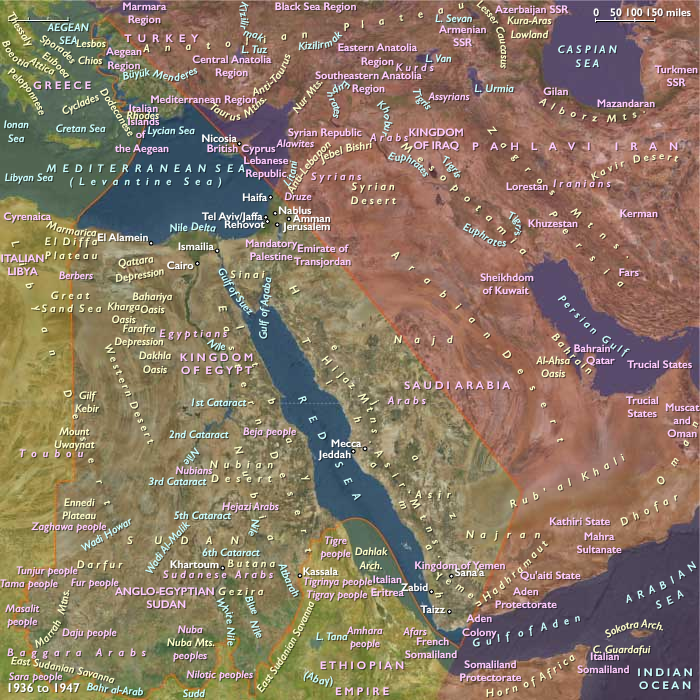
Nationalism reemerges in Sudan in the 1930s.…
1936 CE to 1947 CE
Educated Sudanese want to restrict the governor general's power and to obtain Sudanese participation in the council's deliberations.
However, any change in government requires a change in the condominium agreement.
Neither Britain nor Egypt will agree to a modification.
Moreover, the British regard their role as the protection of the Sudanese from Egyptian domination.
The nationalists fear that the eventual result of friction between the condominium powers might be the attachment of northern Sudan to Egypt and southern Sudan to Uganda and Kenya.
Although they settle most of their differences in the 1936 Treaty of Alliance, which sets a timetable for the end of British military occupation, Britain and Egypt fail to agree on Sudan's future status.
Nationalists and religious leaders are divided on the issue of whether Sudan should apply for independence or for union with Egypt.
The Mahdi's son, Abd ar Rahman al Mahdi, emerges as a spokesman for independence in opposition to Ali al Mirghani, the Khatmiyyah leader, who favors union with Egypt.
Coalitions supported by each of these leaders form rival wings of the nationalist movement.
Later, radical nationalists and the Khatmiyyah create the Ashigga, later renamed the National Unionist Party (NUP), to advance the cause of Sudanese-Egyptian unification.
The moderates favor Sudanese independence in cooperation with Britain and together with the Ansar establish the Umma Party.
Groups
Nuer people
View →
Dinka people
View →
Arab people
View →
Islam
View →
Fur people (Nilo-Saharan tribe)
View →
Britain (United Kingdom of Great Britain and Ireland)
View →
Arab nationalism
View →
Sudan, Anglo-Egyptian
View →
Egypt, Kingdom of (British Protectorate)
View →
Britain (United Kingdom of Great Britain and Northern Ireland)
View →
Subjects
Regions
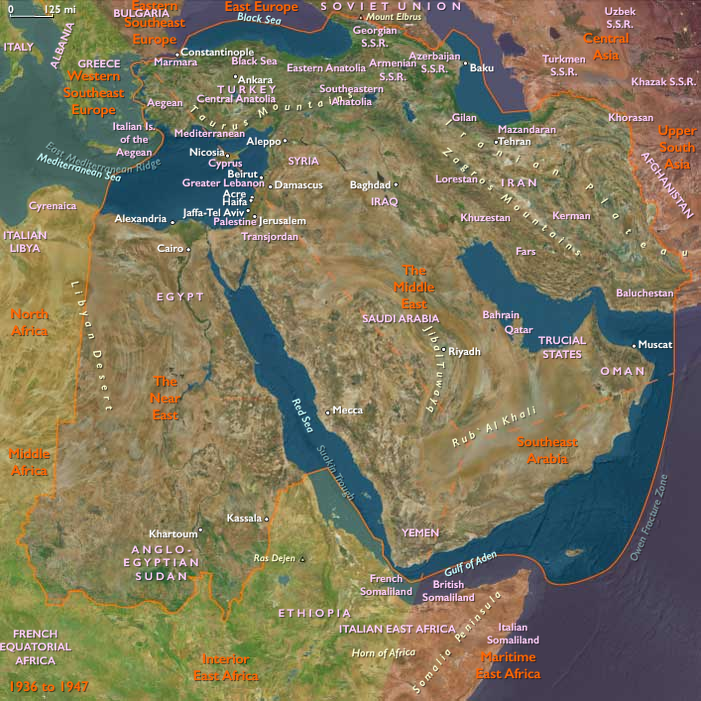
The Near and Middle East
View →Subregions