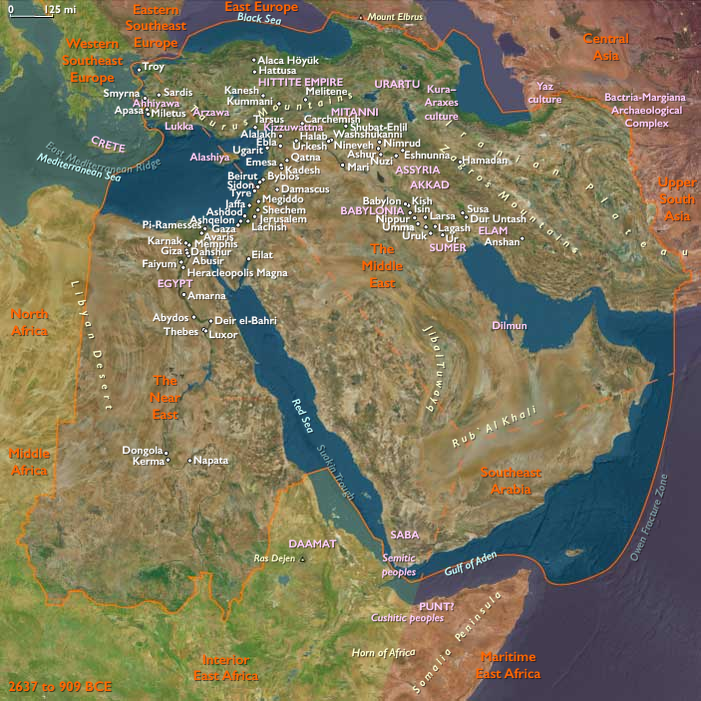
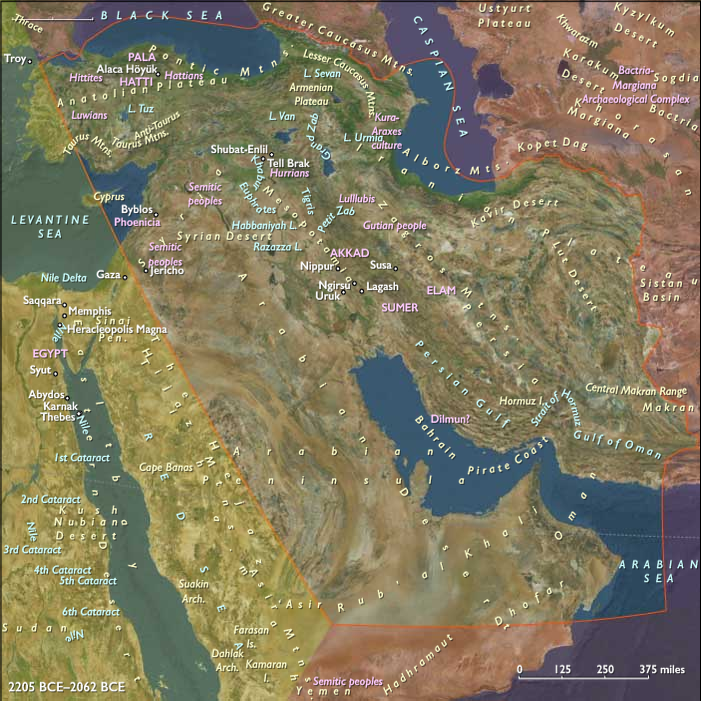
Akkadian hegemony over southern Mesopotamia lasts only …
Years: 2205BCE - 2062BCE
Akkadian hegemony over southern Mesopotamia lasts only two hundred years, despite their military prowess.
Sargon 's great-grandson is overthrown by the Guti, a mountain people from the east.
The fall of the Akkadians and the subsequent reemergence of Sumer under the king of Ur, who defeats the Guti, ushers in the third phase of Sumerian history.
In this final phase, which is characterized by a synthesis of Sumerian and Akkadian cultures, the king of Ur establishes hegemony over much of Mesopotamia.
Sumerian supremacy, however, is on the wane.
Groups
Topics
Subjects
Regions
Subregions
Related Events
Filter results
Showing 10 events out of 32 total
The last ruler of the Xia Dynasty ruled China for fifty-two years until 1618 BCE, according to the Xia Shang Zhou Chronology Project.
According to legend, Tang of Shang overthrew Jie of Xia in the Battle of Mingtiao.
According to the Shiji, the Shang had a long history, and there are different theories about their origin.
An analysis of bones from the remains of Shang people showed a Huaxia (Yellow River area) ethnic origin.
Their civilization was based on agriculture and augmented by hunting and animal husbandry, and in addition to war, the Shang also practiced human sacrifice.
Beginning around 1600, the Shang dynasty takes over a number of petty kingdoms including the Xia and controls a loose confederation of settlement groups in the Henan region of North China.
The Shang have a fully developed system of writing as attested on bronze inscriptions, oracle bones, and a small number of other writings on pottery, jade and other stones, horn, etc.
Their writing system's complexity and sophistication indicates an earlier period of development, but direct evidence of that development is still lacking.
(Chinese writing is thought to descend from a hieroglyphic script.)
Achieving political unification during the sixteenth century, the Shang dynasty maintains cultural continuity in matters of literary functions, as well as social, religious, economic, and governmental controls.
A slave society is apparently emplaced in China under the Shang dynasty, whose urban centers anchor the first true Chinese civilization.
The Shang state employs numerous specialists and distinguishes between commoners, the priesthood, the royal family, the nobility and, almost certainly, the slaves.
Power in Chinese society under the Shang emperors flows from them to the ruling elite, including feudatory landowners and commanders of the organized soldiery, down to the urban artisans and village agriculturists, with enslaved people at the bottom.
Sophisticated bronze metallurgy develops in China in the sixteenth century BCE.
Complex bronze-casting technology (previously undocumented in China) spreads rapidly under the Shang, whose artisans use metal tools in the carving of jade.
The supreme god of the Shangs is Shangdi (Shang-ti), to whom they pray, supplemented by prayers to ancestral spirits.
Maritime East Asia (1485–1342 BCE): Shang Dynasty’s Bronze Age Flourishing and Oracle Bone Divination
Between 1485 BCE and 1342 BCE, Maritime East Asia—comprising lower Primorsky Krai, the Korean Peninsula, the Japanese Archipelago below northern Hokkaido, Taiwan, and southern, central, and northeastern China—experiences a significant cultural and technological flowering under China’s Shang Dynasty. This era sees the dramatic expansion of sophisticated bronze craftsmanship, the consolidation and expansion of Shang political authority, advancements in construction technology, early medicinal practices, and the widespread use of oracle bone script.
Sophisticated Bronze Craftsmanship
Under the Shang Dynasty, Chinese artisans achieve remarkable advancements in bronze metallurgy, crafting highly sophisticated ceremonial vessels such as urns and vases. Molded in sections and featuring intricate decorative patterns, these bronze artifacts appear quite suddenly around the early Shang period (circa 1600 BCE) without clear prior evidence of a comparable metal technology, aside from earlier jade-carving traditions. This advanced bronze technology attests to the remarkable skill, centralized control, and artistic sophistication of Shang culture.
Political Consolidation and Capital Establishment
The Shang Dynasty, traditionally founded around 1600 BCE by the rebel leader Tang of Shang, refers to its rulers as Sons of Heaven, reinforcing their divine right to rule and legitimizing centralized political authority. Shang civilization primarily depends on agriculture, supplemented by hunting and animal husbandry, forming a stable economic base for political expansion and urban growth.
By approximately 1500 BCE, the Shang establish their early capital at Aodu (Bodu)—modern Zhengzhou (Cheng-chou), located strategically in the Yellow River Valley. Here, Chinese engineers demonstrate advanced construction techniques, including the innovative use of open caissons to stabilize and sink shallow walls in the region’s unstable soils.
The Shang court subsequently moves its capital multiple times—six relocations in total, according to the Records of the Grand Historian—culminating in its final, most significant relocation around 1350 BCE to the city of Yin (modern Anyang). This move initiates the dynasty’s "golden age," marking the peak of its political and cultural dominance.
Extent and Influence of Shang Authority
At its zenith following the move to Yin, the Shang domain expands significantly, extending from the Wei River tributaries west of the central Yellow River Valley, eastward to the Yellow Sea coast, northward toward territories occupied by nomadic peoples on the steppes, and approaching the northern boundaries of the Yangtze River basin to the south. The Shang Dynasty will endure as one of China’s longest dynasties, traditionally featuring thirty-one rulers who succeed each other through a fraternal succession pattern, from Tang to the final king, Zhou of Shang.
Early Medicinal Practices
During this period, early medical records in China document the medicinal use of fermented and moldy substances—derived from animal dung and fermented soybean curd—to treat superficial wounds and swelling. These primitive antibiotic treatments underscore early empirical medical experimentation and reflect the beginnings of China's enduring medicinal traditions.
Oracle Bone Script and Divination Practices
Around 1400 BCE, Shang priests increasingly employ the oracle bone script, a form of Chinese writing inscribed onto animal bones or turtle shells during divination rituals. The vast majority of surviving oracle bones date from the Shang capital at Yin (Anyang), ranging approximately from the fourteenth century to the mid-eleventh century BCE. Although the script’s origins likely predate this era, its widespread use from 1400 BCE onward provides China’s earliest significant corpus of recorded writing, invaluable for understanding Shang religious practices, governance, and daily concerns.
Legacy of the Era: Cultural Sophistication and Technological Innovations
Thus, the era 1485–1342 BCE represents a pivotal phase in Maritime East Asia, characterized by the Shang Dynasty's political stabilization, advanced bronze craftsmanship, early engineering achievements, formative medical practices, and innovations in literacy and divination practices. These developments collectively deepen cultural complexity, expand regional influence, and set a foundation for future historical trajectories across East Asia.

Nation-states become multinational in this age, including the Shang in China; the Mitanni, the Hittites, the Assyrians, and the Kassites in West Asia, and the Mycenaeans in the Aegean.
Chinese bronze urns and vases, molded in sections to extremely complex designs, had appeared suddenly under the Shang dynasty with no previous evidence of a metal technology other than jade carving.
A rebel leader who had overthrown the last Xia ruler is believed to have founded China’s Shang dynasty around 1600 BCE.
Its civilization is based on agriculture, augmented by hunting and animal husbandry.
Shang kings call themselves Sons of Heaven.
Aodu, or Bodu, (present-day Zhengzhou, or Cheng-chou, located in the Yellow River valley), one of the earliest known Bronze Age sites in China, has served as the capital of the Shang dynasty from about 1500 BCE, by which time Chinese engineers are using open caissons to sink shallow walls in unstable soil.
Chinese medical records from this period describe the use of moldy and fermented substances from dung and soybean curd to treat wounds and superficial swellings.
The Shang dynasty moved its capital six times, as stated by the Records of the Grand Historian; the final, and most important, move being to Yin (modern Anyang) in 1350 BCE, which leads to what is to be the golden age of the dynasty.
It is to be the longest dynasty in Chinese history, featuring thirty-one kings in fraternal succession from Tang of Shang to King Zhou of Shang.
The Shang domain, now at its height, extends from the Wei River tributary area to the west of the central valley, eastward to the seacoast above the northern edge of the Yangtze River basin, and northward to the steppe country occupied by nomads.
Chinese priests are using the Oracle bone script by 1400 (although its origins probably lie in an earlier time).
Found on oracle bones, which are animal bones or turtle shells used in divination in Bronze Age China.
The vast majority record the pyromantic divinations of the royal house of the late Shang dynasty at the capital of Yin (modern Anyáng, Hénán Province); dating of the Anyáng examples of oracle bone script varies from about the fourteenth to the mid-eleventh centuries BCE.
The Shang rule from the city of Yin, near modern Anyang, beginning about 1350 BCE.
The new capital city includes defensive walls plus palaces, temples, tombs for the elite, facilities for storage of grain, and army barracks.
The Shang dynasty has a fully developed system of writing; its complexity and state of development indicates an earlier period of development, which is still unattested.
Two distinct forms of Chinese writing (readable today) date from around the thirteenth century BCE (still earlier forms are as yet undeciphered).
Pictographic script writing continues to be written on oracle bones, pottery, jade and stone, wooden table surfaces, and silk-covered bamboo.