
Event
Sumerians smelt copper from ore or melt…
Sumerians smelt copper from ore or melt native copper over wood fires; develop kilns for the clay firing of multiple objects; and practice metal-molding techniques.
Initially bronze was made out of copper and arsenic to form arsenic bronze.
It was only later that tin was used, becoming the sole type of bronze in the late third millennium BCE.
Copper/tin ores are rare, as reflected in the fact that there were no tin bronzes in western Asia before 3000 BCE, when the earliest tin-alloy bronzes are found in Susa.
The language known as Proto-Elamite makes, like Sumerian, the transition from pictographic to hieroglyphic script around 3000.
It is uncertain whether the Proto-Elamite script may be considered the direct predecessor of Linear Elamite.
Both scripts remain largely undeciphered, and it is mere speculation to postulate a relationship between the two.
A few Proto-Elamite signs seem either to be loans from the slightly older proto-cuneiform (Late Uruk) tablets of Mesopotamia, or perhaps more likely, to share a common origin.
Whereas proto-cuneiform is written in visual hierarchies, Proto-Elamite is written in an inline style: numerical signs follow the objects they count; some non-numerical signs are 'images' of the objects they represent, although the majority of them are entirely abstract.
Proto-Elamite is used for a brief period around 3000 BCE (presumably contemporaneous with Uruk III, or Jemdet Nasr in Mesopotamia).
Proponents of an Elamo-Dravidian relationship have looked for similarities between the Proto-Elamite and the Indus script.
-
{# Image navigates to the detail page; the magnifying-glass chip is the only Fancybox lightbox trigger (kept a separate sibling — anchors can't nest). #}
 The Great Crossroads
World
-
{# Image navigates to the detail page; the magnifying-glass chip is the only Fancybox lightbox trigger (kept a separate sibling — anchors can't nest). #}
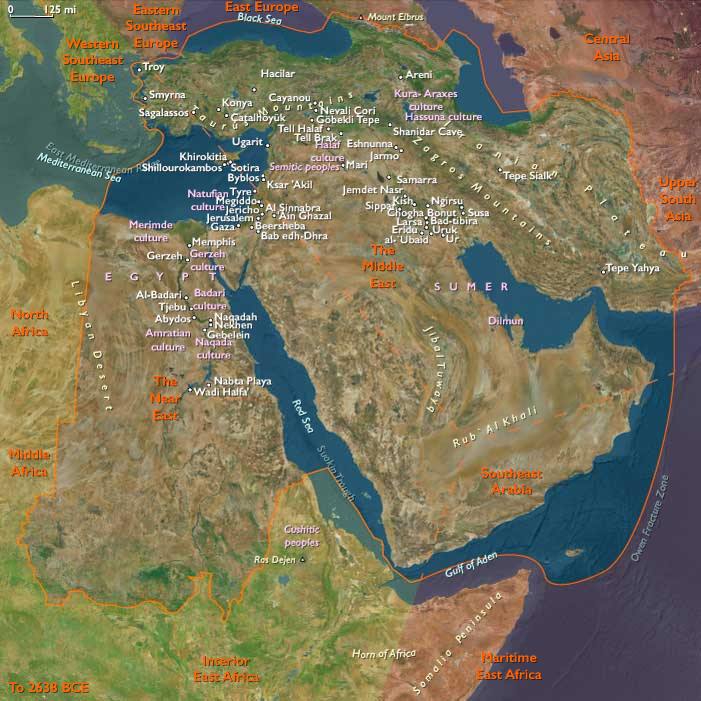 The Near and Middle East
Region
-
{# Image navigates to the detail page; the magnifying-glass chip is the only Fancybox lightbox trigger (kept a separate sibling — anchors can't nest). #}
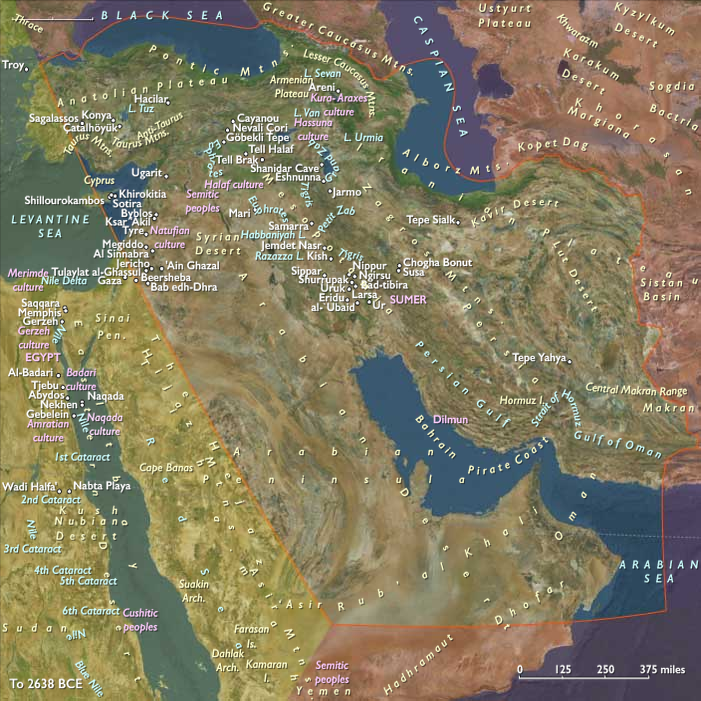 Middle East
Subregion
