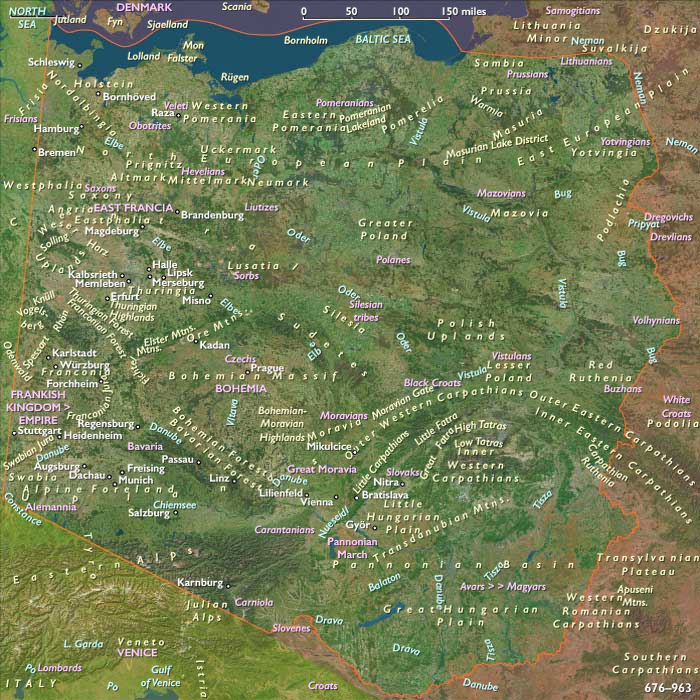
Svatopluk, whose Moravian kingdom has partially filled…
880 CE
Svatopluk, whose Moravian kingdom has partially filled the power vacuum left after Charlemagne’s destruction of the Avar kingdom, rules a Slavic agglomeration covering parts of present Bohemia, Moravia, Poland, Slovakia and Hungary.
Great Moravia had undergone considerable expansion in the 870s.
For instance, the Life of Methodius refers to the capture of "a very powerful pagan prince settled on the Vistula" in territory of later (Poland), and a letter written around 900 by Archbishop Theotmar of Salzburg states that Svatopluk conquered the region of Nitra, which had been thereto inhabited by pagans.
Modern historiography, however, has tended to question the claims that huge neighboring territories were permanently annexed by Great Moravia.
For instance, there is little clear archaeological or written evidence of a permanent extension of Moravian power in Lesser Poland or to the west in Silesia, or in Pannonia, as is suggested in earlier historical works.
Svatopluk's expansionist policy is perhaps so successful because most of Western Europe is in the grip of unusually savage and large-scale Viking raids between 879 and 886.
On the other hand, the Life of Methodius directly links Svatopluk's military achievements and Methodius' work.
For instance, according to his Life, Methodius promises Svatopluk that if the Prince would celebrate Saint Peter's Day in the Archbishop's church, "God will soon deliver" his enemies to him, and "so it came to pass".
Nevertheless, at the court of Svatopluk, who himself professes the Latin rite, intrigues against Methodius and the liturgy in Old Church Slavonic gather strength.
Svatopluk sends John of Venice, a known opponent of the Slavic liturgy, to Rome in 879 to achieve a settlement of ecclesiastical differences.
In a letter addressed to Methodius in the same year, the Pope sharply rebukes him for using Slavonic in church services.
Methodius, however, travels to Rome in 880, together with a Moravian delegation.
Under his influence, Pope John VIII changes his mind and in a letter, known for its incipit, Industriae tuae, the Pope repeats that Mass is to be sung in Latin whenever requested, but he also allows the use of Slavonic liturgy.
The letter also confirms the decision taken by the Holy See during Rastislav's reign to create an archdiocese for Great Moravia.
Upon Svatopluk's request the Pope promotes a German priest, Witching, to be Bishop of Nitra, but he adds that the new Bishop and all the clerics in Great Moravia are expected to be obedient to Methodius, who remains the head of the church in Svatopluk's realms.
Groups
Topics
Commodities
Subjects
Regions
Central Europe
View →Subregions