
Swabia becomes fragmented at the extinction of…
1268 CE
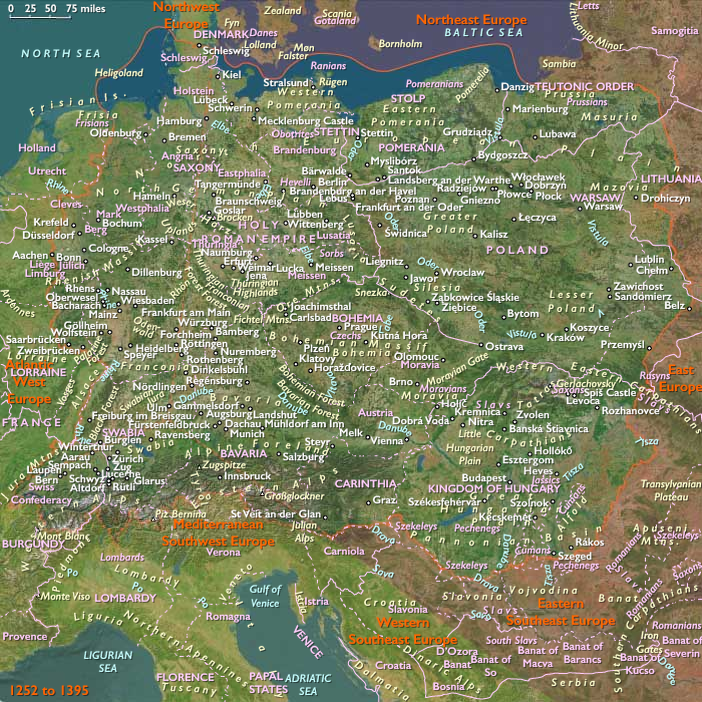
Swabia becomes fragmented at the extinction of the male line of Hohenzollerns with the death of Konradin (Conradin) in 1268, with the Zahringen, Hohenzollern, and Habsburg families owning segments.
People
Subjects
Regions
Central Europe
View →Subregions

West Central Europe
View →Related Events
No active filters.
Showing 10 events out of 45813 total
The Tibetan monk Drogön Chögyal Phagpa of the Sakya school completes the Phagspa script, which is sponsored by Kublai Khan as a new writing system in his empire.
Kublai now turns his full attention to subjugating the Song Dynasty in 1268.
The Battle of Xiangyang, a six-year battle between the Song and the Mongol forces, begins in what is today Hubei.
Kublai sends an emissary to the Kamakura Shogunate of Japan, demanding an acknowledgment of suzerainty and payment of tribute; the Japanese refuse, starting a diplomatic back-and-forth that is to last until the Mongols attempt to invade in 1274.
The city of Pskov, with its surrounding territories along the Velikaya River, Lake Peipus, Pskovskoye Lake and Narva River had become part of the Novgorod Republic after the disintegration of Kievan Rus' in the twelfth century, retaining its special autonomous rights, including the right for independent construction of suburbs (Izborsk is the most ancient among them).
Due to Pskov's leading role in the struggle against the Livonian Order, its influence spreads significantly.
The long reign of Daumantas (1266–99) and especially his victory in the Battle of Rakvere (1268) ushers in the period of Pskov's actual independence.
Shvarn next campaigns against the Volga Tatars and defeats khan Balaklay in the battle of Kojdanow (modern Dzerzinsk, Belarus), which allows Shvarn to capture the towns of …
…Mozyr, …
…Chernigov, …
…Karachev and …
…Starodub.
Dmitry of Pereslavl is the second son of Alexander Nevsky.
When his elder brother Vasily died young, Dmitry had remained the chief heir to his illustrious father.
As early as 1259, he was left by Alexander in charge of Novgorod.
Upon Alexander's death in 1264, however, the Novgorodians had expelled Dmitry to his native Pereslavl-Zalessky, citing his youth as a pretext.
Four years later, when Dmitry had turned eighteen, he was welcomed back to Novgorod and—together with his future son-in-law, Daumantas of Pskov—leads a local militia against Livonian Knights in the Battle of Wesenberg, Rakvere or Rakovor, fought on February 18, 1268, between the Livonian branch of the Teutonic Knights and a coalition of Russian princes.
Apart from the knights, the Livonian army includes Danish forces (right flank) and local Estonian militia (left flank).
It is unclear who the overall commander of the crusading army was, as some sources claim that Livonian Ordensmeister Otto von Lutterberg was not present, while others claim he was.
Bishop Alexander of Dorpat was likely one of the army's leaders, however.
The Livonian forces deploy in their customary deep "boar's head" wedge of heavily armored knights, called by the Russians the "great iron pig."
These deep wedges have considerable penetrative power, but are not maneuverable and are vulnerable to flank attack due to the resulting narrow frontage of the army, facts that had led to the ultimate defeat of the Knights at the Battle of Lake Peipus in 1242.
As a result, the Livonians attempt to remedy this situation at Rakvere by splitting their knightly assault force into two formations, deploying one wedge in the open and a second in ambush, so that when the first wedge is attacked on all sides by the Russians the second wedge would burst from ambush and in turn encircle the enemy.
The tactic works well at first, as the wedge of Livonian knights smashes the Novgorod and Pskov forces facing them, but then the second wedge, seeing the Russians in retreat, apparently assumes the battle is won and emerges from their ambush position to loot the Russian baggage.
This abandonment of the battle plan leads to the first wedge being encircled.
Medieval accounts of the battle vary, with both sides claiming victory, such that the other is unable to mount further attacks.
The most likely conclusion is that the battle was a tactical draw, with both sides withdrawing, badly bloodied, to defend their own lands.
The most proximate Livonian source for the battle, the Livonian Rhymed Chronicle, tells a very different story, however.
According to the anonymous author, von Lutterburg was away, campaigning elsewhere, when the Russians invaded Estonia.
As a result, only a small number of brothers of the Livonian Order were present with the local troops, which included the forces of Bishop Alexander.
In this account, the charge of the Livonian force drove the Russians back across the field of battle, and, despite the death of the bishop Alexander, and a heroic final defense mounted by Prince Dmitry, utterly defeated them.