
The Tamil poet Kampbar, another devotional writer…
1204 CE to 1215 CE
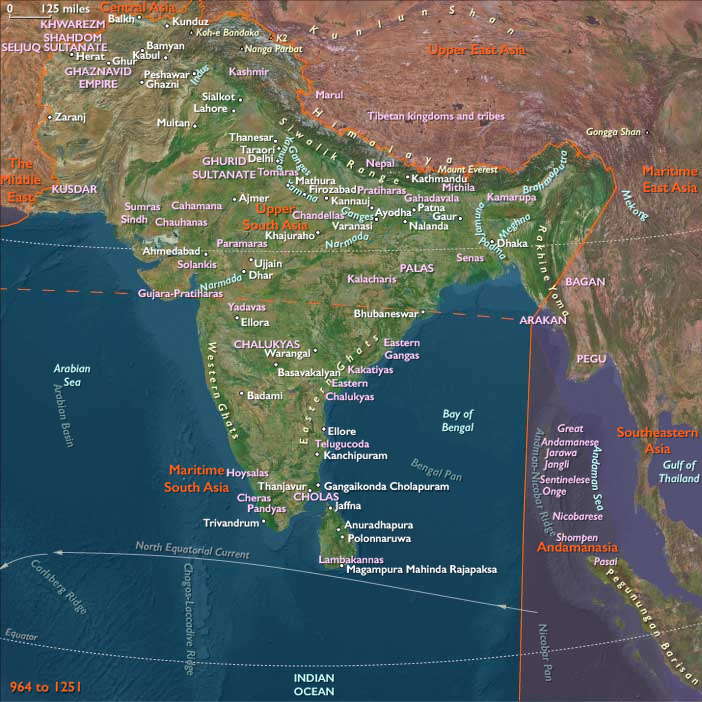
The Tamil poet Kampbar, another devotional writer of the Bhakti Hindu revival, composes the colorful epic “Ramavataram” in the early thirteenth century.
Based on Valmiki's Ramayana in Sanskrit, the story describes the life of King Rama of Ayodhya.
However, Ramavatharam is different from the Sanksrit original in many aspects—both in spiritual concepts and in the specifics of the story line.
This historic work is considered by Tamil scholars as well as the general public as one of the greatest literary works in Tamil literature.
People
Topics
Subjects
Regions
South Asia
View →Subregions

Maritime South Asia
View →Related Events
Showing 10 events out of 36 total
Atlantic West Europe (1192–1203): Shifting Alliances, Angevin Decline, and Cultural Flourishing
Between 1192 and 1203, Atlantic West Europe—including the Low Countries, Brittany, Normandy, Aquitaine, Burgundy, central France, Alsace, and Franche-Comté—experienced dramatic shifts marked by the decline of Angevin power, a significant expansion of Capetian authority under Philip II Augustus, intensified economic prosperity, and remarkable cultural and intellectual growth.
Political and Military Developments
-
Decline of the Angevin Empire and Rise of Capetian France
- Richard I ("the Lionheart," r. 1189–1199), frequently absent from his continental territories due to crusading and captivity, saw Angevin authority weaken significantly.
- Upon Richard’s death (1199), his brother John Lackland (r. 1199–1216) inherited an empire in turmoil, facing immediate challenges from Philip Augustus of France.
- Philip II Augustus skillfully exploited John's vulnerabilities, gradually undermining Angevin control, particularly in Normandy, Anjou, and parts of Aquitaine.
-
Loss of Normandy and Angevin Territories
- Philip II’s military campaigns culminated in the decisive Siege of Château Gaillard (1203), significantly weakening Angevin defenses in Normandy.
- By 1203, Angevin territories were on the brink of collapse, setting the stage for Normandy’s complete loss (1204).
-
Brittany’s Ambiguous Position
- Brittany, under Duchess Constance and later her young son Arthur of Brittany, became embroiled in the Angevin-Capetian conflict, exacerbating regional instability.
- Arthur’s capture (1202) by King John further destabilized the region, ultimately benefiting Capetian ambitions.
-
Burgundy and the Low Countries: Stability Amid Conflict
- Odo III of Burgundy (r. 1192–1218) maintained stable rule, skillfully navigating alliances between France and the Empire.
- The Low Countries, particularly Flanders, continued to prosper economically and maintained relative political autonomy despite external tensions.
Economic and Social Developments
-
Trade Expansion and Urban Prosperity
- Economic activity in Flanders flourished, particularly in Bruges, Ghent, and Ypres, becoming European centers of textile manufacturing and trade.
- Continued growth of the Champagne fairs integrated markets, strengthening Atlantic West Europe's centrality in European commerce.
-
Rural Productivity and Agricultural Innovation
- Increased agricultural productivity and population growth supported further urbanization, with widespread improvements in agricultural technology and crop rotation.
Cultural and Intellectual Developments
-
Gothic Architecture Reaches New Heights
- Gothic construction reached a high point in this era, particularly at Chartres Cathedral (rebuilt after 1194), which became an influential model across Europe.
-
Courtly Literature and Intellectual Activity
- Courtly literature flourished further, notably in the works of Chrétien de Troyes’ successors, who expanded Arthurian romance and courtly poetry.
- Universities, especially the University of Paris, became dominant intellectual hubs, attracting students and scholars from across Europe.
Religious Developments
-
Crusading Zeal and the Fourth Crusade
- Atlantic West Europe actively supported crusading efforts, culminating in regional participation in preparations for the ill-fated Fourth Crusade (1202–1204).
-
Monasticism and Religious Reform
- Continued expansion of Cistercian monasticism influenced regional religious practice, economy, and education, reinforcing their societal significance.
Legacy and Significance
The era 1192–1203 marked a critical turning point in Atlantic West Europe, characterized by the dramatic weakening of Angevin rule and corresponding rise of Capetian dominance under Philip II Augustus. Combined with robust economic growth, cultural achievements, and intense crusading fervor, this era fundamentally reshaped the political and cultural landscape, establishing a clear foundation for Capetian dominance, regional prosperity, and cultural vitality throughout the thirteenth century.
Construction begins on Magdeburg’s Gothic-style cathedral after the entire original cathedral of St. Maurice had been destroyed on Good Friday in 1207 by a city fire.
All but the southern wing of the cloister had burned down.
Archbishop Albrecht II von Kefernburg had decided to pull down the remaining walls and construct a completely new cathedral, against some opposition of the people in Magdeburg.
Only the south wall of the cloister is still standing.
The archbishop, having traveled in Italy and France, has decided to construct the new cathedral modeled upon the Gothic architecture that had intrigued him in France.
The French style is completely unknown in Germany, and the hired craftsmen only gradually master it.
The construction of the choir starts in 1209, only two years after the fire that had destroyed the previous church, but this choir is still in a very Romanesque style, initially still using Romanesque groin vaults, combined with a gothic center stone, which however is not needed for Romanesque groin vaults.
Construction begins in 1211 on the Cathedral of Limburg an der Lahn, whose four-story elevation is planned in emulation of the Cathedral of Laon.
When complete, the Limburger Dom is to be one of the most fully realized iterations of Late Romanesque architecture.
The Construction of Notre-Dame de Reims (1212 CE): The Coronation Cathedral of France
In 1212, construction began on Notre-Dame de Reims, the Roman Catholic cathedral destined to serve as the traditional coronation site of the kings of France. The new Gothic cathedral replaced an earlier church, which had been destroyed by fire in 1211. This earlier structure had itself been built on the site of the basilica where Clovis, the first Christian king of the Franks, was baptized by Saint Remi in 496 CE. The location, already deeply symbolic in French royal history, became the most important site of royal consecration in medieval France.
The Historical and Religious Significance of the Site
- The cathedral's location has deep historical and religious roots.
- The original basilica of Saint Remi, where Clovis was baptized, was a foundational moment in French Christian history, marking the beginning of the alliance between the Frankish monarchy and the Church.
- This basilica itself was constructed over an ancient Roman bath complex, reflecting the site's long-standing importance.
The Destruction of the Earlier Church (1211) and the New Gothic Cathedral (1212)
- The previous cathedral, which had stood on the site for centuries, burned down in 1211.
- In 1212, construction began on a new cathedral in the Gothic style, following the architectural trends of the time.
- Notre-Dame de Reims was designed to surpass its predecessor in grandeur, both architecturally and symbolically, as the spiritual heart of French monarchy.
Architectural Features of Notre-Dame de Reims
- Built in the High Gothic style, the cathedral emphasized height, light, and elaborate sculptural decoration.
- Key features include:
- A soaring façade with intricate Gothic sculptures depicting biblical kings, saints, and historical figures.
- A massive rose window, rivaling those of Notre-Dame de Paris and Chartres Cathedral.
- Flying buttresses, allowing for large stained-glass clerestory windows, illuminating the interior with divine light.
The Coronation Cathedral of France
- From the 13th century onward, nearly every king of France was crowned in Notre-Dame de Reims, reinforcing its central role in French royal ideology.
- The grandeur of the cathedral symbolized the divine right of kings, legitimizing their rule through sacred anointing and ceremony.
Legacy
- Notre-Dame de Reims remains one of the most significant medieval cathedrals in Europe, embodying both religious and political power.
- Its construction was a turning point in Gothic architecture, influencing later cathedrals in France and beyond.
- Despite damage during World War I, the cathedral remains a UNESCO World Heritage site, preserving its legacy as the historic heart of French monarchy.
The construction of Notre-Dame de Reims in 1212 transformed the city into the spiritual and political center of Capetian France, ensuring its place as the cathedral of kings for centuries to come.
The Rebuilding of Chartres Cathedral (1194–1215): A Masterpiece of High Gothic Architecture
Following the devastating fire of 1194, which destroyed most of Bishop Fulbert's cathedral, Chartres Cathedral underwent a major reconstruction, transforming it into one of the greatest Gothic cathedrals of medieval Europe. While the western towers, Royal Portal, and old crypt remained intact, the choir and nave were entirely rebuilt, marking a significant evolution in Gothic architecture and sculpture.
Rapid Construction and Key Milestones (1194–1215)
- Construction proceeded quickly, with approximately 300 workers on site at any time.
- 1206: The south porch and its sculptural program were installed.
- 1215:
- The north porch was completed.
- The western rose window was installed.
- The south transept portals, completed around this time, showcased a new level of naturalism in Gothic sculpture.
High Gothic Sculpture: The Evolution of the Jamb Figures
- The sculptural program on the south transept portals (c. 1215) marked a shift toward greater naturalism, reflecting the stylistic developments of High Gothic art.
- Compared to the earlier columnar figures of the Royal Portal, the new jamb statues:
- Interacted more dynamically with their space, appearing less rigid and more mobile.
- Their axes followed a subtle S-curve, a departure from the strict verticality of earlier figures.
- Displayed more relaxed and expressive poses, suggesting a greater awareness of the human body’s natural movement.
The Legacy of the Rebuilt Chartres Cathedral
- The reconstruction of Chartres set the standard for High Gothic architecture, influencing cathedrals such as Reims and Amiens.
- The cathedral’s sculptural program evolved significantly, transitioning from stiff, column-like figures to more naturalistic depictions of the human form.
- The speed and efficiency of construction demonstrated the organizational prowess of medieval builders, allowing Chartres to be completed in a remarkably short time.
By 1215, the rebuilding of Chartres Cathedral was well underway, with its sculptural innovations and architectural grandeur reinforcing its status as one of the crowning achievements of Gothic art.
Atlantic West Europe (1216–1227): Consolidating Royal Power, Economic Vitality, and Intellectual Progress
Between 1216 and 1227, Atlantic West Europe—including the Low Countries, Brittany, Normandy, Aquitaine, Burgundy, central France, Alsace, and Franche-Comté—experienced a period of political stabilization following significant territorial realignments, alongside sustained economic growth, dynamic urban expansion, and substantial cultural and intellectual advancements.
Political and Military Developments
-
France: Strengthening Capetian Authority
- Under Philip II Augustus (r. 1180–1223) and subsequently Louis VIII (r. 1223–1226), the French crown consolidated power in territories newly acquired from the Angevin Empire, notably Normandy and Anjou.
- Louis VIII reinforced royal control through decisive campaigns in Poitou and further weakened Angevin influence in southwestern France.
-
England and Aquitaine: Shifting Loyalties
- With the decline of Angevin power after King John's death in 1216, Aquitaine became increasingly isolated, facing internal dissent and external pressure from the Capetian monarchy.
- Henry III's accession as a child (1216–1272) left English possessions on the continent vulnerable, weakening Angevin claims.
-
Brittany: Regional Autonomy under French Influence
- The Breton duchy remained nominally independent but increasingly fell under Capetian influence due to dynastic connections and strategic pressures from neighboring French territories.
-
Burgundy and the Low Countries: Political Stability
- Burgundy, under Duke Odo III (r. 1192–1218) and his successor Hugh IV (r. 1218–1272), maintained autonomy, adeptly navigating the complex political landscape dominated by the Capetian kings and Holy Roman Empire.
- In Flanders, Countess Joan (1205–1244) maintained economic prosperity while carefully balancing French and imperial interests.
Economic and Social Developments
-
Urbanization and Commercial Expansion
- Major urban centers, including Bruges, Ghent, Rouen, and Paris, continued to flourish as economic hubs, benefiting from robust trade networks and the continued importance of the Champagne fairs.
- Increased specialization in textiles, wool, and luxury goods supported urban economic vitality, boosting regional prosperity.
-
Agricultural Innovation and Population Growth
- Ongoing agricultural advancements, including crop rotation improvements and enhanced farming techniques, drove rural productivity and sustained population increases, further supporting urban development.
Cultural and Intellectual Developments
-
Gothic Architecture’s Ascendancy
- Gothic architectural styles became widespread, notably with continued construction at cathedrals like Chartres and Reims. These structures embodied both religious devotion and urban prestige.
-
Expansion of Scholasticism
- The University of Paris gained international prominence, attracting notable scholars like William of Auvergne and Robert Grosseteste, who contributed significantly to theology and early scientific inquiry.
-
Courtly Literature and Romance
- The popularity of Arthurian legends and chivalric literature continued to rise, particularly with the works of poets like Chrétien de Troyes, enhancing cultural connections between regions.
Religious Developments
-
Albigensian Crusade (1209–1229)
- The continuation of the Albigensian Crusade in southern France intensified religious fervor throughout the region, impacting political allegiances and reinforcing the authority of the Catholic Church in combating perceived heresy.
-
Monastic Growth and Reform
- Cistercian and other monastic orders continued to expand their spiritual and economic influence, founding monasteries that enhanced both regional productivity and cultural life.
Legacy and Significance
The period 1216–1227 was characterized by a marked consolidation of Capetian power, reshaping Atlantic West Europe's political landscape after the Angevin Empire’s decline. The sustained economic growth, coupled with dynamic cultural and intellectual developments, reinforced the region’s significance and set enduring foundations for its influence throughout the High Middle Ages.
The Construction of Amiens Cathedral Begins (1220 CE): A Masterpiece of High Gothic Architecture
In 1220, construction began on the west end of the nave of Notre-Dame d'Amiens (Cathedral of Our Lady of Amiens), one of the greatest achievements of French High Gothic architecture. Designed to be both monumental in scale and structurally innovative, the cathedral’s soaring 138-foot (42-meter) vault and total length of 476 feet (145 meters) closely followed the plan of Reims Cathedral.
Origins of the Cathedral: The Relic of John the Baptist
- The initial impetus for constructing Amiens Cathedral came with the installation of a highly revered relic—the reputed head of John the Baptist—on December 17, 1206.
- The relic had been looted during the Fourth Crusade, when Crusaders sacked Constantinople in 1204 instead of fighting the Turks.
- A sumptuous reliquary was crafted to house the skull, and the relic drew large numbers of pilgrims to Amiens, necessitating the construction of a grander cathedral to accommodate them.
Architectural Ambitions and Innovations
- French High Gothic in style, the cathedral aimed to surpass its predecessors in height, luminosity, and spatial harmony.
- The work was supervised by master mason Robert de Luzarches, one of the most renowned Gothic architects of his time.
- Key design elements included:
- A soaring vaulted ceiling reaching 138 feet (42 meters), one of the tallest of any medieval cathedral.
- A vast interior space, with a total length of 476 feet (145 meters).
- A highly refined elevation, emphasizing light and verticality, drawing from the structural innovations of Reims Cathedral.
Legacy and Significance
- Amiens Cathedral would become one of the largest and most perfected examples of Gothic architecture, surpassing many of its predecessors in scale and elegance.
- The cathedral’s grandeur was deeply tied to its role as a pilgrimage site, further reinforcing its spiritual and cultural importance.
- Over the next decades, Amiens would emerge as a leading model for later Gothic cathedrals, influencing architectural advancements across France and beyond.
The construction of Amiens Cathedral in 1220, driven by the arrival of the relic of John the Baptist, symbolized the height of medieval Gothic ambition, blending religious devotion, architectural innovation, and the wealth generated from the Crusades into one of the most magnificent cathedrals ever built.
The Rebuilding of Notre-Dame de Reims (1211–1220 CE): The Coronation Cathedral of France
Following the destruction of an earlier church by fire in 1210, construction of the present Notre-Dame de Reims began in 1211. This cathedral would become one of the most important religious and political structures in medieval France, serving as the traditional site of French royal coronations.
The new cathedral was built on a site of immense historical significance, where:
- Clovis I, the first Christian king of the Franks, was baptized by Saint Remi in 496.
- A basilica, founded around 400 under St. Nicaise, once stood.
- The site was originally a Roman bath complex, highlighting its continuous use as a place of importance for centuries.
Expansion and Architectural Evolution
- The fire of 1210 provided an opportunity to construct a larger, grander Gothic cathedral.
- Construction began at the eastern end, gradually extending westward.
- Documentary evidence from 1218 shows land acquisitions to the west, suggesting that:
- The new cathedral was substantially larger than its predecessors.
- The nave was extended, likely to accommodate the massive crowds attending royal coronations.
The “Annunciation” Sculpture and the Evolution of Gothic Art (c. 1220)
- The west façade of the cathedral was adorned with sculptural masterpieces, including the "Annunciation" group, completed around 1220.
- This sculpture marks a key transition in Gothic art, characterized by:
- Supple, flowing drapery, creating a sense of movement.
- More naturalistic facial expressions, departing from earlier rigid Romanesque forms.
- A heightened emotional quality, reflecting the growing humanization of sacred figures in Gothic art.
Legacy of Notre-Dame de Reims
- The cathedral became the official site of French royal coronations, reinforcing the divine right of kings.
- Its Gothic architectural innovations influenced later cathedrals across France, particularly in Amiens and Chartres.
- The Annunciation sculpture exemplifies the refinement of High Gothic art, demonstrating a shift toward greater naturalism and emotional depth.
The reconstruction of Reims Cathedral (1211–1220) transformed it into one of the most significant Gothic structures in Europe, embodying both religious devotion and the grandeur of French monarchy.
Construction begins in 1220 on Salisbury Cathedral, planned in the clear and austere Early English Gothic style.
One of the few churches of the age built on a previously unoccupied site, the episcopal see that it is intended to house had previously been located at Sherborne and is now at Old Sarum.
Also intended to house a monastic community, the dual function dictates the large size of the planned church and the presence of two transepts.
The plan of the cathedral takes the form of a double, or Greek, cross.
The Foundation of Burgos Cathedral (1221)
On July 20, 1221, King Ferdinand III of Castile and Mauricio, the English-born Bishop of Burgos, ordered the construction of the Cathedral of Burgos, a grand new structure inspired by the French Gothic style. The cathedral’s design was modeled after Bourges Cathedral, featuring a gigantic arcade and a relatively short clerestory, hallmarks of High Gothic architecture.
A Monument of Gothic Architecture
Construction commenced on the site of the former Romanesque cathedral, beginning with the chevet, which would be completed in just nine years. The new cathedral reflected the growing influence of French Gothic design in Iberia, marking a departure from earlier Romanesque traditions and signaling Castile’s cultural and political ties to European Christendom.
Over the coming centuries, Burgos Cathedral would continue to evolve, incorporating additional embellishments and architectural refinements, ultimately becoming one of Spain’s most iconic Gothic cathedrals.