
Taungoo had been founded in 1279 in…
1510 CE
Taungoo had been founded in 1279 in the waning days of Pagan as part of frontier expansion southwards.
After the fall of the Pagan Empire in 1287, Taungoo had come under the rule of Myinsaing Kingdom and later the Pinya Kingdom.
In 1358, Toungoo had successfully revolted and became independent until 1367 when it became a nominal part of the Ava Kingdom.
Its rulers had retained a large degree of autonomy, playing the larger Ava and Hanthawaddy kingdoms against each other.
In 1470, Ava had put down another rebellion and made Sithu Kyawhtin, the general who defeated the rebellion, governor.
Sithu Kyawhtin's grandson Mingyi Nyo became governor of Toungoo in 1485.
Under Mingyi Nyo's leadership, the principality has grown powerful.
In October 1510, Mingyi Nyo formally breaks away from Ava and founds the Taungoo Kingdom.
Mingyi Nyo's successors Tabinshwehti and Bayinnaung will go on to found the largest empire in the history of Southeast Asia.
Locations
Subjects
Regions
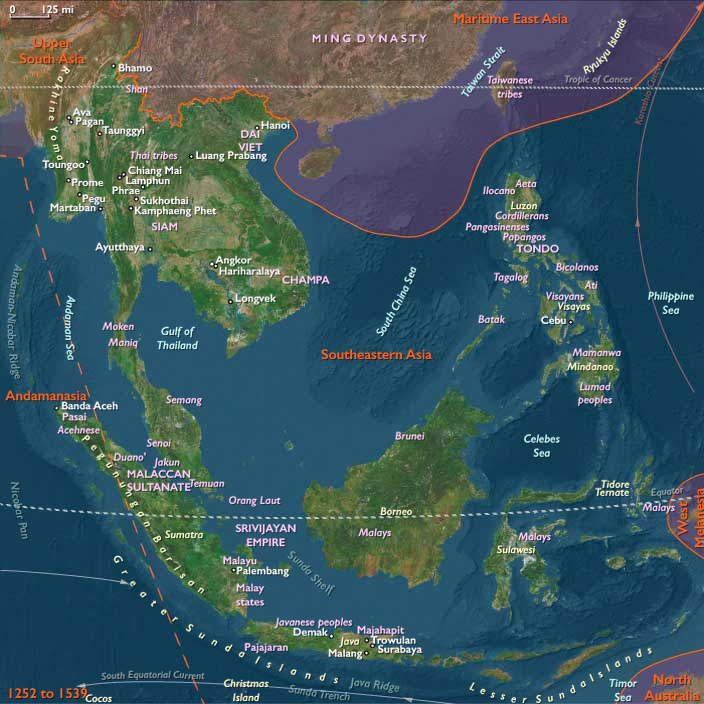
Southeast Asia
View →Subregions
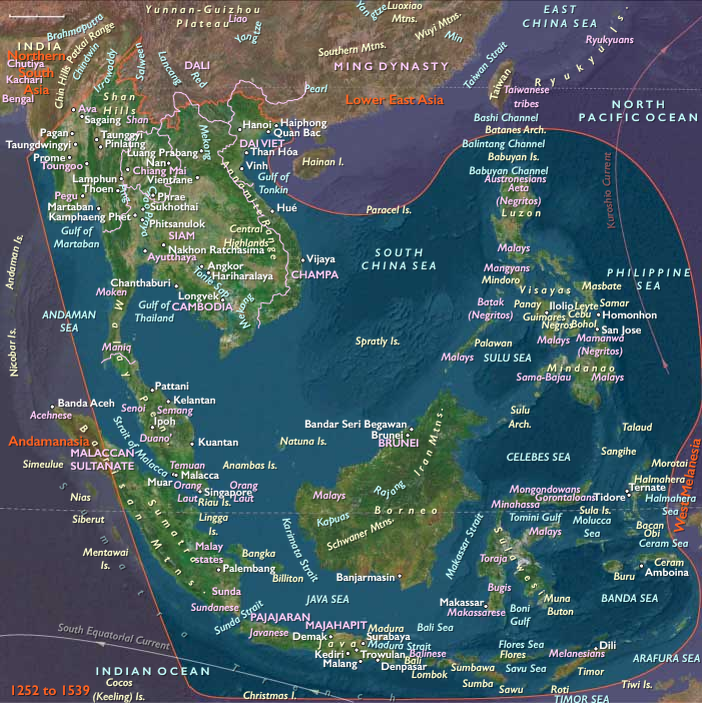
Southeastern Asia
View →Related Events
No active filters.
Showing 10 events out of 39359 total
Sultan Mahmud Shah, the younger brother of Sultan Alauddin Riayat Shah, rules the Sultanate of Malacca from 1488.
Upon his father's premature death, he had been installed at a very young age.
The regent at that time was the prime minister (Bendahara in Malay) Tun Perak.
During his initial years as a young adult, the sultan was known to be a ruthless monarch.
The administration of the sultanate was in the hands of an able and wise Tun Perak.
After the death of Tun Perak in 1498, he was succeeded by a new Prime Minister Tun Mutahir.
The death of Tun Perak is associated with the transformation of Sultan Mahmud into a more responsible ruler.
During Portuguese admiral Diogo Lopes de Sequeira's visit to Malacca from 1509–1510, the sultan had plannned to assassinate him.
However, Sequeira had learned of this plot and fled Malacca.
When the famous Portuguese naval officer Afonso de Albuquerque receives word of this, he decides to utilize this to embark upon his expeditions of conquest in Asia.
The Ayutthayans again invade Chiang Mai, unsuccessfully, in 1510.
Shah Ismail moves against the Uzbeks in 1510.
In battle near the city of Merv, some seventeen thousand Qizilbash warriors ambush and defeat a superior Uzbek force numbering twenty-eight thousand.
The Uzbek ruler, Muhammad Shaybani, is caught and killed trying to escape the battle and the shah has his skull made into a jeweled drinking goblet.
Vasili III continues the policies of his father Ivan III and will spend most of his reign consolidating Ivan's gains.
He begins in 1510 to annexes to Muscovy the last surviving autonomous provinces.
Arrived in Pskov in 1510, he pronounces it his votchina, or personal estate, thus putting an end to the Pskov Republic and its autonomous rights.
The city's ruling body, the Pskov Veche, is dissolved and some three hundred families of rich Pskovians are deported from the city.
Their estates are distributed among the Muscovite service class people.
From this time forward, the city of Pskov and the lands around it will continue to develop as a part of the centralized Russian state, preserving some of its economic and cultural traditions.
Hans Burgkmair the Elder was born in Augsburg, the son of painter Thomas Burgkmair and his son, Hans the Younger, has become one too.
From 1488, he was a pupil of Martin Schongauer in Colmar, who died during his two years there, before Burgkmair completed the normal period of training.
He may have visited Italy at this time, and certainly did so in 1507, which greatly influenced his style.
From 1491, he was working in Augsburg, where he became a master and opened his own workshop in 1498.
He is an important innovator of the chiaroscuro woodcut, and seems to have been the first to use a tone block, in a print of 1508.
Burgkmair, an accomplished fresco painter, also pioneers, with Jost de Negker, the development of woodcut chiaroscuro, which creates contrasts of light and shade by using two or more blocks inked with different tones.
His Lovers Surprised by Death (1510) is the first chiaroscuro print to use three blocks, and also the first print that is designed to be printed only in color, as the line block by itself would not make a satisfactory image.
Other chiaroscuro prints from around this date by Baldung and Cranach have line blocks that could be and are printed by themselves.
Hollstein ascribes eight hundred and thirty-four woodcuts to him, mostly for book illustrations, with slightly over a hundred being "single-leaf", that is prints not for books.
The best of them show a talent for striking compositions, and a blend, not always fully successful, of Italian Renaissance forms and underlying German style.
Ismail has conquered the whole of Iran and Azerbaijan, southern Dagestan (with its important city of Derbent), Mesopotamia, Armenia, Khorasan, and Eastern Anatolia by 1510, and has made the Georgian kingdoms of Kartli and Kakheti his vassals.
During the same year, Husayn Beg Shamlu loses his office as commander-in-chief in favor to Muhammad Beg Ustajlu, a man of humble origins.
Moreover, Ismail has also appointed Najm-e Sani as the new vakil of the empire due to death of Mas'ud Gilani.
The Portuguese, led by the viceroy himself, who is seeking to avenge the death of his son and free the Portuguese prisoners taken by the Mamluk fleet at Chaul in 1508, had fought back fiercely, and eventually succeeded in eliminating the Mamluk southern fleet at the Battle of Diu in 1509.
Mamluk resistance has prevented the Portuguese from blocking Red Sea trade completely.
However, interruption in supply is enough to force prices in Egypt to astronomical levels.
Fra Bartolommeo is established as the leading painter in Florence by 1510.
The influential Sandro Botticelli, who has apparently worked little since the 1494 expulsion of the Medici from Florence and seems to have suffered extreme financial hardship, dies at sixty-five on May 17, 1510.
Although Florentine painting began to move rapidly in new directions after 1500, Botticelli’s most gifted pupil, Filippino Lippi, son of his first teacher, had carried his style into the next generation.
Andrea del Sarto's San Filippo Benizzi fresco series, executed in 1510 for the atrium of Santissima Annunziata in Florence, owe their fantastic landscapes to the conservative style of Piero di Cosimo, who has has become known as a painter of charming mythological scenes such as Venus, Mars and Cupid, (now in the Gemäldegalerie, Berlin, Germany).
The haunting painting variously known as The Death of Procris, A Satyr mourning over a Nymph or simply as A Mythological Subject is an unsigned and undated panel painting in the National Gallery in London, United Kingdom, securely attributed to Piero di Cosimo (who never signs his works).
Its date is uncertain, and its subject has been a matter of dispute.
The name The Death of Procris (Italian: Morte di Procri) has been used since the nineteenth century, and is supposed to have been inspired by Ovid's tale of the death of Procris at the hands of her husband Cephalus, in Metamorphoses VII.
The National Gallery has rejected this title since at least Cecil Gould's catalogue of 1951, since when it has preferred to describe the subject as "A Mythological Subject" or "A Satyr mourning over a Nymph".
Despite the uncertainty surrounding the subject matter, the painting, which shows a satyr mourning over the body of a young woman, has been one of the most popular works by Piero di Cosimo.
Bramante constructs the important Palazzo Caprini, which will set the style for palace architecture for the next century.
Vittore Carpaccio’s Presentation of Christ in the Temple, along with his undated Two Courtesans, exemplify the painter’s lively use of light, his design, and his sharp, often witty, powers of observation.