
Tensions between Spain and Britain are high. …
Years: 1718 - 1718
August
Tensions between Spain and Britain are high.
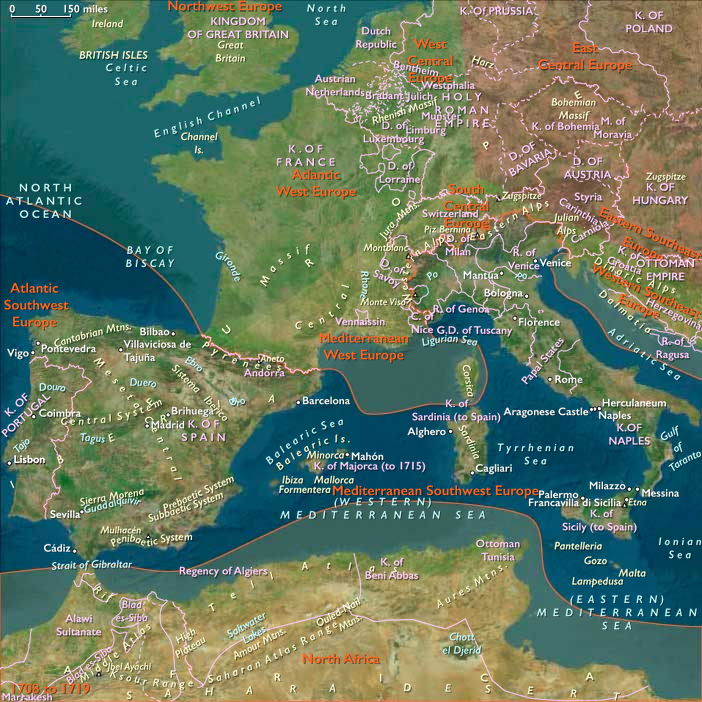
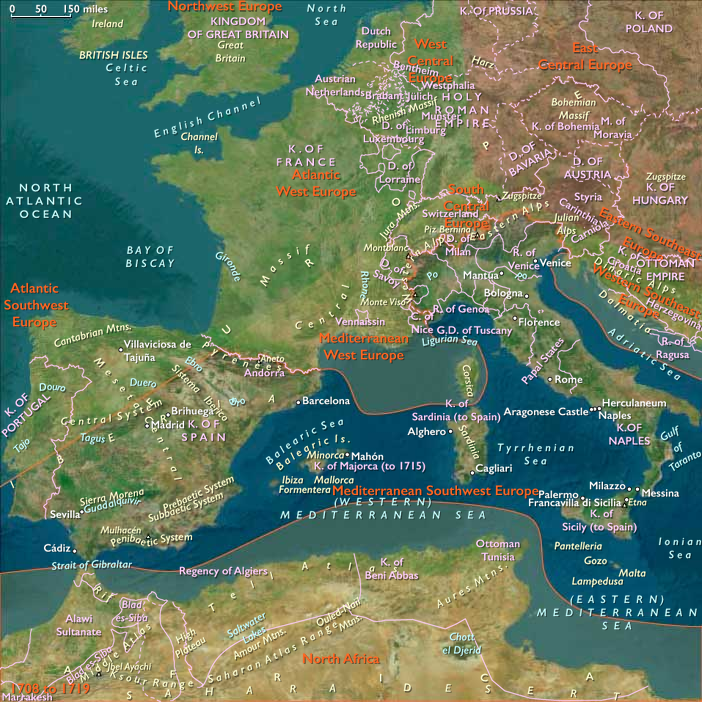
The Treaty of Passarowitz, which had finally ended the war with the Ottoman Empire on July 21, 1718, leads to the formation of the Quadruple Alliance, with the Emperor now joining the Triple Alliance on August 2, 1718.
A British fleet led by Sir George Byng on August 11 effectively eliminates the Spanish fleet stationed off Sicily at the Battle of Cape Passaro.
Locations
People
- Charles VI, Holy Roman Emperor, King of the Romans (King of Germany)
- Eugene of Savoy
- George Byng, 1st Viscount Torrington
- Jean François de Bette, 3rd Marquis of Lede
- José Carrillo de Albornoz, 1st Duke of Montemar
- Philip V of Spain
Groups
- Austria, Archduchy of
- Ottoman Empire
- Naples, Kingdom of
- Savoy, Duchy of
- France, (Bourbon) Kingdom of
- Habsburg Monarchy, or Empire
- Spain, Bourbon Kingdom of
- Britain, Kingdom of Great
- Triple Alliance (1717)
- Quadruple Alliance (1718)
Topics
Commodoties
Subjects
Regions
Subregions
Related Events
Filter results
Showing 10 events out of 28251 total
Charles XII, after returning from the Ottoman Empire and resuming personal control of the war effort, had initiated two Norwegian Campaigns, starting in February 1716, to force Denmark–Norway into a separate peace treaty.
Furthermore, he had attempted to bar Great Britain access to the Baltic Sea.
In a search for allies, Charles XII had also negotiated with the British Jacobite party.
This had resulted in Great Britain declaring war on Sweden in 1717.
The Norwegian campaigns had been halted and the army withdrawn when Charles XII was shot dead while besieging Norwegian Fredriksten, a fortress in the city of Halden, on November 30, 1718 (OS).
He is succeeded by his sister, Ulrika Eleonora.
The Cellamare Conspiracy and the War of the Quadruple Alliance (1718–1720)
The Cellamare Conspiracy (1718) confirmed France’s fears of Spanish aggression, as Philip V of Spain attempted to reclaim lost territories in Sardinia and Sicily, violating the Treaty of Utrecht (1713). This led to the formation of the Quadruple Alliance (1718)—an anti-Spanish coalition of Austria, France, Britain, and the Dutch Republic—which fought Spain in the War of the Quadruple Alliance (1718–1720).
Background: Spain’s Expansionist Ambitions Under Philip V
- Philip V, still seeking to reverse Spain’s losses from the War of the Spanish Succession, aimed to expand Spanish influence in Italy.
- In July 1718, Spanish forces seized Sardinia and Sicily, directly challenging the terms of the Peace of Utrecht.
- France, Austria, Britain, and the Dutch Republic saw this as a threat to European stability.
The Formation of the Quadruple Alliance (1718)
- In response to Spanish aggression, Austria, France, Britain, and the Dutch Republic formed the Quadruple Alliance to uphold the balance of power in Europe.
- The treaty aimed to force Spain to withdraw from Sardinia and Sicily.
- France, Britain, and Austria formally declared war on Spain on December 17, 1718.
- The Dutch Republic joined the war in August 1719.
Military Campaigns and Spain’s Defeat
✔ The Allies Occupied Sicily and Northern Spain
- Austrian forces landed in Sicily, engaging Spanish troops in a series of battles.
- British and French fleets secured naval dominance, isolating Spain’s forces.
- French troops invaded northern Spain, forcing Philip V onto the defensive.
✔ Spain Is Forced to Renounce Its Claims
- The war ended with Spain renouncing its claim to Sardinia and Sicily.
- Sardinia was given to Austria, while Sicily was transferred to the House of Savoy.
Conclusion: A Setback for Spanish Ambitions
The War of the Quadruple Alliance (1718–1720) halted Spain’s attempts to expand in Italy, reinforcing the balance of power established by the Treaty of Utrecht. The war:
✔ Weakened Spain’s military and diplomatic standing.
✔ Strengthened Britain, Austria, and France’s control over European affairs.
✔ Ensured that Spain remained isolated from major European alliances for decades.
Philip V’s aggressive policies backfired, reinforcing Habsburg and Bourbon dominance in Italy, while Spain struggled to recover from its diplomatic and military defeats.
The Cellamare Conspiracy and the War of the Quadruple Alliance (1718–1720)
The Cellamare Conspiracy (1718) confirmed France’s fears of Spanish aggression, as Philip V of Spain attempted to reclaim lost territories in Sardinia and Sicily, violating the Treaty of Utrecht (1713). This led to the formation of the Quadruple Alliance (1718)—an anti-Spanish coalition of Austria, France, Britain, and the Dutch Republic—which fought Spain in the War of the Quadruple Alliance (1718–1720).
Background: Spain’s Expansionist Ambitions Under Philip V
- Philip V, still seeking to reverse Spain’s losses from the War of the Spanish Succession, aimed to expand Spanish influence in Italy.
- In July 1718, Spanish forces seized Sardinia and Sicily, directly challenging the terms of the Peace of Utrecht.
- France, Austria, Britain, and the Dutch Republic saw this as a threat to European stability.
The Formation of the Quadruple Alliance (1718)
- In response to Spanish aggression, Austria, France, Britain, and the Dutch Republic formed the Quadruple Alliance to uphold the balance of power in Europe.
- The treaty aimed to force Spain to withdraw from Sardinia and Sicily.
- France, Britain, and Austria formally declared war on Spain on December 17, 1718.
- The Dutch Republic joined the war in August 1719.
Military Campaigns and Spain’s Defeat
✔ The Allies Occupied Sicily and Northern Spain
- Austrian forces landed in Sicily, engaging Spanish troops in a series of battles.
- British and French fleets secured naval dominance, isolating Spain’s forces.
- French troops invaded northern Spain, forcing Philip V onto the defensive.
✔ Spain Is Forced to Renounce Its Claims
- The war ended with Spain renouncing its claim to Sardinia and Sicily.
- Sardinia was given to Austria, while Sicily was transferred to the House of Savoy.
Conclusion: A Setback for Spanish Ambitions
The War of the Quadruple Alliance (1718–1720) halted Spain’s attempts to expand in Italy, reinforcing the balance of power established by the Treaty of Utrecht. The war:
✔ Weakened Spain’s military and diplomatic standing.
✔ Strengthened Britain, Austria, and France’s control over European affairs.
✔ Ensured that Spain remained isolated from major European alliances for decades.
Philip V’s aggressive policies backfired, reinforcing Habsburg and Bourbon dominance in Italy, while Spain struggled to recover from its diplomatic and military defeats.
Lady Mary Wortley Montagu had accompanied her husband to Vienna, and thence to Adrianople and Constantinople.
Edward had been recalled in 1717, but they remain until at Constantinople, where January 19, 1718, he has a daughter, who will grow up to be Mary, Countess of Bute.
The Montagus return to England after an unsuccessful delegation between the Austrian and Ottoman empires.
The Funj Sultanate of Sennar, at the peak of its power in the mid-seventeenth century, had repulsed the northward advance of the Nilotic Shilluk people up the White Nile and compelled many of them to submit to Funj authority.
After this victory, the mek Badi II Abu Duqn (1642-81) sought to centralize the government of the confederacy at Sannar.
To implement this policy, Badi had introduced a standing army of slave soldiers that would free Sannar from dependence on vassal sultans for military assistance and would provide the mek with the means to enforce his will.
The move has alienated the dynasty from the Funj warrior aristocracy, which in 1718 deposes the reigning mek and places one of their own ranks on the throne of Sennar.
Plague breaks out in Marseille in 1718.
The damage to dykes and sluices from the Christmas flood of 1717 is immense.
Survivors remain unaware of the fate of missing family members for a long time.
For example, of two hundred and eighty-four persons missing from Werdum in East Frisia, only thirty of them had been found by February 5, 1718.
The impact of this storm flood in the cold winter time—two days after this flood had come hard frost and snowfall—is worsened on the night of February 25 or 26 by another storm flood.
Two thousand six hundred and eighty slaves had been carried in 1714, and thirteen thousand for 1716–1718, but the trade continues to be unprofitable.
An import duty of thirty-three pieces of eight is charged on each slave, although for purposes of payment slaves are not counted individually, but might only be counted as part slaves according to quality.
Mortality among the slaves is higher than average among more experienced slavers.
One of the extra trade ships had been sent to Cartagena in 1714 carrying woolen goods, despite warnings there was no market for them there, and they had remained unsold for two years.
By the time of the next director's elections in 1718, politics has changed again, with a schism within the Whigs between Walpole's faction supporting the Prince of Wales and James Stanhope supporting the King.
Argyll and Towshend are dismissed as directors, as are surviving Tories Sir Richard Hoare and George Pitt, and King George I becomes Governor.
Four members of parliament remain directors, as do six people holding government financial offices.
The Sword Blade Company remains bankers to the South Sea, and indeed has flourished despite the company’s doubtful legal position.
Blunt remains a South Sea director, as does Sawbridge and they have been joined by Gibbon and Child.
Caswall has retired as a South Sea director to concentrate on the Sword Blade business.
Sub-Governor Bateman, then shortly after Deputy Governor Shepheard, both die in November 1718.
Leaving aside the honorary position of Governor, this leaves the company suddenly without its two most senior and experienced directors.
They are replaced by Sir John Fellowes as Sub-Governor and Charles Joyce as Deputy.
War breaks out in 1718 with Spain once again.
The company's assets in South America are seized, which the company claims cost it three hundred thousand pounds.
Any prospect of profit from trade, for which the company has purchased ships and has been planning its next ventures, disappears.
Peter Anthony Motteux, a native of Rouen, is a French Huguenot who had come to England in 1685 after the revocation of the Edict of Nantes.
At first making his living as an auctioneer, by 1706 he was maintaining a shop in Leadenhall Street, selling imports from China, Japan, and India, and (in his own words) "silks, lace, linens, pictures, and other goods."
He also holds a position with the Post Office in the first decade of the eighteenth century.
Among his miscellaneous works, A Poem in Praise of Tea (1701) is arguably the best known.
Motteux is perhaps best known for completing Sir Thomas Urquhart's translation of Rabelais' Gargantua and Pantagruel.
Books I and II of Urquhart's translation of Rabelais had been published in 1653; Motteux (with outside help) had revised these, completed Urquart's translation of Book III, and translated Book IV and the possibly spurious Book V. The entire work was published in 1693 and 1694 (reprinted in 1708; revised by John Ozell in 1737).
While Urquhart's original version of Rabelais has sometimes been acclaimed as a masterpiece in itself, critics have had reservations about Motteux's continuation.
In part, Motteux suffered for frankly rendering the vulgarity of Rabelais, to a generation of readers less prepared to tolerate it than Urquhart's had been.
Motteux produced an important translation of Cervantes' Don Quixote; this four-volume 1712 edition is credited as "translated from the original by many hands and published by Peter Motteux."
Very popular in its own era, Motteux's version of the work has been condemned by later, more rigorous translators, for: adopting a frivolous style, compared to the mock-serious and ironic tone of the original; turning Don Quixote and Sancho Panza into buffoons; casting the work in a "Franco-Cockney" rather than a Spanish ambience.
John Ormsby, in his Introduction to his own 1885 translation of the novel, will call Motteux's version "worse than worthless."
Motteux has translated other works as well, one example being The Present State of the Empire of Morocco (1695) by François Pidou de Saint-Olon.
Motteux's end is controversial, and may have constituted a case of autoerotic asphyxiation: "His death in a bawdy house was thought to be suspicious, and caused a good deal of legal disturbance."
(MacDonald, Hugh. John Dryden: A Bibliography of Early Editions and of Drydeniana. Oxford, Clarendon Press, 1939; reprinted Kessinger, 2006) Five people are tried for his murder, but are acquitted.
He is survived by his widow Priscilla, two sons and a daughter.
The Carolinas have participated in many wars against the Spanish and the natives, including the Yamasee and Cherokee tribes, throughout the Colonial Period.
The colony's plantations had been relatively small in its first decades and its wealth came from the IndianTrade, mainly in enslaved natives and deerskins.
The slave trade has affected tribes throughout the Southeast, and historians estimate that Carolinians exported twenty-four thousand to fifty-one thousand enslaved natives from 1670-1717, sending them to markets ranging from Boston to Barbados.
Planters have financed the purchase of enslaved Africans by their sale of natives.
After the pan-native alliance that had risen up against the settlers in the Yamasee War (1715-1717) and nearly destroyed the colony, the planters have turned exclusively to importing enslaved Africans for labor.
The various proto-Creek Muskogean tribes grow closer after the Yamasee War.
The reoccupation of the Chattahoochee River by the Ochese Creek, along with remnants of the Apalachicola, Apalachee, Yamasee, and others, seem to Europeans to represent a new native identity, and needs a new name.
It seems to the Spanish like a reincarnation of the Apalachicola Province of the seventeenth century.
To the English, the term Lower Creek becomes common.
Years: 1718 - 1718
August
Locations
People
- Charles VI, Holy Roman Emperor, King of the Romans (King of Germany)
- Eugene of Savoy
- George Byng, 1st Viscount Torrington
- Jean François de Bette, 3rd Marquis of Lede
- José Carrillo de Albornoz, 1st Duke of Montemar
- Philip V of Spain
Groups
- Austria, Archduchy of
- Ottoman Empire
- Naples, Kingdom of
- Savoy, Duchy of
- France, (Bourbon) Kingdom of
- Habsburg Monarchy, or Empire
- Spain, Bourbon Kingdom of
- Britain, Kingdom of Great
- Triple Alliance (1717)
- Quadruple Alliance (1718)
