The accession of Matthias Corvinus, the son…
1468 CE to 1479 CE
The accession of Matthias Corvinus, the son of John Hunyadi, in 1458, represented the first time in the history of the medieval Hungarian kingdom that a member of the nobility without dynastic ancestry mounted the royal throne.
John Hunyadi, although very prominent in the governing of the kingdom of Hungary, was never crowned king or contracted a dynastic marriage.
His son Matthias is a true Renaissance prince: a successful military leader and administrator, an outstanding linguist, a learned astrologer, and an enlightened patron of the arts and learning.
Although he regularly convenes the Diet and expands the lesser nobles' powers in the counties, he exercises absolute rule over Hungary by means of a huge secular bureaucracy.
Matthias had set out to build a realm that will expand to the south and northwest, while he also implements internal reforms.
The serfs consider Matthias a just ruler, because he protects them from excessive demands and other abuses by the magnates.
Like his father, Matthias desires to strengthen the kingdom of Hungary to the point where it can become the foremost regional power, indeed strong enough to push back the Ottoman Empire; towards that end he deems it necessary to conquer large parts of the Holy Roman Empire.
Hungary's Black Army, also called the Black Legion/Regiment—possibly after their black armor panoply—is a common name given to the military forces serving under the reign of King Matthias.
The ancestor and core of this early standing mercenary army had appeared in the era of his father John Hunyadi in the early 1440s.
The idea of the professional standing mercenary army had come from Matthias' juvenile readings about the life of Julius Caesar.
The Black Army traditionally encompasses the years from 1458 to 1494.
The mercenary soldiers of other countries in the era are conscripted from the general population at times of crisis, and soldiers work as bakers, farmers, brick-makers, etc.
for most of the year.
In contrast, the men of the Black Army fight as well-paid, full-time mercenaries and are purely devoted to the arts of warfare.
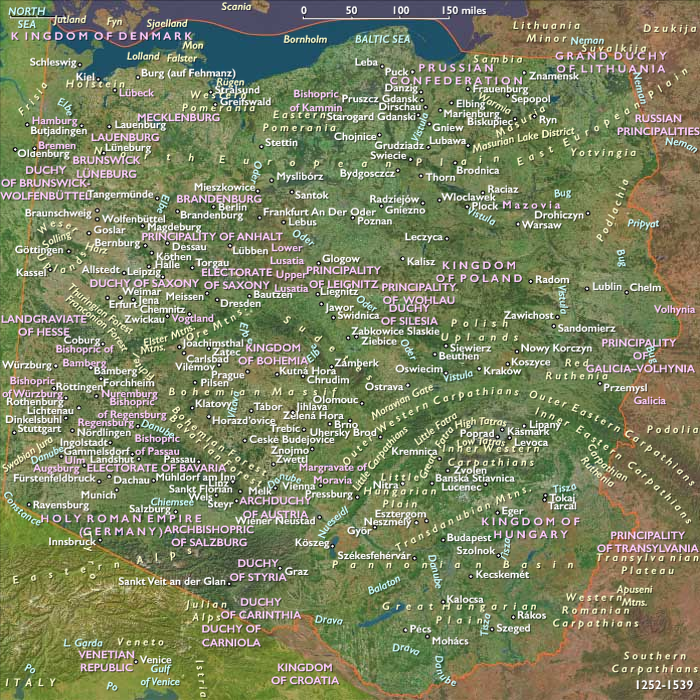
It is a standing mercenary army that conquers large parts of Austria (including the capital Vienna in 1485) and more than half of the Crown of Bohemia (Moravia, Silesia and both Lusatias).
Matthias recognizes the importance and key role of early firearms in the infantry, which greatly contributes to his victories.
Every fourth soldier in the Black Army has an arquebus in the infantry, which is an unusual ratio at this time.
The high price of medieval gunpowder prevents them from raising it any further.
Even a decade after the disbandment of the Black Army, by the turn of the sixteenth century, only around ten percent of the soldiers of Western European armies will us firearms.
The main troops of the army are the infantry, artillery and light and heavy cavalry.
The function of the heavy cavalry is to protect the lightly armored infantry and artillery, while the other corps delivers sporadic, surprise assaults on the enemy.
One important victory of the Black Army of Hungary is at the Battle of Breadfield against a combined Ottoman-Wallachian force.
Locations
People
Groups
Topics
Commodities
Subjects
Regions
Central Europe
View →Subregions