
Three peoples—Jews, Greeks, and Nabataeans—decisively affect the …
Years: 333BCE - 190BCE
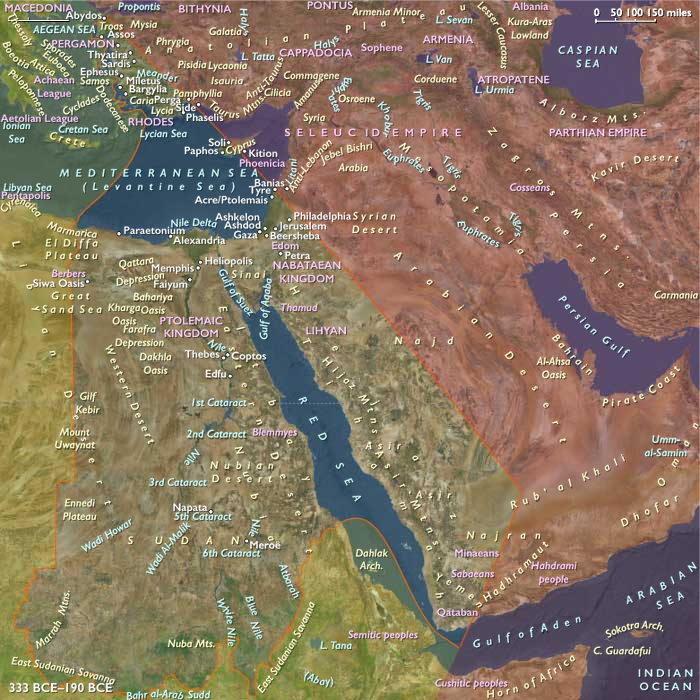
Three peoples—Jews, Greeks, and Nabataeans—decisively affect the history of Jordan between the third century BCE and the first century CE.
Jews, many of whom are returnees from exile in Babylonia, settle in southern Gilead.
Along with Jews from the western side of the Jordan and Jews who had remained in the area, they establish closely settled communities in what will later become known in Greek as the Perea.
The Greeks are mainly veterans of Alexander's military campaigns who fight one another for regional hegemony.
The Nabataeans are Arabs who had wandered from the desert into Edom in the seventh century BCE.
Shrewd merchants, they monopolize the spice trade between Arabia and the Mediterranean.
By necessity experts at water conservation, they also prove to be accomplished potters, metal- workers, stone masons, and architects.
They adopt the use of Aramaic, the Semitic lingua franca in Syria and Palestine, and belong entirely to the cultural world of the Mediterranean.
The Jordan region comes under the control of the Ptolemies in 301 BCE.
Greek settlers found new cities and revive old ones as centers of Hellenistic culture.
Amman is renamed Philadelphia in honor of the pharaoh Ptolemy Philadelphus.
Urban centers assume a distinctly Greek character, easily identified in their architecture, and prospered from their trade links with Egypt.
The East Bank is also a frontier against the rival dynasty of the Seleucids, who in 198 BCE displace the Ptolemies throughout Palestine.
Hostilities between the Ptolemies and Seleucids enable the Nabataeans to extend their kingdom northward from their capital at Petra (biblical Sela) and to increase their prosperity based on the caravan trade with Syria and Arabia.
Locations
People
Groups
- Semites
- Edomites, Kingdom of the
- Arab people
- Nabataeans
- Jews
- Greeks, Hellenistic
- Nabataean Kingdom
- Egypt, Ptolemaic Kingdom of
- Seleucid Empire
Commodoties
Subjects
Regions
Subregions
Related Events
Showing 10 events out of 64522 total
Years: 333BCE - 190BCE
Locations
People
Groups
- Semites
- Edomites, Kingdom of the
- Arab people
- Nabataeans
- Jews
- Greeks, Hellenistic
- Nabataean Kingdom
- Egypt, Ptolemaic Kingdom of
- Seleucid Empire
Commodoties
Subjects
Regions
Subregions