
News of Jane McCrea's death travels relatively …
Years: 1777 - 1777
August
News of Jane McCrea's death travels relatively quickly by the standards of the time.
News accounts are published in Pennsylvania on August 11 and on August 22 as far away as Virginia.
Often the accounts become more exaggerated as they travel, describing indiscriminate killings of large numbers of Loyalists and Patriots alike.
Burgoyne's campaign had intended to use the natives as a means to intimidate the colonists; however, the American reaction to the news is not the one hoped for.
The propaganda war receives a boost after Burgoyne writes a letter to the American general Horatio Gates, complaining about American treatment of prisoners taken in the August 17 Battle of Bennington.
Gates' response is widely reprinted:
That the savages of America should in their warfare mangle and scalp the unhappy prisoners who fall into their hands is neither new nor extraordinary; but that the famous Lieutenant General Burgoyne, in whom the fine gentleman is united with the soldier and the scholar, should hire the savages of America to scalp europeans and the descendants of europeans, nay more, that he should pay a price for each scalp so barbarously taken, is more than will be believed in England. [...] Miss McCrae, a young lady lovely to the sight, of virtuous character and amiable disposition, engaged to be married to an officer of your army, was [...] carried into the woods, and there scalped and mangled in the most shocking manner [...]
—Gates to Burgoyne
News accounts elaborate on her beauty, describing her as "lovely in disposition, so graceful in manners and so intelligent in features, that she was a favorite of all who knew her", and that her hair "was of extraordinary length and beauty, measuring a yard and a quarter".
One of the only contemporary accounts by someone who actually saw her was that of James Wilkinson, who describes her as "a country girl of honest family in circumstances of mediocrity, without either beauty or accomplishments."
Later accounts will embellish details; historian Richard Ketchum notes that the color of her hair has been described as everything from black to blonde to red; he also cites an 1840s examination of an alleged lock of her hair that described it as "reddish".
Her death, and those of others in similar raids, inspire some of the resistance to Burgoyne's invasion leading to his defeat at the Battle of Saratoga.
The effect will expand as reports of the incident are used as propaganda to excite rebel sympathies later in the war, especially before the 1779 Sullivan Expedition.
David Jones, apparently bitter over the experience, will never marry and will settle in Canada as a United Empire Loyalist.
The story will eventually become a part of American folklore.
An anonymous poet will write "The Ballad of Jane McCrea", which will be set to music and become a popular folk song.
In Philadelphia in 1799, Ricketts' Circus will perform "The Death of Miss McCrea", a pantomime co-written by John Durang, and John Vanderlyn will paint a portrait (shown upper right) in 1803.
Several markers will be placed in and near Fort Edward commemorating her death.
News accounts are published in Pennsylvania on August 11 and on August 22 as far away as Virginia.
Often the accounts become more exaggerated as they travel, describing indiscriminate killings of large numbers of Loyalists and Patriots alike.
Burgoyne's campaign had intended to use the natives as a means to intimidate the colonists; however, the American reaction to the news is not the one hoped for.
The propaganda war receives a boost after Burgoyne writes a letter to the American general Horatio Gates, complaining about American treatment of prisoners taken in the August 17 Battle of Bennington.
Gates' response is widely reprinted:
That the savages of America should in their warfare mangle and scalp the unhappy prisoners who fall into their hands is neither new nor extraordinary; but that the famous Lieutenant General Burgoyne, in whom the fine gentleman is united with the soldier and the scholar, should hire the savages of America to scalp europeans and the descendants of europeans, nay more, that he should pay a price for each scalp so barbarously taken, is more than will be believed in England. [...] Miss McCrae, a young lady lovely to the sight, of virtuous character and amiable disposition, engaged to be married to an officer of your army, was [...] carried into the woods, and there scalped and mangled in the most shocking manner [...]
—Gates to Burgoyne
News accounts elaborate on her beauty, describing her as "lovely in disposition, so graceful in manners and so intelligent in features, that she was a favorite of all who knew her", and that her hair "was of extraordinary length and beauty, measuring a yard and a quarter".
One of the only contemporary accounts by someone who actually saw her was that of James Wilkinson, who describes her as "a country girl of honest family in circumstances of mediocrity, without either beauty or accomplishments."
Later accounts will embellish details; historian Richard Ketchum notes that the color of her hair has been described as everything from black to blonde to red; he also cites an 1840s examination of an alleged lock of her hair that described it as "reddish".
Her death, and those of others in similar raids, inspire some of the resistance to Burgoyne's invasion leading to his defeat at the Battle of Saratoga.
The effect will expand as reports of the incident are used as propaganda to excite rebel sympathies later in the war, especially before the 1779 Sullivan Expedition.
David Jones, apparently bitter over the experience, will never marry and will settle in Canada as a United Empire Loyalist.
The story will eventually become a part of American folklore.
An anonymous poet will write "The Ballad of Jane McCrea", which will be set to music and become a popular folk song.
In Philadelphia in 1799, Ricketts' Circus will perform "The Death of Miss McCrea", a pantomime co-written by John Durang, and John Vanderlyn will paint a portrait (shown upper right) in 1803.
Several markers will be placed in and near Fort Edward commemorating her death.
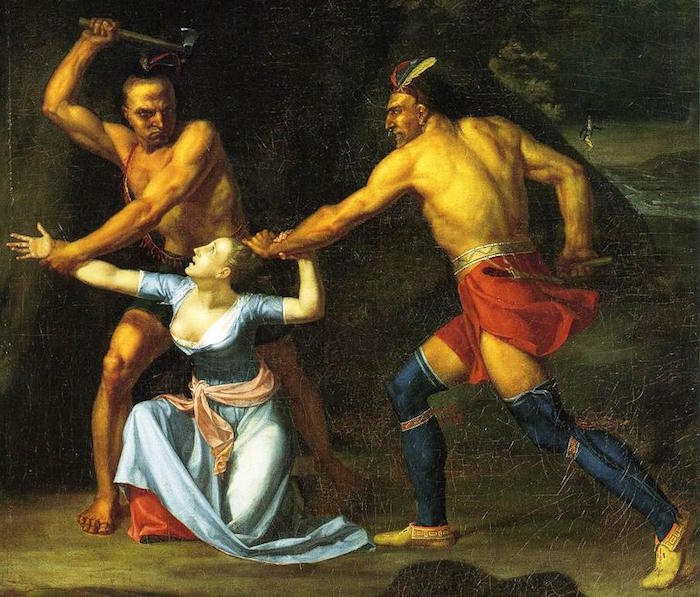
John Vanderlyn: The Death of Jane McCrea (1804) ) Oil on canvas. Wadsworth Atheneum, Hartford, Connecticut.
Locations
People
- Arthur St. Clair
- Barry St. Leger
- Friedrich Adolf Riedesel
- George Washington
- Guy Carleton, 1st Baron Dorchester
- Horatio Gates
- Israel Putnam
- James Wilkinson
- Jane McCrea
- John Burgoyne
- Luc de la Corne
- Philip Schuyler
- Seth Warner
- Simon Fraser
- William Phillips
Groups
- Iroquois (Haudenosaunee, also known as the League of Peace and Power, Five Nations, or Six Nations)
- Wyandot, or Wendat, or Huron people (Amerind tribe)
- Mississaugas (Amerind tribe)
- Meskwaki, or Fox tribe (Amerind tribe)
- Ojibwa, or Ojibwe, aka or Chippewa (Amerind tribe)
- Odawa, or Ottawa, people (Amerind tribe)
- Nipissing people (Amerind tribe)
- Hesse-Kassel, Landgraviate of
- Hessians
- Britain, Kingdom of Great
- British people
- Quebec (British Province)
- Patriots (American Revolution)
- Loyalists (American Revolution)
- United States of America (US, USA) (Philadelphia PA)
- New Hampshire, State of (U.S.A.)
- New York, independent state of
- Americans
- Vermont, Republic of
Topics
- American Revolution
- American Revolutionary War, or American War of Independence
- Bennington, Battle of
- Saratoga Campaign
Commodoties
Subjects
Regions

Subregions

Related Events
Showing 10 events out of 25428 total
Years: 1777 - 1777
August
John Vanderlyn: The Death of Jane McCrea (1804) ) Oil on canvas. Wadsworth Atheneum, Hartford, Connecticut.
Locations
People
- Arthur St. Clair
- Barry St. Leger
- Friedrich Adolf Riedesel
- George Washington
- Guy Carleton, 1st Baron Dorchester
- Horatio Gates
- Israel Putnam
- James Wilkinson
- Jane McCrea
- John Burgoyne
- Luc de la Corne
- Philip Schuyler
- Seth Warner
- Simon Fraser
- William Phillips
Groups
- Iroquois (Haudenosaunee, also known as the League of Peace and Power, Five Nations, or Six Nations)
- Wyandot, or Wendat, or Huron people (Amerind tribe)
- Mississaugas (Amerind tribe)
- Meskwaki, or Fox tribe (Amerind tribe)
- Ojibwa, or Ojibwe, aka or Chippewa (Amerind tribe)
- Odawa, or Ottawa, people (Amerind tribe)
- Nipissing people (Amerind tribe)
- Hesse-Kassel, Landgraviate of
- Hessians
- Britain, Kingdom of Great
- British people
- Quebec (British Province)
- Patriots (American Revolution)
- Loyalists (American Revolution)
- United States of America (US, USA) (Philadelphia PA)
- New Hampshire, State of (U.S.A.)
- New York, independent state of
- Americans
- Vermont, Republic of
Topics
- American Revolution
- American Revolutionary War, or American War of Independence
- Bennington, Battle of
- Saratoga Campaign
Commodoties
Subjects
Regions
Subregions