
The advance of the Ottoman Turks in …
Years: 1371 - 1371
The advance of the Ottoman Turks in Europe is a far more serious problem for Serbia—and the entire Balkans—than the internal squabbling of the Serbian nobles.
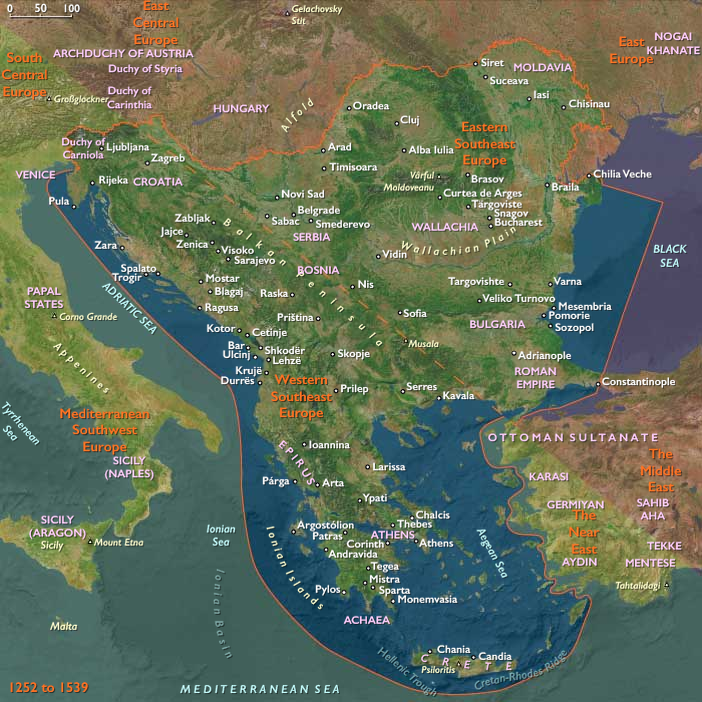
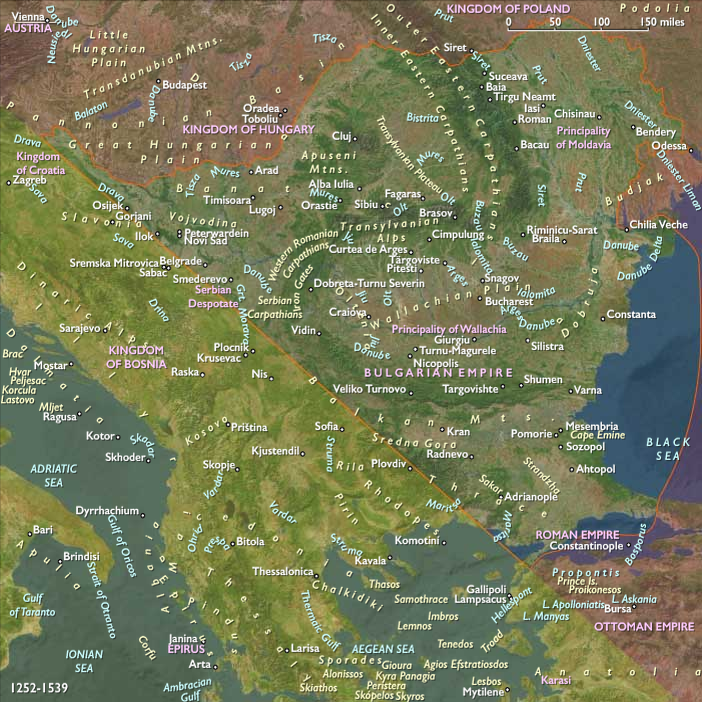
Following their acquisition of Gallipoli on the European side of the Dardanelles in 1354, the Ottoman Turks had expanded into Thrace, taking Demotika from the Greeks in 1361 and Philippopolis from the Bulgarians in 1363 and finally in 1369 the major city of Adrianople.
By 1370, Turks had occupied most of Thrace to the Rhodopes and to the Balkan Mountains.
As they reached the Rhodopes they collided with Jovan Uglješa, brother of Serbian co-king Vukašin, who has extended his realm beyond the Mesta into this territory, and the threat from them becomes increasingly serious.
Vukašin, the king of the southern Serbian lands, with his brother leads a Serb army against the advancing Ottoman Empire forces, led by the beylerbey of Rumeli Lala Şâhin Paşa, at the Battle of Maritsa on September 26, 1371.
The offensive against the Turks, originally scheduled for early 1371, had been delayed, perhaps because Uglješa had hoped that Bulgaria might also join the coalition.
King Vukašin and his son Marko had been preparing for action against Nicholas Altomanovich, intending to recapture Skadar (now Shkodër) for the Serbian Empire, when they were informed of a large Ottoman army advancing from the east.
Summoned to join up with Uglješa and his army, the Mrnjavčević brothers and their troop easily penetrate into what is supposedly Turkish territory and reach Cernomen on the Maritsa River, where the Serbs do not bother to post sentries or deploy scouts.
Furthermore, they have not kept their horses or their weapons in readiness.
The Serbian army numbers twenty thousand to seventy thousand men.
Most sources agree on the higher number.
Despot Uglješa wants to make a surprise attack on the Ottomans in their capital city, Adrianople, while Murad I is in Asia Minor.
The Ottoman army is much smaller.
Byzantine Greek scholar Laonikos Chalkokondyles and other sources give the number of eight hundred men, but due to superior tactics, by conducting a night raid on the Serbian camp, Şâhin Paşa is able to defeat the Serbian army and kill King Vukašin and despot Uglješa.
Thousands of Serbs are killed, and thousands drown in the Maritsa river when they try to flee.
After the battle, the Maritsa runs scarlet with blood.
The bodies of the two Serbian commanders are not found.
The battle involves such carnage that the field will later be referred to as “the Serbs' destruction.” Ottoman sultan Murad has thus increased his own confidence and demoralized his smaller enemies, who rapidly accept his suzerainty without further resistance.
The independent South Serbian kingdom is thus destroyed; its new ruler, Marko Kraljevic (“Mark, the King's Son”), the son of Vukashin and a chieftain of Prilep, becomes a vassal of Murad and retains a nominal independence.
Locations
People
Groups
- Greeks, Medieval (Byzantines)
- Serbs (South Slavs)
- Bulgarian Empire (Second), or Empire of Vlachs and Bulgars
- Serbia, Kingdom of
- Roman Empire, Eastern: Palaiologan dynasty
- Ottoman Empire
- Rumelia Eyalet
Topics
Commodoties
Subjects
Regions
Subregions
Related Events
Showing 10 events out of 43855 total
Years: 1371 - 1371
Locations
People
Groups
- Greeks, Medieval (Byzantines)
- Serbs (South Slavs)
- Bulgarian Empire (Second), or Empire of Vlachs and Bulgars
- Serbia, Kingdom of
- Roman Empire, Eastern: Palaiologan dynasty
- Ottoman Empire
- Rumelia Eyalet
Topics
Commodoties
Subjects
Regions
Subregions