Event
The earliest inscriptions of Semitic languages in…
The earliest inscriptions of Semitic languages in Eritrea and Ethiopia date to the ninth century BCE in Epigraphic South Arabian (ESA), an Abjad shared with contemporary kingdoms in South Arabia.
After the seventh and sixth centuries BCE, however, variants of the script arise, evolving in the direction of the Ge'ez abugida (a writing system that is also called an alphasyllabary).
This evolution can be seen most clearly in evidence from inscriptions (mainly graffiti on rocks and caves) in Tigray region in northern Ethiopia and the former province of Akkele Guzay in Eritrea.
By the first centuries CE, what is called "Old Ethiopic" or the "Old Ge'ez alphabet" arises, an abjad written left-to-right (as opposed to boustrophedon like ESA) with letters basically identical to the first-order forms of the modern vocalized alphabet (e.g. "k" in the form of "kä").
There are also minor differences such as the letter "g" facing to the right, instead of to the left as in vocalized Ge'ez, and a shorter left leg of "l", as in ESA, instead of equally-long legs in vocalized Ge'ez (resembling the Greek letter lambda, somewhat).
Vocalization of Ge'ez occurs in the 4th century, and though the first completely vocalized texts known are inscriptions by Ezana, vocalized letters predate him by some years, as an individual vocalized letter exists in a coin of his predecessor Wazeba.
According to the beliefs of the Eritrean Orthodox Tewahedo Church and Ethiopian Orthodox Tewahedo Church, the original consonantal form of the Ge'ez fidel was divinely revealed to Henos "as an instrument for codifying the laws", and the present system of vocalization is attributed to a team of Aksumite scholars led by Frumentius (Abba Selama), the same missionary said to have converted the king Ezana to Christianity in the fourth century CE.
It has been argued that the vowel marking pattern of the script reflects a South Asian system, such as would have been known by Frumentius.
A separate tradition, recorded by Aleqa Taye, holds that the Ge'ez consonantal alphabet was first adapted by Zegdur, a legendary king of the Ag'azyan Sabaean dynasty held to have ruled in Ethiopia around 1300 BCE.
-
{# Image navigates to the detail page; the magnifying-glass chip is the only Fancybox lightbox trigger (kept a separate sibling — anchors can't nest). #}
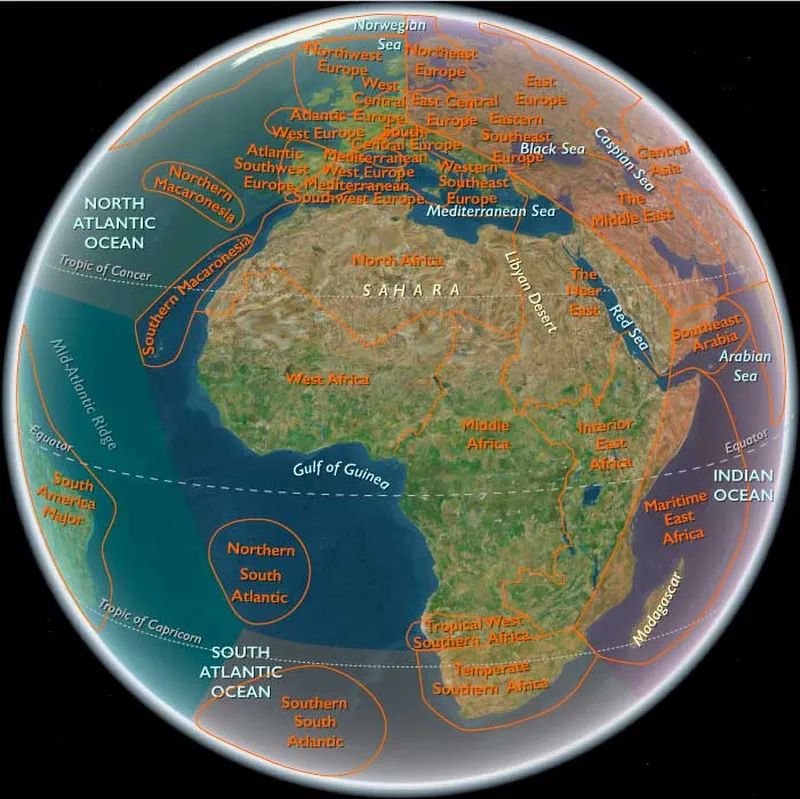 The Middle of The Earth
World
-
{# Image navigates to the detail page; the magnifying-glass chip is the only Fancybox lightbox trigger (kept a separate sibling — anchors can't nest). #}
 East Africa
Region
-
{# Image navigates to the detail page; the magnifying-glass chip is the only Fancybox lightbox trigger (kept a separate sibling — anchors can't nest). #}
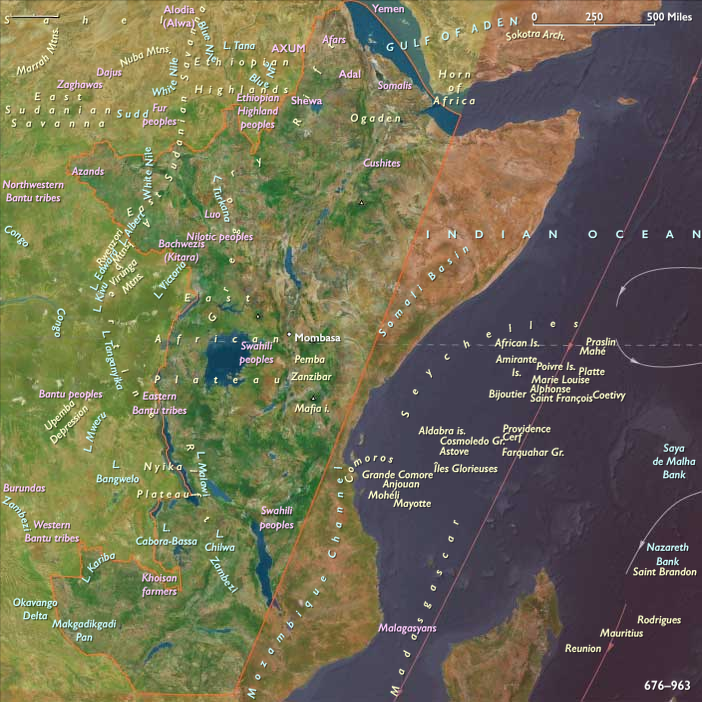 Interior East Africa
Subregion