The aim of Emperor Francis had been…
1840 CE to 1851 CE
To accomplish the first, he had issued a new penal code in 1803 and a new civil code in 1811, expecting that the second—material well-being—would evolve naturally with the reestablishment of peace, and he considered additional measures unnecessary.
Political and cultural life was kept under careful scrutiny, however, to prevent the spread of nationalism and liberalism.
These two movements had been a common threat to Francis's conservative regime because his political opponents looked to the establishment of a unified German nation-state incorporating Austria as a means for realizing the liberal reforms impossible in the framework of the Habsburg state.
Political stagnation, however, has not prevented prevent broader socioeconomic changes in the empire.
By 1843 the population has risen to 37.5 million, an increase of forty percent from 1792.
The urban population is rising quickly, and Vienna counts nearly four hundred thousand inhabitants.
Economically, a degree of stability has been reached, and the massive wartime deficits have given way to almost balanced budgets.
This has been made possible by cutting state expenditures to a level near actual revenues, and not by instituting fiscal reforms to increase tax revenues.
Austria's ability to protect its interests abroad or carry out domestic programs thus continues to be severely restrained by lack of revenue.
Locations
Groups
Topics
Subjects
Regions
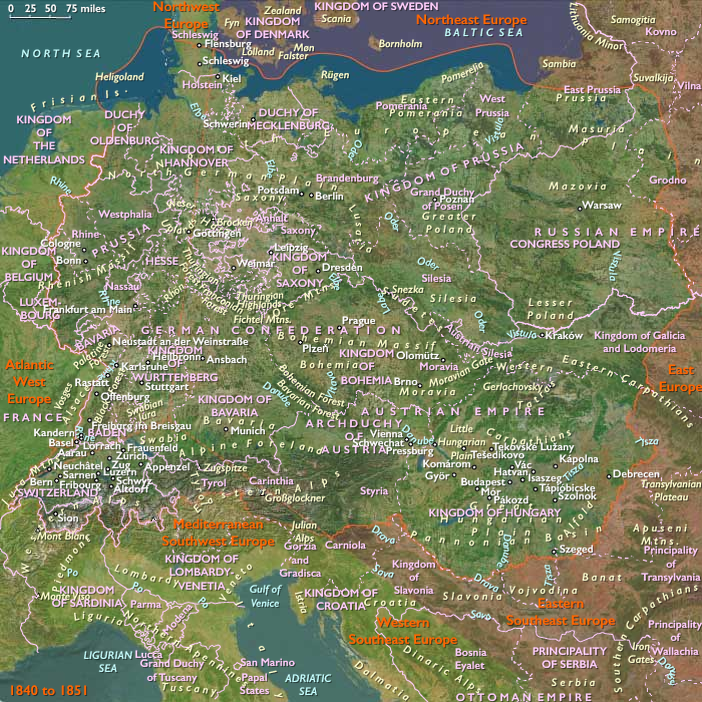
Central Europe
View →Subregions