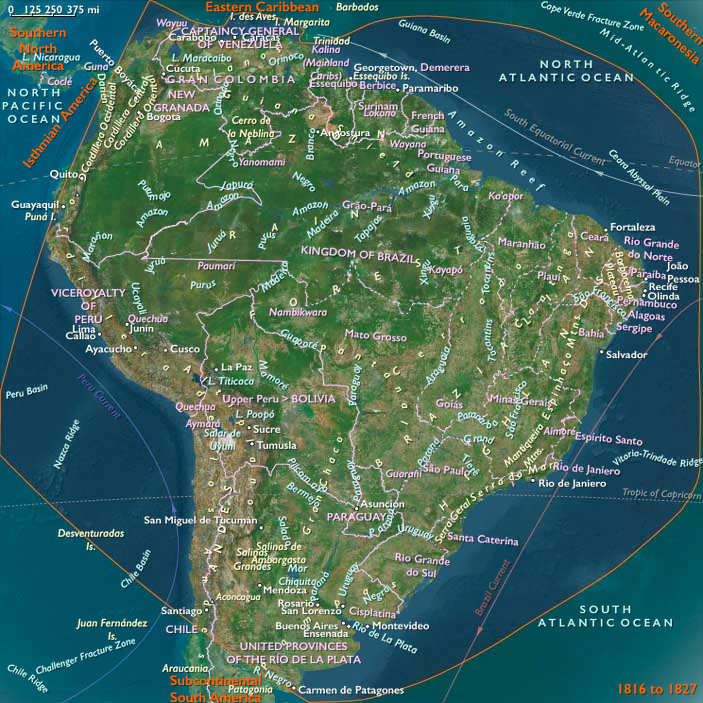
The Pernambucan revolt of 1817 is sparked…
1817 CE
The Pernambucan revolt of 1817 is sparked mainly by the decline of sugar production in the province of Pernambuco in the Northeastern region of Brazil.
Other important reasons for the revolt include the ongoing struggle for the independence of Spanish colonies all over in South America; the independence of the United States; the generally liberal ideas that had come through all of Brazil the century before, including many French philosophers, such as Charles Montesquieu and Jean-Jacques Rousseau; the actions of secret societies, which insist on the liberation of the colony; and the development of a distinct culture in Pernambuco.
The governor of Pernambuco, Caetano Pinto de Mirando Montenegro, has some knowledge of the plans of the revolutionaries, and thus sends out to arrest the primary leaders in the plot.
These revolutionaries anticipate the danger to the movement, which begins after the Pernambucan capitan, José de Barros Lima (nicknamed the Crowned Lion), kills the Portuguese officer assigned to arrest him.
The revolutionaries organize a provisional government, with the leader aiming to extend the movement to other capitanias and obtain recognition from other nations.
Although a republic is declared, there are no measures adopted to abolish slavery.
The Consulate General of the United States in Recife, America’s oldest diplomatic post in the Southern Hemisphere, publicly supports the Pernambucan revolutionaries.
The revolt extends to Ceará, Paraíba and to Rio Grande do Norte, but is only able to survive two months before Recife is surrounded by sea and land by troops of the Portuguese monarch.
The revolution, soon after, is dismantled.
Before the fall of the movement, the revolutionaries had sought out the support of the United States, Argentina and England, without success.
Known casualties of the conflict include the eventual execution of the rebel leaders: Domingos José Martins, José Luis de Mendonça, Domingos Teotônio Jorge and the Catholic priests Miguelinho and Pedro de Sousa Tenório.
The corpses of the condemned are later mutilated by having their hands and heads cut off.
Other corpses are dragged by their heads to a burial ground.
This revolution is notable for being one of the first attempts to establish an independent government in Brazil, as it had been preceded by the Inconfidência Mineira.
Locations
Groups
Regions
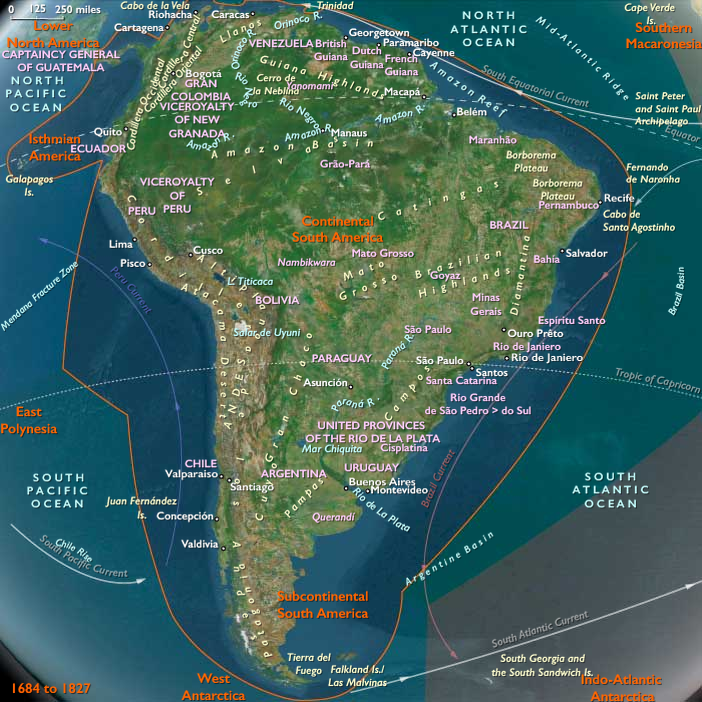
South America
View →Subregions