
The Arabs of Palestine have, like the…
January 1940 CE
The Arabs of Palestine have, like the Jews, increased under the mandate (through high birth rates and immigration) from about four hundred and forty thousand to roughly one million in 1940.
Groups
Topics
Commodities
Regions
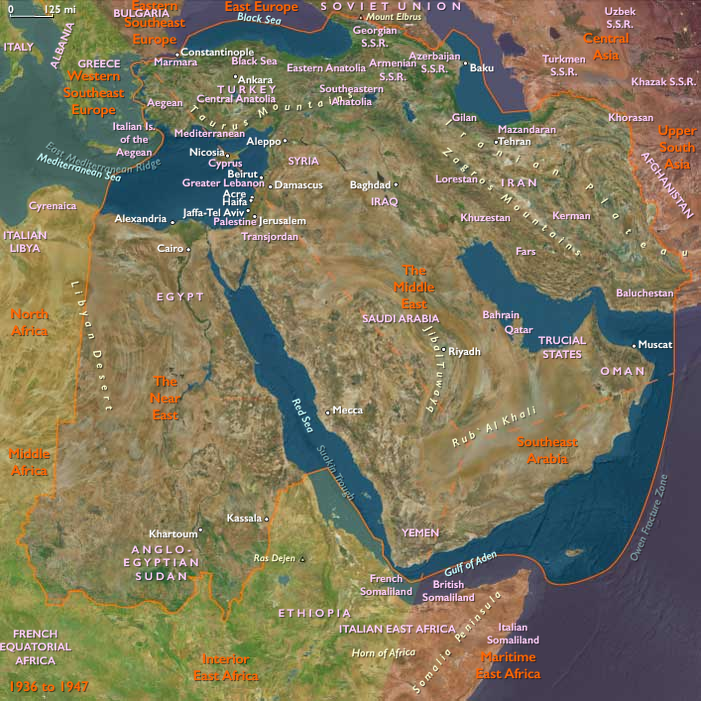
The Near and Middle East
View →Subregions
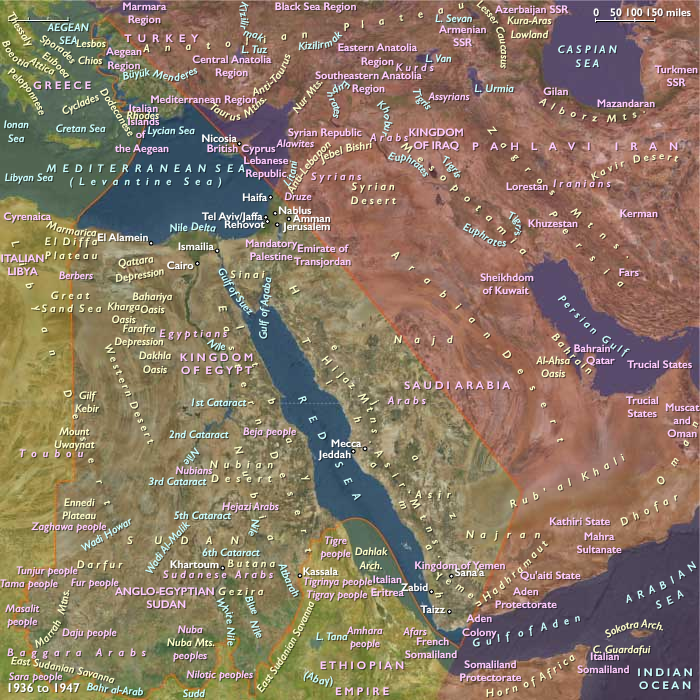
Near East
View →Related Events
No active filters.
Showing 10 events out of 5755 total
Luang Pibul Songgram, in 1940, demands of France the return of some territories controlled by French Indochina.
French rejection results in fighting over the disputed territories.
By 1940, Japan has subjugated Vietnam, forcing emperor Bao Dai to collaborate with the army of occupation.
In August 1940, the French Vichy government acquiesces to Japan’s insistence that that aid through French Indochina be terminated and that Japan be permitted to use Indochinese air bases.
Japanese troops move into northern Indochina in September.
In September 1940, US President Roosevelt imposes an embargo on US exports of scrap iron and steel to Japan, thus crippling Japans’ war machine and dashing Japanese prime minster Prince Konoe Fukimaro’s hopes that the US will accept this latest round of Japanese expansion.
On September 27, 1940, Japan, Italy and Germany sign a 10-year military and economic alliance, the Tripartite Pact, known as the Berlin-Rome-Tokyo Axis.
Japan call on the beleaguered British, curently fighting for their lives, to close the Burma Road to supplies bound for China.
Japan presses the Netherlands government-in-exile in London for economic and political concessions in the Dutch East Indies.
The first well at Dukhan Field, today a large petroleum-producing field extending over an area of approximately eighty kilometers in Qatar, is drilled in 1939/1940.
At its annual session in Lahore's Minto Park (popularly known as Iqbal Park) on March 23, 1940, the Muslim League resolves that the areas of Muslim majority in northwestern and eastern India should be grouped together to constitute independent states-autonomous and sovereign-and that any independence plan without this provision is unacceptable to Muslims.
Federation is rejected.
The 'Pakistan Resolution,' moved by the Chief Minister of Bengal Maulvi Fazal-ul-Haq, is unanimously passed by the participants.
(Although the Lahore Resolution is often referred to as the "Pakistan Resolution", the word Pakistan does not appear in it.)
The Hindu leaders condemn it and refer to the partition as the 'vivisection of Mother India'.
An interesting aspect of the Pakistan movement is that it receives its greatest support from areas in which Muslims are a minority.
In those areas, the main issue is finding an alternative to replacing British rule with Congress, that is, Hindu, rule.
Congress, predictably opposing all proposals for partition, advocates a united India with a strong center and a fully responsible parliamentary government.
To many, notably to Jawaharlal Nehru, the idea of a sovereign state based on a common religion seems a historical anachronism and a denial of democracy.
From 1940 on, reconciliation between Congress and the Muslim League nearly impossible.
The Soviets, using their best troops, crush the Finns’ spirited and, at first, effective resistance by March 1940.
Interpol moves, in 1940, near to Berlin, with Reinhard Heydrich in charge.
In 1940, the Soviets annex the Baltic countries—Estonia, Latvia and Lithuania—and part of Romania.
The Cliveden Set strategy is temporarily thwarted.
By June, the Axis controls an uninterrupted stretch of territory from North Africa to the Arctic.
The Nazis confine more than 400,000 Jews to the already-crowded Warsaw ghetto.
About 300,000 more are deported to concentration camps.
The Soviets, eyeing Romania’s rich oil reserves, seize Bessarabia and northen Bucovina in June 1940, a move that doesn’t sit well with Hitler.
In August, Hitler orders Romania to transfer land to Bulgaria and Hungary; in September, he forces King Carol II to abdicate the Romanian throne.
Hitler incorporates Romania and Hungary into the Axis alliance, then turns his attentions to Bulgaria and Yugoslavia.
The Nazis allegedly begin building Hitler's secret hideout in Antarctica in 1940.
The Moslem League under Mohammed Ali Jinnah, in 1940, pledges support for the British war effort and demands that a separate Moslem country (Pakistan) eventually be carved from India.
On September 27, 1940, Japan, Italy and Germany sign a 10-year military and economic alliance, the Tripartite Pact, known as the Berlin-Rome-Tokyo Axis.
Hitler, believing a battered and isolated Britain to be hors de combat, begins full-scale preparations in December 1940 for a mid-May invasion of the USSR called Operation Barbarossa.
In early 1940, the Nazis had established the first forced-labor camp for Polish Jews in and near the village of Belzec along the Lublin-Lviv railway line in the Lublin province of German-occupied Poland, and by autumn of this year there are three camps in the village itself and a number of satellite camps in surrounding areas, accommodating more than 11,000 prisoners at a time.
Hundreds die from overwork, starvation, disease, and brutal living conditions.
The camps are closed in December 1940, and the population dispersed.
In 1940, young lawyer B. Johannes Vorster, leader of a fascist organization in South Africa, is interned for the duration of the war because of his pro-Nazi sentiments, .
Germany takes France in May of 1940 and sets up the Vichy Republic.
English writer Graham Greene writes his early novels from a strong Roman Catholic perspective.
Richard Wright deals with racial prejudice in his 1940 novel, “Native Son.
“ Attorney Leon Cooke, a friend of Jack Ruby and financial secretary of the union which employs Ruby, is allegedly killed by union president Jack Martin in 1940.
The union is subsequently taken over by the Mafia.
Hitler, after the six-month lull of the “phony war”, turns his attentions to Scandinavia to access Swedish iron ore and secure a valuable source of foods such as dairy priducts anf fish while depriving the British of same.
On April 9, 1940, German forces pour across the Danish border and quickly overwhelm the Danes, who soon capitulate.
Concurrent with their invasion of Denmark, a German naval task force enters Oslo Fjord while the Luftwaffe strikes Oslo’s airport and drops troops and guns to the ground.
British prime minister Neville Chamberlain falls from grace, to be replaced on May 10 by appeasement opponent and reputed Cliveden tool Winston Churchill, who, in a radio address three days later, offers Britons nothing but “blood, toil, tears and sweat” in their battle against Nazi Germany.
Hitler seeks control of the vast industrial bases and potential assault bases in the Low Countries.
On May 10, 1940, Germany invades and occupies Belgium, the Netherlands and Luxembourg.
Undefended Luxembourg capitulates immediately; Belgium and the Netherlands fight back.
The Dutch, assistance from the French and British expeditionary forces coming too little and too late, are overwhelmed in 5 days; Queen Wilhelmina flees to England.
On May 13, the Germans establish a bridgehead at Sedan, the gateway to France, then invade in force three days later by outflanking the Maginot Line and attacking through the forested Ardennes rather than the Belgian plain.
The Belgians last only two weeks longer than the Dutch in the face of German tanks and paratroopers, but follow Leopold III’s orders to lay down their arms in unconditional surrender on May 28.
The German army advances quickly into northern France.
Still hopeful of a settlement with Britain, Hitler spares Britain's retreating army at Dunkirk (Dunkerque), evacuated by an impromptu armada and protected from German bombers by Royal Air Force (RAF) fighters while French First Army troops fend off the Nazi forces in a fierce rearguard action.
British and French aid to Norwegian resistance proves insufficient, in that the Allied troops succeed only in seizing Narvik after a month-long battle; upon the Allied withdrawal on June 9, the German invasion of Norway is complete.
Mussolini declares war on the Allies on June 10, invading southern France in what Roosevelt terms a “stab-in-the-back”.
In an unparalleled evacuiation effort, the makeshift British transport fleet pulls about 338,000 British, French and Belgian troops from Dunkirk between May 26 and June 14.
The Germans launch another offensive southward from the Somme, enter Paris unopposed on June 14 and force an armistice upon France at Compiegne on June 22, 1940.
The Germans then occupy most of northern and central France and establish the Vichy Republic under Great War hero Marshal Henri Petain and collaborationist Pierre Laval.
General Charles De Gaulle proclaims himself leader of the Free French, drawing French patriots to his ranks.
Britain shuns Hitler’s July peace overtures.
Goering’s Luftwaffe launches Operation Sea Lion, an all-out attack on British airfields, ports and industrial centers in August, then concentrates its attack on London in the Battle of Britain, history’s first great air battle.
An average 160 German bombers attack London for 57 consecutive nights, losing 1,733 aircraft to the outnumbered RAF’s 915 fighters.
In October, Hitler indefinitely postpones the invasion.
Plutonium, the first of the artificial elements, is produced in 1940.
In 1940, the British secret police are renamed MI-5 and MI-6 for the duration of the war.
Radar is used for the first time during the 1940 Battle of Britain.
Roosevelt and the US Congress begin war preparations.
Roosevelt sends Gen. William "Wild Bill" Donovan on an info-gathering mission to Europe in 1940; Donovan recommends the creation of a central intelligence organization.
The US State Deptartment creates the Division of Special Research headed by CFR member Pasbolsky.
The first peacetime draft law in US history, passed in September 1940, provides for the registration of 17 million men.
The US passes the Alien Registration Act of 1940 to curb subversive activities.
On September 22, 1940, eighty-four year old inventor Nikola Tesla tells a New York Times reporter “that he stands ready to divulge to the United States Government the secret of his “teleforce” with which,…airplane motors would be melted at a distance of 250 miles, so that an invisible Chinese Wall of Defense would be built around this country…”.
“This teleforce…is based on an entirely new principle of physics that “no one has ever dreamed about” [and] “would operate through a beam one one hundred millionth of a square centimeter in diameter, and could be generated from a special plant that would cost no more than $2,000,000 and would take only three months to construct.” The United States resurrected the Invention Secrecy Act in 1940.
The US donates 50 overage destroyers to the British navy in exchange for 8 air bases in British possession, the first step in the transfer of empire from the Crown to the White House.
Britain’s air defenses serve Hitler his first reversal in the fall 1940 Battle of Britain and force him to abandon his plans to invade the island.
U-boat “wolf-packs” and long-range bombers have dramatically increase British shipping losses in the last half of 1940.
The Hollywood film industry, following a pattern established in the Great War, cranks out reels and reels of pro-Allied propaganda films.
Hollywood expands beyond its staple genre films of gangsters, cowboys and romance with Orson Welles’s Citizen Kane.and John Ford’s adaptation of Steinbeck’s The Grapes of Wrath.
The Pasadena freeway, the first in America, opens in 1940.
Leon Trotsky is assassinated in Mexico in 1940.