
The art of rocketry has begun to…
1268 CE
The art of rocketry has begun to appear in the Middle East and Europe.
Roger Bacon describes the preparation of gunpowder specifying 41.2 parts saltpeter, 29.4 parts charcoal, and 29.4 parts sulfur.
He also successfully distills saltpeter—an oxygen-producing ingredient—to achieve the faster rates of burning that make rockets more practicable.
At the request of Pope Clement IV, Bacon has prepared three works, the Opus maius, Opus minus, and Opus tertium, in which he outlines proposals for a reform of education, arguing that a study of the natural world using observation and exact measurement is the surest foundation for a knowledge of the world's creator.
He recommends the replacement of the current university curriculum with the study of languages, mathematics, alchemy, and experimental sciences—especially optics.
Opus Majus contains wide-ranging discussion of mathematics, optics, alchemy, astronomy, astrology, and other topics, and includes what some believe to be the first description of a magnifying glass.
In Opus majus, Bacon uses the term “almanac” to denote permanent tables showing the movements of the stars and planets.
Although almanacs were compiled in ancient times, the term itself may be derived from the Spanish-Arabic almanakh (manakh, "calendar"; manah, "sundial").
Locations
Commodities
Subjects
Regions
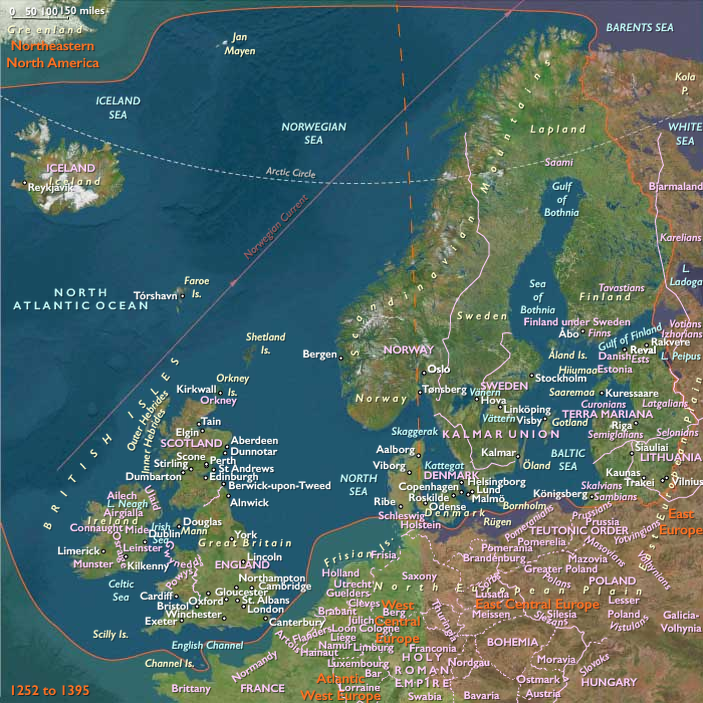
North Europe
View →Subregions
