
Filters:
The prospect of fighting in Western Germany …
Years: 1756 - 1756
August
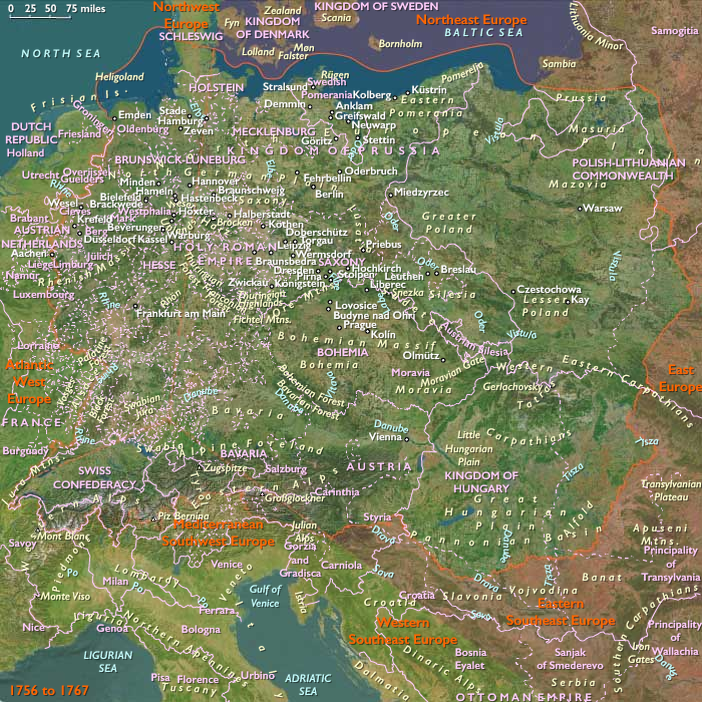
The prospect of fighting in Western Germany coincides with a dispute between Austria and Prussia, who go to war in August 1756.
Most of the states of the Holy Roman Empire—reluctantly, by following the imperial diet—join Austria's cause.
The Anglo-Prussian alliance is joined by smaller German states (especially Hanover).
The British attempt to persuade the Dutch Republic to join the alliance, but the request is rejected, as the Dutch wish to remain fully neutral.
The French leadership, following the outbreak of the first fighting between Britain and France in North America in 1754, had seen that the limited population, troops and resources available in French Canada meant it would ultimately fall to the British if the war was prolonged, and has decided to try and gain an equivalent in Europe to exchange for Canada at the negotiating table.
Britain and the Electorate of Hanover have shared a single monarch since 1714.
George II is ruler of both states—and the French believe they can exert pressure on him as King of Great Britain by occupying Hanover.
In response, Britain had initially planned to hire fifty thousand Russian troops to defend Hanover but later altered the plan by making an alliance with Prussia and forming an Army of Observation composed of Hanoverian, Brunswick and Hessian troops mostly paid for by the British government.
A number of British officers, such as Jeffrey Amherst and Guy Carleton, have been given commands in the force, which has been placed under the overall command of Prince William Augustus, Duke of Cumberland, second son of George II.
The name Army of Observation expresses a hope that the army will serve as a deterrent and their role will merely be to observe.
In early 1756, when a French invasion of the British Isles seemed imminent, many of the Hanoverian and Hessian troops had been shipped to southern England to boost its defenses.
As the threat of invasion subsided, the troops were then shipped back to Germany again.
Most of the states of the Holy Roman Empire—reluctantly, by following the imperial diet—join Austria's cause.
The Anglo-Prussian alliance is joined by smaller German states (especially Hanover).
The British attempt to persuade the Dutch Republic to join the alliance, but the request is rejected, as the Dutch wish to remain fully neutral.
The French leadership, following the outbreak of the first fighting between Britain and France in North America in 1754, had seen that the limited population, troops and resources available in French Canada meant it would ultimately fall to the British if the war was prolonged, and has decided to try and gain an equivalent in Europe to exchange for Canada at the negotiating table.
Britain and the Electorate of Hanover have shared a single monarch since 1714.
George II is ruler of both states—and the French believe they can exert pressure on him as King of Great Britain by occupying Hanover.
In response, Britain had initially planned to hire fifty thousand Russian troops to defend Hanover but later altered the plan by making an alliance with Prussia and forming an Army of Observation composed of Hanoverian, Brunswick and Hessian troops mostly paid for by the British government.
A number of British officers, such as Jeffrey Amherst and Guy Carleton, have been given commands in the force, which has been placed under the overall command of Prince William Augustus, Duke of Cumberland, second son of George II.
The name Army of Observation expresses a hope that the army will serve as a deterrent and their role will merely be to observe.
In early 1756, when a French invasion of the British Isles seemed imminent, many of the Hanoverian and Hessian troops had been shipped to southern England to boost its defenses.
As the threat of invasion subsided, the troops were then shipped back to Germany again.
Locations
People
- George II of Great Britain
- Guy Carleton, 1st Baron Dorchester
- Jeffery Amherst, 1st Baron Amherst
- Prince William, Duke of Cumberland
Groups
- Austria, Archduchy of
- Brunswick-Wolfenbüttel, Duchy of
- Saxony, Electorate of
- Holy Roman Empire
- Hesse-Kassel, Landgraviate of
- Netherlands, United Provinces of the (Dutch Republic)
- France, (Bourbon) Kingdom of
- Bavaria, Electorate of
- Brunswick-Lüneburg, Electorate of (Electorate of Hanover)
- Spain, Bourbon Kingdom of
- Prussia, Kingdom of
- Britain, Kingdom of Great
- Russian Empire
Topics
Subjects
Regions
Subregions

Years: 1756 - 1756
August
Locations
People
- George II of Great Britain
- Guy Carleton, 1st Baron Dorchester
- Jeffery Amherst, 1st Baron Amherst
- Prince William, Duke of Cumberland
Groups
- Austria, Archduchy of
- Brunswick-Wolfenbüttel, Duchy of
- Saxony, Electorate of
- Holy Roman Empire
- Hesse-Kassel, Landgraviate of
- Netherlands, United Provinces of the (Dutch Republic)
- France, (Bourbon) Kingdom of
- Bavaria, Electorate of
- Brunswick-Lüneburg, Electorate of (Electorate of Hanover)
- Spain, Bourbon Kingdom of
- Prussia, Kingdom of
- Britain, Kingdom of Great
- Russian Empire
Topics
Subjects
Regions
Subregions