
Filters:
Austrian Neoabsolutism, with its aim of creating …
Years: 1852 - 1863
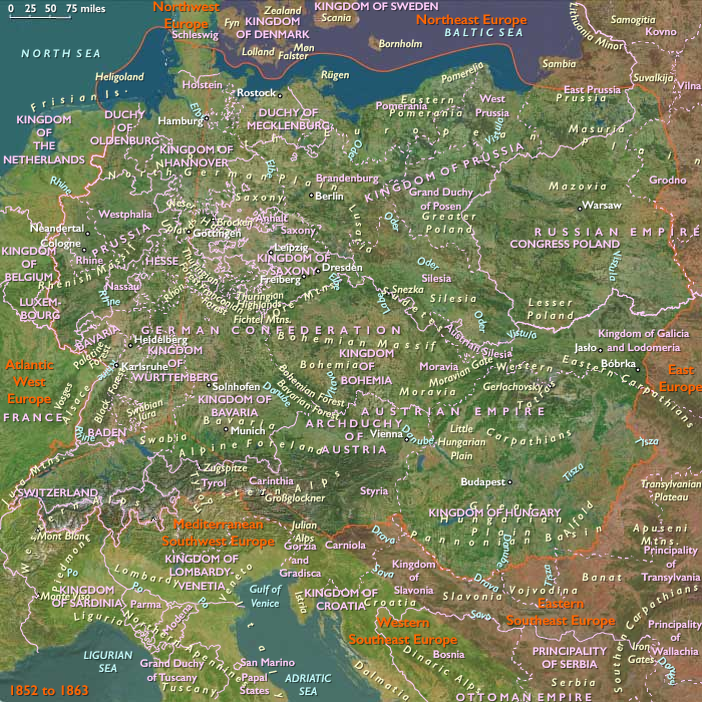
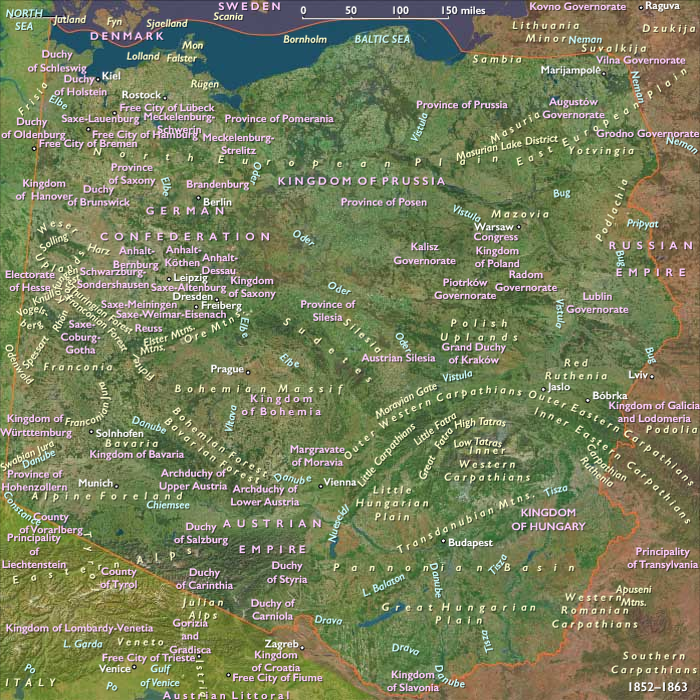
Austrian Neoabsolutism, with its aim of creating a unified, supranational state, runs counter to the prevailing European trend.
The empire's peoples cannot be isolated from the larger nationalist struggles of the German, Italian, and Slavic peoples.
In Hungary, active resistance to the Austrian government declines, but passive resistance grows.
During the Crimean War (1853-56), the situation in Hungary makes Austria vulnerable to economic and political pressure from Britain and France, the allies of Turkey against Russia.
Thus, when Russia asks for Austria's support, Austria initially seeks to mediate the conflict but then joins the western allies against Russia.
By failing to repay Russia for its help in Hungary in 1849, Austria loses critical Russian support for its position in Germany and Italy.
The empire's peoples cannot be isolated from the larger nationalist struggles of the German, Italian, and Slavic peoples.
In Hungary, active resistance to the Austrian government declines, but passive resistance grows.
During the Crimean War (1853-56), the situation in Hungary makes Austria vulnerable to economic and political pressure from Britain and France, the allies of Turkey against Russia.
Thus, when Russia asks for Austria's support, Austria initially seeks to mediate the conflict but then joins the western allies against Russia.
By failing to repay Russia for its help in Hungary in 1849, Austria loses critical Russian support for its position in Germany and Italy.
Locations
Groups
- Ottoman Empire
- Hungary, Kingdom of
- Prussia, Kingdom of
- Russian Empire
- Britain (United Kingdom of Great Britain and Ireland)
- Austrian Empire
- German Confederation
- Lombardy-Venetia, Kingdom of
- France, Second Empire of
Topics
Subjects
Regions
Subregions
Years: 1852 - 1863
Locations
Groups
- Ottoman Empire
- Hungary, Kingdom of
- Prussia, Kingdom of
- Russian Empire
- Britain (United Kingdom of Great Britain and Ireland)
- Austrian Empire
- German Confederation
- Lombardy-Venetia, Kingdom of
- France, Second Empire of
Topics
Subjects
Regions
Subregions