Japan had turned down a demand from…
1852 CE to 1863 CE
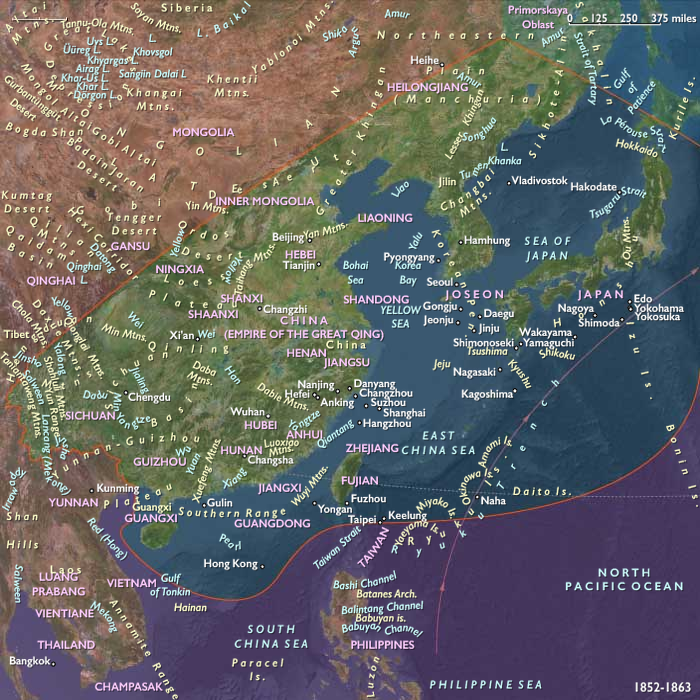
Japan had turned down a demand from the United States, which is greatly expanding its own presence in the Asia-Pacific region, to establish diplomatic relations when Commodore James Biddle appeared in Edo Bay with two warships in July 1846.
However, when Commodore Matthew C. Perry's four-ship squadron appears in Edo Bay in July 1853, the bakufu is thrown into turmoil.
The chairman of the senior councilors, Abe Masahiro (1819-57), is responsible for dealing with the Americans.
Having no precedent to manage this threat to national security, Abe tries to balance the desires of the senior councilors to compromise with the foreigners, of the emperor who wants to keep the foreigners out, and of the daimyo who want to go to war.
Lacking consensus, Abe decides to compromise by accepting Perry's demands for opening Japan to foreign trade while also making military preparations .
In March 1854, the Treaty of Peace and Amity (or Treaty of Kanagawa) opens two ports to American ships seeking provisions, guarantees good treatment to shipwrecked American sailors, and allows a United States consul to take up residence in Shimoda, a seaport on the Izu Peninsula, southwest of Edo.
A commercial treaty, opening still more areas to American trade, is forced on the bakufu five years later.
Locations
People
Groups
Regions
East Asia
View →Subregions