
Atlantic West Europe (2637 – 910 BCE): …
Years: 2637BCE - 910BCE
Atlantic West Europe (2637 – 910 BCE): Coasts, Rivers, and Lowland Hubs
Geographic and Environmental Context
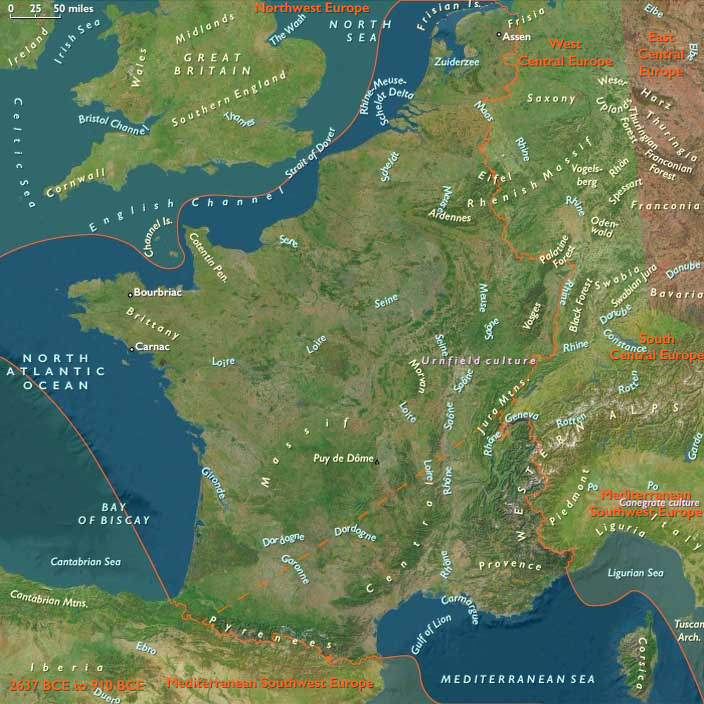
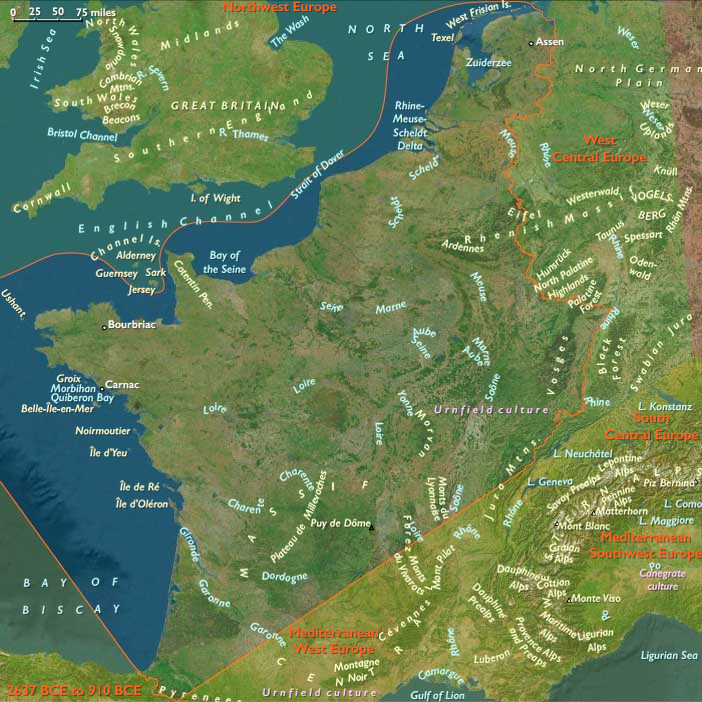
Atlantic West Europe—including the Atlantic and English Channel coasts of France, the Loire Valley, Burgundy, northern France (including Paris), and the Low Countries (Belgium, the Netherlands, and Luxembourg)—was a region of temperate oceanic climate, fertile lowlands, and navigable waterways. The coastline alternated between sandy beaches, estuaries, tidal flats, and chalk cliffs, while inland river systems like the Loire, Seine, Somme, and Scheldt connected the interior to the sea. The fertile loess soils of the Low Countries and northern France supported dense vegetation and productive farmland.
Subsistence and Settlement
By the mid–third millennium BCE, farming communities cultivated wheat, barley, and legumes, supplemented by cattle, sheep, goat, and pig husbandry. Coastal and riverine populations also exploited fish, shellfish, and waterfowl, while inland hunting continued for red deer, wild boar, and smaller game. Settlements ranged from small hamlets to larger, more permanent villages in fertile valleys, with timber longhouses and wattle-and-daub structures.
Technological and Cultural Developments
Stone tool traditions continued alongside growing use of copper and early bronze in weapons, ornaments, and tools, with metallurgy influenced by trade with Central Europe and the Iberian Peninsula. Pottery styles varied from simple utilitarian wares to decorated vessels, reflecting both local innovation and external influences. In some areas, megalithic traditions persisted, with dolmens and passage graves still in use, though new burial forms—such as barrows and cists—were becoming more common.
Maritime and Overland Networks
The Atlantic and Channel coasts supported maritime exchange, moving stone, metals, salt, and prestige goods between Britain, Iberia, and continental Europe. The Seine, Loire, and Rhine river systems served as inland highways linking the coast to Burgundy and beyond. The Low Countries acted as a cultural crossroads, integrating influences from the North Sea and the continental interior.
Cultural and Symbolic Expressions
Burials sometimes included bronze daggers, axes, beads, and decorated ceramics, reflecting status and participation in long-distance exchange. Rock carvings and decorated standing stones in Brittany and Normandy carried geometric motifs and stylized weapon imagery. Ritual deposition of metal objects in rivers and wetlands hinted at emerging warrior and elite identities.
Environmental Adaptation and Resilience
Communities adapted to seasonal flooding in lowland valleys through settlement placement and use of raised storage facilities. Coastal dwellers managed the risks of storms and tidal surges by situating villages inland from vulnerable shores, while exploiting estuaries for salt production and rich fisheries. Crop diversity and integration of pastoralism provided resilience against localized failures.
Transition to the Early First Millennium BCE
By 910 BCE, Atlantic West Europe had become a major hub of agricultural production and maritime trade. Its integration of coastal and inland networks fostered a cultural dynamism that would grow with the expansion of bronze metallurgy and the intensification of long-distance exchange.
Groups
Topics
Commodoties
Subjects
Regions
Subregions
Years: 2637BCE - 910BCE
Groups
Topics
Commodoties
Subjects
Regions
Subregions