
Diocletian's preference for activist government, combined with…
303 CE
Diocletian's preference for activist government, combined with his self-image as a restorer of past Roman glory, presages the most pervasive persecution of Christians in Roman history.
People
Groups
Subjects
Regions
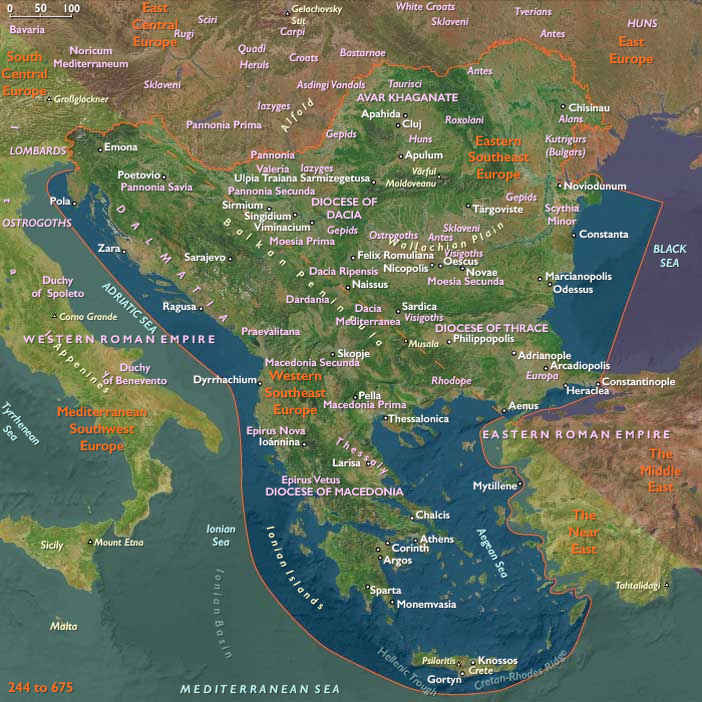
Southeast Europe
View →Subregions
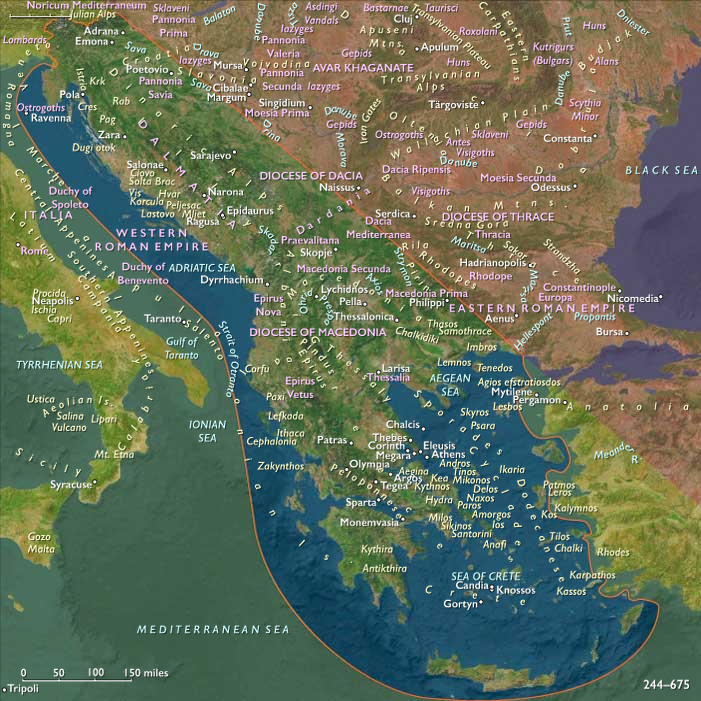
Western Southeast Europe
View →Related Events
No active filters.
Showing 10 events out of 60056 total
Sima Ai, as regent, pays attention to reforming the government, and he sees the importance of formally honoring Emperor Hui while maintaining resemblance to impartial governance.
He continues to try to share power with Sima Ying.
However, in autumn 303, Sima Yong, dissatisfied that his plan had not come to fruition, persuades Sima Ying to again join him against Sima Ai.
While Sima Yong and Sima Ying have overwhelming force, their forces cannot score a conclusive victory against Sima Ai.
Chinese poet Lu Ji leads a Taoist and Buddhist-influenced movement toward a more individualistic and uninhibited literary style.
After Wu’s subjugation by the Jin Dynasty in 280, Lu Ji, a direct descendant of the founders of Eastern Wu and son of the general Lu Kang, had moved with his brother Lu Yun to the capital, Luoyang, where he has become prominent in both literature and politics and has been made president of the imperial university.
According to Achilles Fang, quoted in Eliot Weinberger (ed.
), The New Directions Anthology of Classical Chinese Poetry (New Directions, 2003: ISBN 0811215407), p. 240, “ He was too scintillating for the comfort of his jealous contemporaries; in 303 he, along with his two brothers and two sons, was put to death on a false charge of high treason."
Lu Ji wrote much lyric poetry but is better known for writing fu, a mixture of prose and poetry.
He is best remembered for the Wenfu ("On Literature"), a piece of literary criticism that discourses on the principles of composition.
Christians have often been scapegoats during the Roman Empire's Crisis of the third century, and when Diocletian at the beginning of the fourth century makes this persecution systematic, Christian refugee communities fleeing the chaos and persecution of these times form in Egypt at the edges of population centers, far enough away to be safe from Imperial scrutiny, but still close enough to have access to civilization.
Records from this time indicate that Christians often lived in tombs and trash heaps on the edges of major cities, more or less protected by their obscure status.
Christian hagiography venerates a Christian named George, a soldier of the Roman Empire, who in the manner of the mythical Pers reportedly saved a Libyan princess from a dragon and may have been martyred in Palestine under the persecutions initiated by Diocletian. (He will become one of the most venerated saints in the Eastern Orthodox Church and Oriental Orthodox Churches and the patron saint of Canada, Catalonia, England, Ethiopia, Georgia, Greece, Montenegro, Portugal, Serbia, the cities of Istanbul, Ljubljana and Moscow, as well as a wide range of professions, organizations, and disease sufferers.)
Maximian (although he will long be viewed by future Christians as a persecutor of their religion) seems to have done no more than obediently execute in his part of the empire the first edict of Diocletian, which ordered the burning of the Scriptures and the closing of the churches.
Maximian is disturbed from his rest in 303 only by Diocletian's vicennalia, the twenty-year anniversary of his reign, in Rome.
Some evidence suggests that it was on that date that Diocletian exacted a promise from Maximian to retire together, passing their titles as Augusti to the Caesars Constantius and Galerius.
Constantius' enforcement of Diocletian's edicts against the Christians is deliberately lax; he demolishes some churches but does not execute believers.
A Briton named Alban, according to Christian tradition, had sheltered a fugitive priest during Diocletian's persecution of Christians and been baptized by him.
When the emperor's soldiers arrived to search his house, in Verulianum, Alban, found disguised in the priest's cloak, was arrested and then beheaded.
Verulianum will later be named Saint Albans for the man supposed to have been the first British martyr.
Christians have lived in peace during most of the rule of Diocletian, but the victories of the staunchly pagan Galerius against the Sassanians have increased his influence; as he is a fierce advocate of the old ways and old gods, Christians credit Galerius with persuading the emperor to initiate the persecution of the Christians that begins with an edict of February 24, 303.
Christian houses of assembly are destroyed, for fear of sedition in secret gatherings.
Hierocles, proconsul of Bithynia and Alexandria, is said to have been the instigator of the fierce persecution of the Christians.
He is the author of a work (not extant) in two books, in which he endeavors to persuade the Christians that their sacred books are full of contradictions, and that in moral influence and miraculous power Christ is inferior to Apollonius of Tyana.
Our knowledge of this treatise is derived from Lactantius (Instit.
div.
v. 2) and Eusebius, who wrote a refutation.
Diocletian had not been anti-Christian during the first part of his reign, and historians have claimed that Galerius decided to prod him into persecuting them by secretly burning the Imperial Palace and blaming it on Christian saboteurs.
Regardless of who was at fault for the fire, Diocletian's rage is aroused and he begins one of the last and greatest Christian persecutions in the history of the Roman Empire.
On February 23, 303, Diocletian orders that the newly built Christian church at Nicomedia be razed, its scriptures burned, and its treasures seized.
February 23 is the feast of the Terminalia, for Terminus, the god of boundaries, and the day the Tetrarchy terminates Christianity.
The next day, Diocletian's first "Edict against the Christians" is published.
The key targets of this piece of legislation are, as they had been during Valerian's persecution, Christian property and senior clerics.
The edict orders the destruction of Christian scriptures, liturgical books, and places of worship across the empire, and prohibits Christians from assembling for worship.
Christians are also deprived of the right to petition the courts, making them potential subjects for judicial torture; Christians cannot respond to actions brought against them in court; Christian senators, equestrians, decurions, veterans, and soldiers are deprived of their ranks; and imperial freedmen are re-enslaved.
Diocletian requests that the edict be pursued "without bloodshed", against Galerius's demands that all those refusing to sacrifice be burned alive.
In spite of Diocletian's request, local judges will often enforce executions during the persecution, as capital punishment is among their discretionary powers.
Galerius's recommendation—burning alive—will become a common method of executing Christians in the East.
After the edict is posted in Nicomedia, a man named Eutius tears it down and rips it up, shouting "Here are your Gothic and Sarmatian triumphs!"
He is arrested for treason, tortured, and burned alive soon after, becoming the edict's first martyr.
The provisions of the edict are known and enforced in Palestine by March or April (just before Easter), and is in use by local officials in North Africa by May or June.
The earliest martyr at Caesarea is executed on June 7; the edict is in force at Cirta from May 19.
The first edict is the sole legally binding edict in the West.
In the East, however, progressively harsher legislation is devised.
In the summer of 303, following a series of rebellions in Melitene (Malatya, Turkey) and Syria, a second edict is published, ordering the arrest and imprisonment of all bishops and priests.
In the judgment of historian Roger Rees, there was no logical necessity for this second edict; that Diocletian issued one indicates that he was either unaware the first edict was being carried out, or that he felt it was not working as quickly as he needed it to.
Following the publication of the second edict, prisons begin to fill—the underdeveloped prison system of the time cannot handle the deacons, lectors, priests, bishops, and exorcists forced upon them.
Eusebius writes that the edict netted so many priests that ordinary criminals were crowded out, and had to be released.
Diocletian, in anticipation of the upcoming twentieth anniversary of his reign on November 20, 303, declares a general amnesty in a third edict.
Any imprisoned clergyman can now be freed, so long as he agrees to make a sacrifice to the gods.
Diocletian may be searching for some good publicity with this legislation.
He may also seek to fracture the Christian community by publicizing the fact that its clergy has apostatized.
The demand to sacrifice is unacceptable to many of the imprisoned, but wardens often manage to obtain at least nominal compliance.
Some of the clergy sacrifice willingly; others do so on pain of torture.
Wardens are eager to be rid of the clergy in their midst.
Eusebius, in his Martyrs of Palestine, records the case of one man who, after being brought to an altar, had his hands seized and made to complete a sacrificial offering.
The clergyman was told that his act of sacrifice had been recognized and was summarily dismissed.
Others were told they had sacrificed even when they had done nothing.