The history of the Brazilian republic will…
1888 CE to 1899 CE
The history of the Brazilian republic will be a search for a viable form of government to replace the monarchy.
That search will lurch back and forth between state autonomy and centralization.
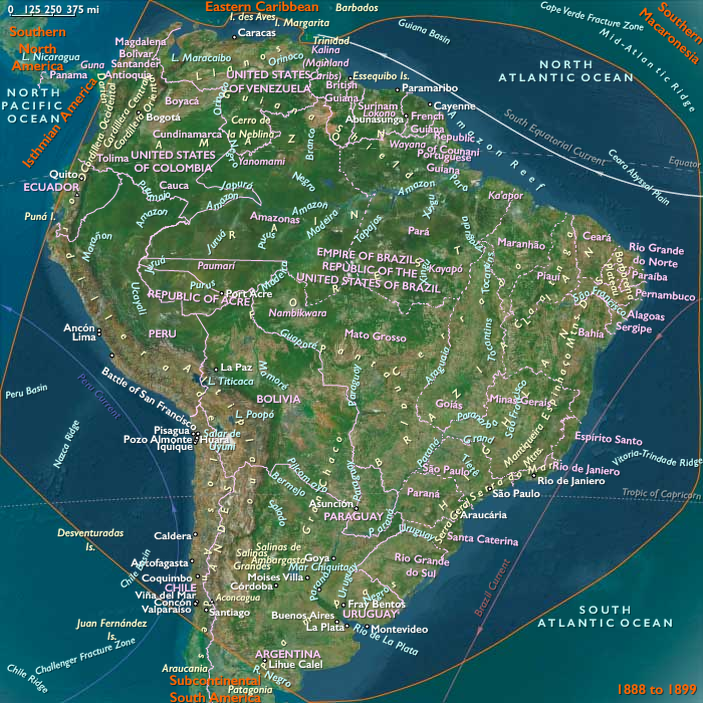
The constitution of 1891, establishing the United States of Brazil (Estados Unidos do Brasil), restores autonomy to the provinces, now called states.
It recognizes that the central government does not rule at the local level, that it exercises control only through the local oligarchies.
The empire had not absorbed fully the regional pátrias, and now they reassert themselves.
Into the 1920s, the federal government in Rio de Janeiro will be dominated and managed by a combination of the more powerful pátrias (São Paulo, Minas Gerais, Rio Grande do Sul, and to a lesser extent Pernambuco and Bahía).
After the revolution of 1930, the trend will be strongly toward absorption of the pátrias, reaching a peak in the New State (Estado Novo) of 1937-45.
Centralization will extend into the smallest remote villages as the nation-state's bureaucracy and power grow to previously unknown levels.
Renewed autonomy will come with the constitution of 1946 but will disappear under the military regime.
The constitution of 1988 will once again restore a degree of state autonomy but in the context of a powerful, all-embracing nation-state
In the 1990s, the pátrias will be more folkloric vestiges than autonomous centers of power.
Subjects
Regions
South America
View →Subregions