To divert French troops from Germany, William…
May 1759 CE
British troops are sent on diversionary attacks on the French coast, at St. Malo and Cherbourg.
An expedition to western Africa captures the French slaving station at Senegal.
In North America, a force is dispatched to take Louisbourg and Quebec.
In India Robert Clive wins the Battle of Plassey.
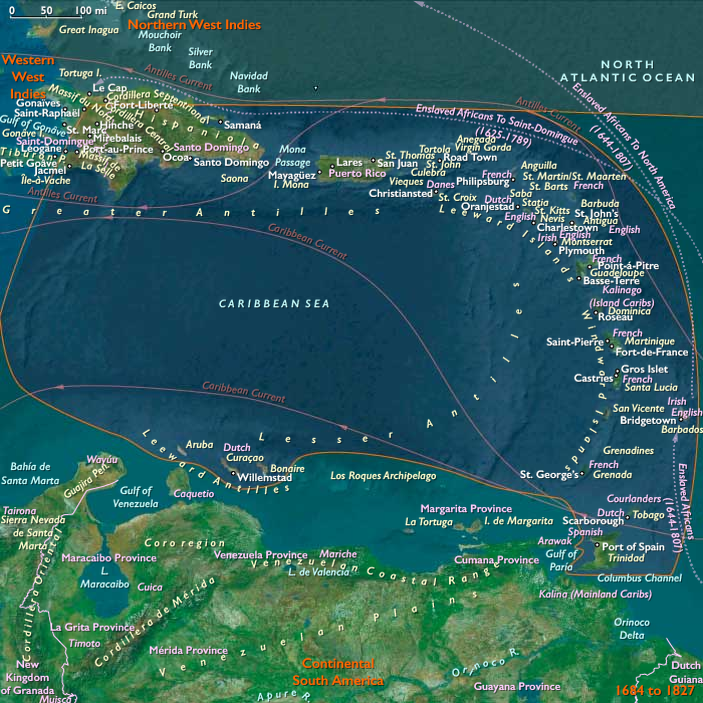
For 1759, Pitt directs attention to the West Indies, specifically Martinique and Guadeloupe.
Major-General Peregrine Hopson, who had been Governor at Nova Scotia before the outbreak of war, is appointed to the chief command, and Colonel John Barrington, a junior officer, is selected to be his second.
On November 12,1758, the transports, escorted by eight ships of the line under Commodore Hughes, had gotten under way and sailed with a fair wind to the west.
On January 3, 1759, the British expedition had reached Barbados, where Commodore John Moore was waiting with two more ships of the line to join it and to take command of the fleet.
The total expeditionary force numbers some sixty-eight hundred men.
The primary target of the attack is Martinique.
Hopson lands his troops near Fort Royal and fights a battle against the French, leaving one hundred British dead or wounded.
The terrain ahead is judged so difficult that it is decided to re-embark the troops immediately.
A second landing is considered at Saint-Pierre but the defenses are so formidable that Hopson decides to abandon the attack on Martinique and to proceed to Guadeloupe.
The fleet sails to Basse-Terre and on January 22 opens fire on the town, reducing it to a heap of blackened ruins.
At dawn on January 24, the British troops are landed, and move inland for some five kilometers, until they meet a strong French position in a rugged, mountainous terrain.
By this time the men on the sick list number fifteen hundred, or fully a quarter of the force.
Hopson's health is failing rapidly too and he remains inactive.
Even the representations of Barrington cannot stimulate him to further action
On 27 February, Hopson dies, leaving the command to devolve to Barrington.
The British expeditionary force is by now on the brink of destruction.
More than six hundred invalids have been sent to Antigua, and another sixteen hundred men are on the sick list.
The remainder are succumbing so fast that sufficient men can hardly be found to do the daily duty.
Meanwhile, John Moore, being fortunately independent of Hopson in respect of naval operations, has sent ships round to Fort Louis.
They speedily batter the fort into surrender and install a garrison of three hundred Highlanders and Marines.
Barrington quickly puts an end to the fatal period of inaction.
He attacks from three sides and forces the French governor Nadau du Treil to capitulate on May1, 1759.
The island has been conquered, but the climate has not and it takes its revenge.
By the close of the seven months that remained of the year 1759 nearly eight hundred officers and men of the garrison will have found their graves in Guadeloupe.
The island will be given back to France after the Treaty of Paris (1763), in return for France dropping its claim to Canada.
Locations
People
Groups
Topics
Commodities
Regions
West Indies
View →Subregions