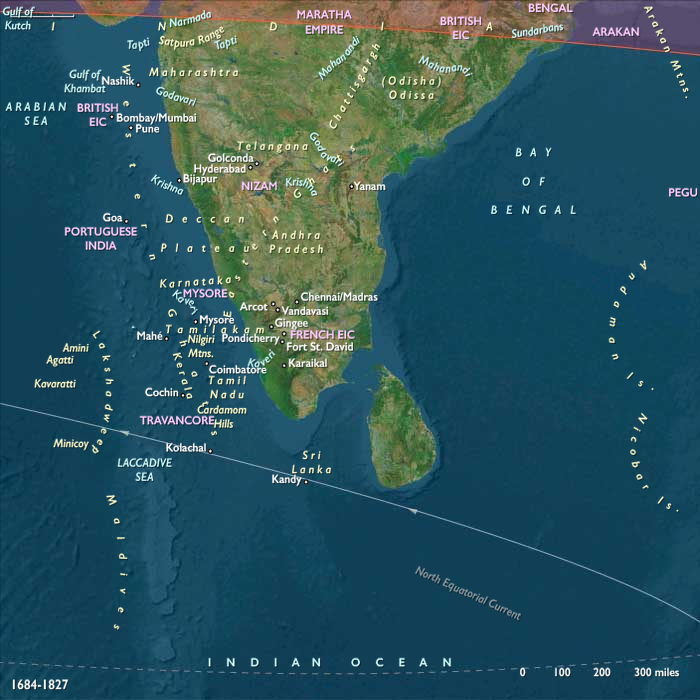
Great Britain and France have been struggling…
February 1759 CE
In 1746 the city of Madras had been captured by the French, but it had been returned to the British in 1748.
Following the fresh outbreak of war both sides were soon in conflict again.
By 1757 Britain held the upper hands after several victories by Robert Clive.
In 1758 French reinforcements under Lally had arrived in Pondicherry and set about advancing France's position on the Coromandel Coast, notably capturing Fort St. David.
This had caused alarm to the British, most of whose troops were with Clive in Bengal.
Lally had been poised to strike against Madras in June 1758, but short of money, he had launched an unsuccessful attack on Tanjore hoping to raise revenue there.
By the time he was ready to launch his assault on Madras it was December before the first French troops reached Madras, delayed partly by the onset of the monsoon season.
This had given the British extra time to prepare their defenses, and withdraw their outposts—boosting the garrison to nearly four thousand troops.
Madras in at this time was divided broadly into two distinct parts: the "Black town" where the majority native population lives, which is unfortified—and the "White town" where the smaller European population lives, which is dominated by Fort St George.
On December 14, French troops had entered the Black town unopposed, and finding it undefended, had begun to loot the houses.
The British had then launched a sortie with six hundred men under Colonel William Draper attacking the scattered French.
Bloody street-fighting had broken out which had left three hundred dead on each side before Draper's men withdrew into the fort.
While the result had been indecisive, and casualties even, the fight had had a devastating effect on French morale.
The two French commanders Lally and Bussy had begun arguing over the failure to cut off and trap Draper's raiding force.
Lally had fiercely criticized Bussy in public, but had not dismissed him from his post as second-in-command.
As the French took up their positions around the city, ready to besiege Fort St George, they were unable to open fire as they were still waiting for artillery ammunition to be brought up for the major siege guns.
For three weeks the guns had stood silent, until on January 2, 1759 they begin firing on the citadel.
In spite of an intense five-day bombardment and several infantry assaults, the French have failed to make the breakthrough they are hoping for—as the British defenses remain largely intact.
A large mine is detonated under the fortress, but this makes little impact on the defenses.
French morale falls further as they realize how little effect their attacks have had on the defenders.
Many of the soldiers grow disgruntled and desert, including one hundred and fifty who switch sides to join the garrison.
Lally is also facing an attack on his lines of supply by Muhammed Yusuf Khan, the British Sepoy commander at Chingleput, the only force that had not withdrawn into Madras upon the approach of the French.
Lally manages to beat off the British attack, but they still remain in the vicinity menacing his rear, stealing much needed supplies and blocking the passage of many to his forces.
After several weeks of heavy bombardment, the French are at last starting to make headway against the town's defenses.
The main bastion has been destroyed, and a breach opened in the walls.
The heavy exchange of fire has flattened much of Madras, with most of the town's houses gutted by shells.
A Royal Navy frigate runs the French blockade on January 30 and carries a large sum of money and a company of reinforcements into Madras.
Significantly they bring the news that the British fleet under Admiral George Pocock is on its way from Calcutta.
When Lally discovers this news he becomes aware that he will have to launch an all-or-nothing assault to storm the fortress before Pocock arrives.
He convenes a council of war, where it is agreed to launch an intense bombardment on the British guns, to knock them out of action.
On February 16, six British vessels, carrying six hundred troops, arrive off Madras.
Faced with this added threat, Lally takes the immediate decision to break off the siege and withdraw south.
The British victory at Madras is considered part of the Annus Mirabilis of 1759 as part of a string of British successes around the globe, and helps lay the foundations for eventual British strategic supremacy in India.
British forces will go on the offensive in India, decisively defeating a French force at Wandiwash, then capturing Pondicherry in 1761.
The string of battles are a major turning point in the battle for dominance on the subcontinent between Britain and France.
Locations
People
Groups
Topics
Regions
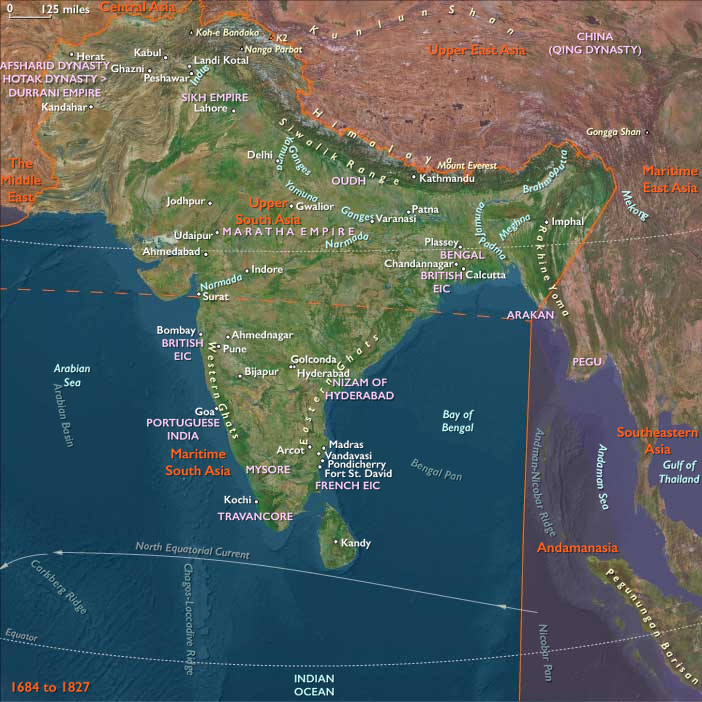
South Asia
View →Subregions