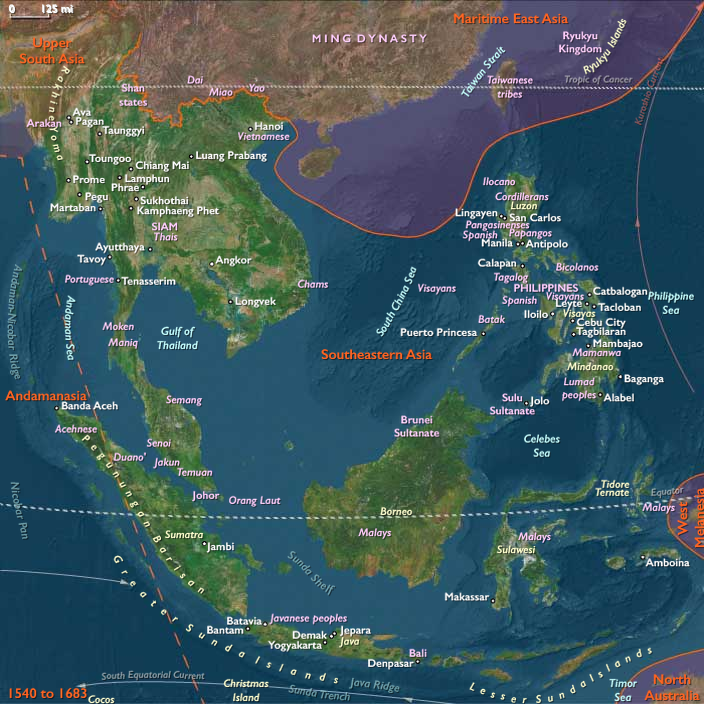
The Burmese send their own princes to…
1578 CE
The Burmese send their own princes to serve as rulers of Lanna when the dynasty of Mengrai becomes extinct in 1578.

Locations
People
Groups
Regions
Southeast Asia
View →Subregions
Southeastern Asia
View →Related Events
No active filters.
Showing 10 events out of 35075 total
The Portuguese, who had arrived on Todore in 1521 and destroyed the capital of the sultanate, build a fort in 1578.
A giant materia medica, describes more than two thousand drugs and presents directions for preparing more than eight thousand prescriptions.
Completed in 1578 by Li Shih-chen, the Pen-ts'ao kang-mu (“Great Pharmacopoeia”) is in part a compilation of other smaller works of the same kind.
It contains one hundred and forty-two illustrations and descriptions of one thousand and seventy-four vegetable, four hundred and forty-three animal, and two hundred and seventeen mineral substances.
Li describes such seemingly modern processes as distillation and the uses of mercury, ephedrine, chaulmoogra oil, iodine, and even smallpox inoculation.
A giant materia medica describes more than two thousand drugs and presents directions for preparing more than eight thousand prescriptions.
Completed in 1578 by Li Shih-chen compiles, the the Pen-ts'ao kang-mu (“Great Pharmacopoeia”) is in part a compilation of other smaller works of the same kind.
It contains one hundred and forty-two illustrations and descriptions of one thousand and seventy-four vegetable, four hundred and forty-three animal, and two hundred and seventeen mineral substances.
Li describes such seemingly modern processes as distillation and the uses of mercury, ephedrine, chaulmoogra oil, iodine, and even smallpox inoculation.
Olivier Brunel, the first Flemish navigator of the Arctic Ocean, had sailed beyond Lapland in 1565 in search of a northeast route to China.
After establishing a trading post at the mouth of the Northern Dvina River (now Archangel'sk, Russia), he had been imprisoned by the Russian government.
He had been released, sometime around 1566, through the intervention of the Stroganovs, a wealthy Russian merchant family, for whom he then went to work.
As their agent he had established regular trade between Russia and the Netherlands by 1570.
Continuing his search for a northeastern passage, Brunel had become the first western European to make an overland trip from Moscow to the Ob River in Siberia, in 1576.
The Netherlands' commercial sphere of influence has spread over the entire White Sea region by 1578, and a Dutch settlement is founded on the present site of Archangel'sk, on the Northern Dvina River, thirty miles (fifty kilometers) from the White Sea.
Piotrków Trybunalski, in central Poland, first chronicled in the thirteenth century when it obtained town rights, in 1578 becomes the seat of the Polish tribunal, after which it is named, and the meeting place of the diets (assemblies) and synods.
Cloth manufacture had begun here in the fifteenth century.
Faustus Socinus, a Unitarian theologian, is one of the most important of the Italian religious exiles in Poland.
His acquisition in 1562 of the papers of his uncle Laelius Socinus (1525–62), a theologian suspected of heterodox views, has led him to adopt some of Laelius' proposals for the reformation of Christian doctrines and to become an anti-Trinitarian theologian.
Laelius' commentary on the prologue to the Gospel According to John presented Christ as the revealer of God's new creation and denied Christ's preexistence.
Faustus' own Explicatio primae partis primi capitis Ioannis (first edition published in Transylvania in 1567–68; “Explanation of the First Part of the First Chapter of John's Gospel”) and his manuscripts of 1578, De Jesu Christo Servatore (first published 1594; “On Jesus Christ, the Savior”) and De statu primi hominis ante lapsum (1578; “On the State of the First Man Before the Fall”), will be of subsequent influence, the first, particularly, in Transylvania and all three in Poland.
Selim's son had ascended the throne as Murad III at his father's death in December 1574, Selim’s brilliant grand vizier Mehmed Pasa Sokollu had lost much of his power.
During what becomes known as the “Sultanate of the Women” from 1570 to 1578, Murad has come under the influence of the women in his harem and of his courtiers, and ignored the advice of Sokollu, who favors peace, in 1578 opposing Ottoman entry into war with Venice and with Persia.
Externally, Murad continues the military offensive of his predecessors.
The rising principality of Moscow has conquered the last Mongol states in Central Asia and reached the Caspian Sea, thus posing a threat to the Ottoman positions north of the Black Sea and in the Caucasus.
Anarchy has followed the death of Shah Tahmasp I in 1576, and a civil war seems to be developing, leading the Ottoman Turks to believe the Persians can at last be conquered.
A large Ottoman offensive begins in 1578 with a surprise invasion from Crimea.
Two Persian armies are overwhelmed in rapid succession, Georgia is conquered and ottomanized, and Dagestan is invaded.
Bahr negus Yeshaq once again revolts against the Ethiopian crown with support of the ruler of Harar, Sultan Mohammed IV Mansur.
Emperor Sarsa Dengel then marches to Tigray in 1578, where he defeats and kills Yeshaq in battle.