
The Chinese introduce the seven-day week into…
1192 CE to 1203 CE
The Chinese introduce the seven-day week into their calendar around 1200.
Subjects
Regions

East Asia
View →Subregions
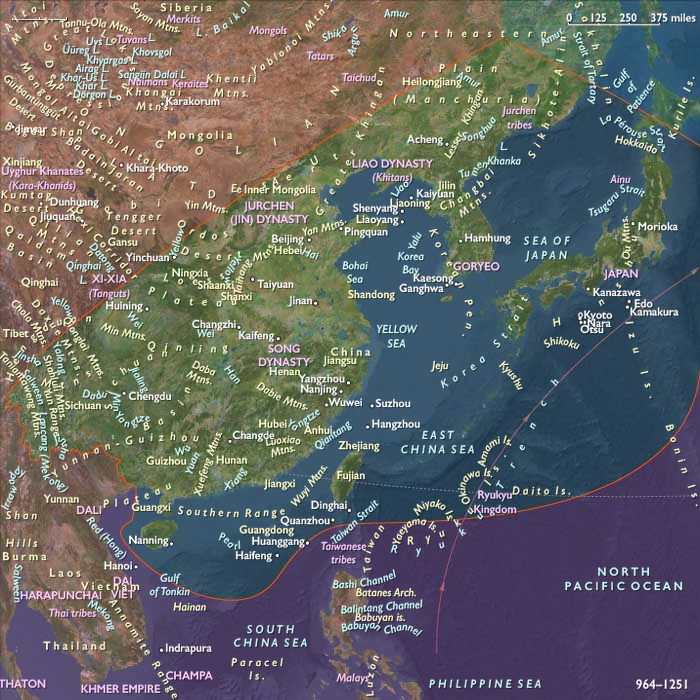
Maritime East Asia
View →Related Events
Showing 10 events out of 65 total
The German fraternity that had taken over a hospital in the town of Acre had begun to describe itself as the Hospital of St. Mary of the German House in Jerusalem.
The late Pope Clement III had approved it, and it adopts a rule like that of the original Hospital of St. John of Jerusalem.
Richard I of England, intent on recapturing Jerusalem from the Ayyubid Sultanate, had called on Conrad of Monferrat to join him on campaign, but he had refused, citing Richard's alliance with his vassal Guy of Lusignan.
He too had been negotiating with Saladin, as a defense against any attempt by Richard to wrest Tyre from him for Guy.
Richard is forced to accept Conrad as king of Jerusalem after an election in April by the barons of the remnant crusader states.
Richard unhappily consents to the request that Guy, who has managed to lose the support of nearly all the barons, be deposed and Conrad of Montferrat, Lord of Tyre, immediately be accepted as titular King of Jerusalem.
Guy receives no votes at all, but Richard sells him Cyprus as compensation.
Richard departs the Third Crusade for his kingdom on October 9.
The Kingdom of Jerusalem is now relatively secure, with its new capital at Acre, from which a narrow strip along the Mediterranean coast is ruled.
When the Muslims recaptured Jerusalem in 1187, the Hospitallers had removed their headquarters first to Margat and in 1197 to Acre.
Members continue to nurse the sick, guard the roads, and fight the Muslims.
On the accidental death of Henry of Champagne in 1197 (due to a fall from a first-floor window of his palace), Amalric succeeds to the throne of Jerusalem-Acre, accepting investiture as King Amalric II of Jerusalem from the chancellor of the Hohenstaufen emperor Henry VI.
A widower, Amalric is induced to marry Henry's widow, the thrice married, thrice widowed Queen Isabella I, because the emperor's German advisers are hoping to get the Latin kingdom of Jerusalem as a fief like Cyprus.
Amalric has chosen to govern his two domains separately and to regard himself as merely Jerusalem's regent, and in Acre, he proves to be an excellent administrator.
As titular king of Jerusalem, Amalric is able to make peace with his Muslim neighbors, thanks to the struggle that had taken place among them after Saladin's death in 1193.
He also deals wisely with Saladin's brother, al-'Adil of Egypt.
The death of Emperor Henry VI from malaria on September 28, 1197, has caused an important change: a number of German crusaders who had arrived in Palestine decide to return home.
In order to fill the gap, the German princes and bishops, together with those of the Kingdom of Jerusalem, militarize the House of the Hospitallers of Saint Mary of the Teutons in Jerusalem in 1198, making it a religious order of knights.
The new order is put under a monastic and military rule like that of the Templars and Hospitallers.
It receives privileges from Popes Celestine III and Innocent III and extensive grants of land, not only in the kingdom of Jerusalem but also in Germany and elsewhere.
The members, who are nobles, take vows of poverty, chastity, and obedience, and come to be called the Teutonic Knights.
…the kingdom of Jerusalem remains in the possession of Queen Isabella, widowed for the fourth time.
In this year, Pope Innocent III grants the Teutonic knights of Acre the use of the white habit with a black cross.
Isabella, who died on April 5, 1205, had been succeeded at her death as Queen of Jerusalem by her eldest daughter Maria of Montferrat, daughter of Conrad of Montferrat.
Jean of Brienne, a penniless younger son of the French count Erard II of Brienne and Agnes of Montbéliard, had passed most of his life as a minor noble until befriended by Philip II of France, who arranges for him to marry Maria.
Destined originally for a clerical career, he had preferred to become a knight, and in forty years of tournaments and fights he had won himself a considerable reputation, when in 1208 envoys had come from the Holy Land to ask Philip to select one of his barons as husband to the heiress and ruler of the Kingdom of Jerusalem.
To overcome his lack of fortune and to enable him to fund his sovereign obligations (court and army) King Philip and Pope Innocent III have each paid him the sum of forty thousand livres.
John reaches Acre on September 3, 1210, and marries Marie the following day.
John of Brienne, after some desultory operations, had in 1212 concluded a five years' truce with the Ayyubid Sultan of Egypt, al-Adil.
The following year, he loses his wife, who leaves him a daughter, Yolande (also known as Isabella).
John marries Princess Stephanie of Armenia, daughter of the Armenian king Leo II, in 1214.
During the truce with the Ayyubids, he persuades Pope Innocent to launch the Fifth Crusade in support of his daughter's kingdom.
Pope Innocent III, having since 1208 planned a crusade in order to destroy the Ayyubid Empire and to recapture Jerusalem, had in April 1213 issued the papal bull Quia maior, calling all of Christendom to join a new crusade.
This had been followed in 1215 by another papal bull, the Ad Liberandam.
Innocent had in 1215 summoned the Fourth Lateran Council, where, along with the Latin Patriarch of Jerusalem, Raoul of Merencourt, he had discussed the recovery of the Holy Land, among other church business.
Pope Innocent wants it to be led by the papacy, as the First Crusade should have been, in order to avoid the mistakes of the Fourth Crusade, which had been taken over by the Venetians.
Innocent plans for the crusaders to meet in 1216 at Brindisi and to ensure that the crusaders will have ships and weapons prohibits trade with the Muslims.
Every crusader will receive an indulgence, including those who simply help pay the expenses of a crusader, but do not go on crusade themselves.
The message of the crusade had been preached in France by Robert of Courçon; however, unlike other Crusades, not many French knights have joined, as they are already fighting the Albigensian Crusade against the heretical Cathar sect in southern France.
Oliver of Cologne had preached the crusade in Germany, and King Frederick II of Sicily, a Hohenstaufen and grandson of Frederick I Barbarossa, twice crowned king of the Germans, had in 1215 attempted to join.
Frederick was the last monarch Innocent wanted to join the movement, as he had challenged the Papacy (and would do so in the years to come).
Innocent dies, however, in 1216.
Honorius III, who succeeds Innocent on July 28, immediately activates Innocent's plan to restore the kingdom of Jerusalem, organizing crusading armies led by King Andrew II of Hungary and duke Leopold VI of Austria.