
The church of the Gesu, first conceived …
Years: 1568 - 1568
The church of the Gesu, first conceived in 1551 by Ignatius of Loyola, the founder of the Jesuits Society of Jesus, is located in the Piazza del Gesù in Rome, built on the same spot as the previous church Santa Maria della Strada, where Loyola had once prayed before an image of the Holy Virgin.
Michelangelo, at the request of the Spanish cardinal Bartolomeo de la Cueva, had offered, out of devotion, to design the church for free The endeavor is instead funded by Cardinal Alessandro Farnese, grandson of Pope Paul III, the pope who had authorized the founding of the Society of Jesus.
The main architects ultimately involved in the construction are Giacomo Barozzi da Vignola, architect of the Farnese family, and Giacomo della Porta.
Vignola's Il Gesu, begun in Rome for the Jesuits in 1568, calls for a large, single-aisled church, with truncated transept arms and a large dome over the crossing, all leading to the altar set in a deep, wide apse.
In this design, in which he departs from oval format design of his earlier churches of Sant' Andrea in Via Flaminia and Sant'Anna dei Palafrenieri, can be seen the full development of a new style, later called the baroque, that departs from the classical rules.
His elimination of side aisles creates an uncluttered and airy interior.
Giacomo della Porta designs the facade.
The Gesù, active during the Protestant Reformation and the subsequent Catholic Reformation, is also to be the home of the Superior General of the Society of Jesus until the suppression of the order in 1773.
Officially named Chiesa del Santissimo Nome di Gesù all'Argentina (English: Church of the Most Holy Name of Jesus), the church serves as model for innumerable Jesuit churches all over the world, especially in the Americas.
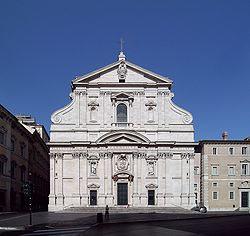
Giacomo della Porta's façade of the Church of the Gesù, a precursor of the Baroque (Photo by Alessio Damato, 2007)
Locations
People
Groups
Topics
- Renaissance, Italian
- Protestant Reformation
- Counter-Reformation (also Catholic Reformation or Catholic Revival)
- Western Architecture: 1540 to 1684
Subjects
Regions
Subregions
Related Events
Showing 10 events out of 35519 total
Years: 1568 - 1568
Giacomo della Porta's façade of the Church of the Gesù, a precursor of the Baroque (Photo by Alessio Damato, 2007)
Locations
People
Groups
Topics
- Renaissance, Italian
- Protestant Reformation
- Counter-Reformation (also Catholic Reformation or Catholic Revival)
- Western Architecture: 1540 to 1684
Subjects
Regions
Subregions