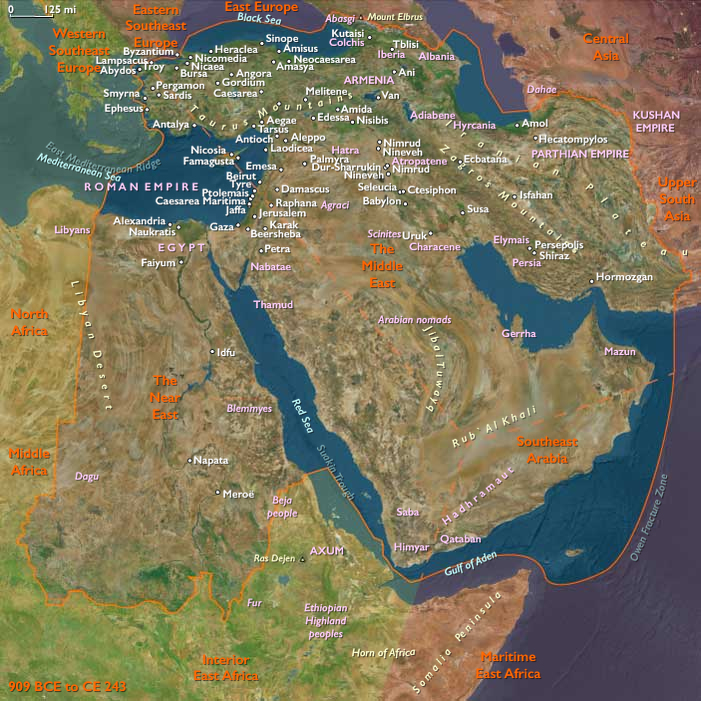
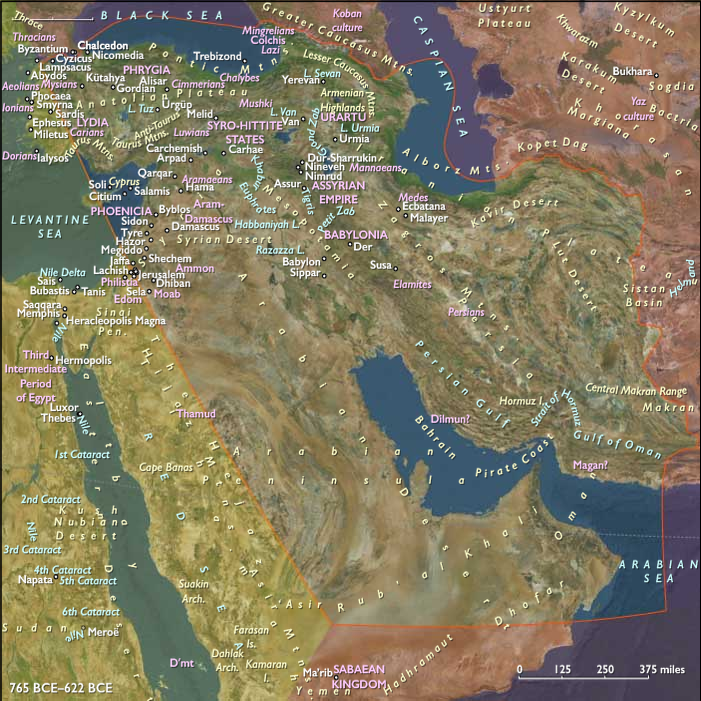
The Cimmerians harry Lydia, the new hegemon …
Years: 693BCE - 682BCE
The Cimmerians harry Lydia, the new hegemon of western Anatolia, until being finally driven into Cappadocia by the Scythians.
Phrygia will linger as a geographic expression under the successive rulers of Anatolia; the Greeks will value its people as slaves.
Locations
Groups
Topics
Commodoties
Subjects
Regions
Subregions
Related Events
Filter results
Showing 10 events out of 16 total
The Austrian-Dutch-Brandenburg league had collapsed owing to the defection of the elector of Brandenburg, and the more durable Quadruple Alliance is formed in August 1673 for the same purpose, including, besides the Holy Roman Empire and the United Provinces , the Kingdom of Spain, the Duke of Lorraine, and several German princes, and the war is renewed.
The Empire at this time, twenty-five years after the peace of Westphalia, is virtually a confederation of independent princes, and it is very difficult for its head to conduct any war with vigor and success, some of its members being in alliance with the enemy and others being only lukewarm in their support of the imperial interests.
Thus this struggle, which is to last until the end of 1678, will on the whole be unfavorable to Germany, and the advantages of the Treaty of Nijmegen are to be with France.
It is often incorrectly assumed the fourth partner was not the Duke of Lorraine but the Electorate of Brandenburg, which will indeed join the alliance, but only in July 1674.
A new peace treaty is signed after the battle of Żurawno in 1676.
Under the Treaty of Żurawno, which results in a partial reversal of the terms of Buczacz, the Ottomans keep approximately two thirds of the territories they had gained in 1672, and the Commonwealth no longer is obliged to pay any kind of tribute to the Empire; a large numbers of Polish prisoners are released by the Ottomans.
It also stipulates that the Lipka Tatars, a group of Tatars who had originally settled in the Grand Duchy of Lithuania at the beginning of fourteenth century, are to be given a free individual choice of whether they want to serve the Ottoman Empire or the Polish Lithuanian Commonwealth.
Thanks to the efforts of Sobieski, who is held in great esteem by the Tatar soldiers, many of the Lipkas seeking asylum and service in the Turkish army will return to his command and participate in the struggles with the Ottoman Empire up to the Treaty of Karlowitz in 1699.
The signing of the treaty begins a period of peace that is much needed for the repair the country and strengthening of the royal authority.
Although constantly hampered by the magnates and foreign courts of Brandenburg and Austria (Austria even tries to oust Sobieski and replace him with Charles of Lorraine), Sobieski manages to completely reform the Polish army.
The military is reorganized into regiments, the infantry finally drops pikes, replacing them with battle-axes, and the Polish cavalry adopts hussar and dragoon formations.
Sobieski also greatly increases the number of guns and introduces new artillery tactics.
The Polish-Ottoman War of 1672-16 has showed the increasing weakness and disorder of the Commonwealth, which by the second half of the seventeenth century had started the gradual decline that is to culminate a century later in the partitions of Poland.
The unruly Sejm, paralyzed by liberum veto and foreign bribery, is dominated by politicians who think in short term gains only and constantly refuse the funds to raise an army, as it appears that most of the Commonwealth will not be ravaged by the Ottoman armies.
Even after the unfavorable Buczacz treaty, which had persuaded the Sejm to raise the taxes, once initial successes were achieved, the majority of the Sejm again couldn't be convinced to keep up the pressure on the enemy; soldiers are left unpaid and desertions on a mass scale negatively affect the Polish cause.
This apparent inability to defend itself, also seen in the other recent and future conflicts involving the Commonwealth, increasingly invites foreign forces to prey on the country.
Sobieski, as a diplomat, envisions an alliance with France and the Ottomans against the Austrian empire and Brandenburg.
His plans have never come to fruition, however, and finally, in 1683, have to be abandoned.
Conscious that Poland lacks allies and risks war against most of its neighbors (similar to the Deluge), Sobieski has allied himself with Leopold I, of the Holy Roman Empire.
The alliance, although aimed directly against the Turks and indirectly against France, has the advantage of gaining support for the defense of Poland's southern borders.
Royal spies uncover Turkish preparations for a military campaign in the spring of 1683, and Sobieski fears that the target might be the Polish cities of Lwów and Kraków.
To counteract the threat, Sobieski begins the fortification of the cities and orders universal military conscription.
Charles V is the younger brother of Ferdinand Philip of Lorraine, who had died at twenty years of age in 1659, and with whose demise Charles had inherited his aunt's Duchy of Bar.
Charles has been the titular Duke of Lorraine from 1675.
Lorraine being occupied by France, Charles had found refuge with the Habsburgs, in whose service he has had a notable military career.
He was supposed to have married Marie Jeanne of Savoy (a cousin via Maria Jeanne's grandmother).
Despite a marriage contract being signed, Charles had backed out of the union, which is seen as void due to not having been consummated.
Marie Jeanne had instead married Charles Emmanuel II, Duke of Savoy, in 1665.
The Habsburg connection had been cemented in 1678 by the marriage of Charles to Eleonora Maria Josefa, Archduchess of Austria, daughter of Ferdinand III, Holy Roman Emperor and Eleonore Gonzaga.
She is also the widow of Michael Korybut Wiśniowiecki, King of Poland, and will pass to her heirs the inheritance of the Gonzaga of Mantua.
In the Imperial service, Charles had first distinguished himself at the battle of August 1, 1664, fighting among Imperial forces against the Turks, and had campaigned in Hungary with general Johann Sporck in 1671.
He had been in command at the siege of Murau in the Steiermark.
The following year he was in command of Imperial cavalry under Raimondo Montecuccoli.
At Seneffe in 1674, he had received a head wound; in 1676 he had been present at the siege of Philipsburg.
Finally, named generalissimo of the Imperial army in April 1683, he will aid the king of Poland at the imminent Battle of Vienna.

One hundred and fifty thousand Turkish troops, with the tacit support of the Hungarian army, lay siege to Vienna in mid-July, succeed in capturing the outer fortifications, and begin to tunnel to the inner walls.
The emperor flees the city, which is guarded by only ten thousand Habsburg soldiers.
Pope Innocent XI, after trying unsuccessfully to induce Louis XIV of France to aid Leopold against the Turks, appeals to Poland with a large subsidy.
Although Sobieski and the emperor had made a pact of alliance earlier that year, the Polish king is reluctant to come until Innocent persuades Charles of Lorraine to join a combined army with the electors of Saxony and Bavaria as well as thirty German princes.
The eight thousand troops of this relieving army form along the top of the Vienna hills, and, on the morning of September 12, Lorraine's and Sobieski's forces attack the Turks.
The battle rages for fifteen hours before the Turkish invaders are driven from their trenches.
The red tent of the grand vizier is blown up, but he escapes while thousands of members of his routed army are slaughtered or taken prisoner.
Reports state that it takes the armies and the Viennese a week to collect the booty that has been left behind in the Turkish camp.
As Mustafa Pasha's army retreated, it had left several large bags of green beans behind in their camp.
These sacks contain unroasted coffee beans which as legend has it, forms the nucleus from which the Viennese coffee trade begins.
Sobieski's demonstration of military skill in war against the Ottoman Empire contributes to his prowess as King of Poland.
As one of his ambitions is to unify Christian Europe in a crusade to drive the Turks out of Europe, he had joined the alliance of the Holy Roman Emperor and joined the Holy League initiated by Innocent XI to preserve Christendom.
Christian forces have begin the slow process of driving the Turks from Europe, forcing them out of northwestern Hungary by late 1683.