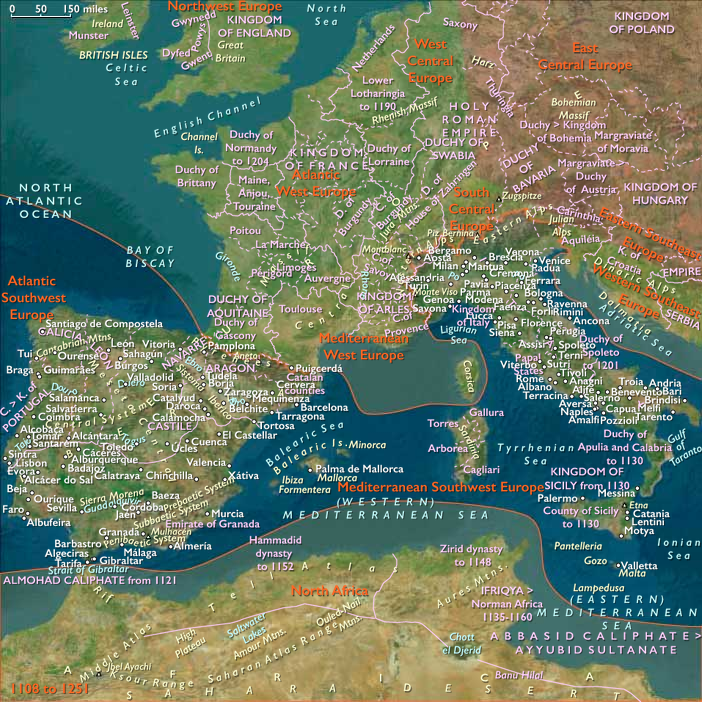
…the cities of Alcántara and …
Years: 1164 - 1164
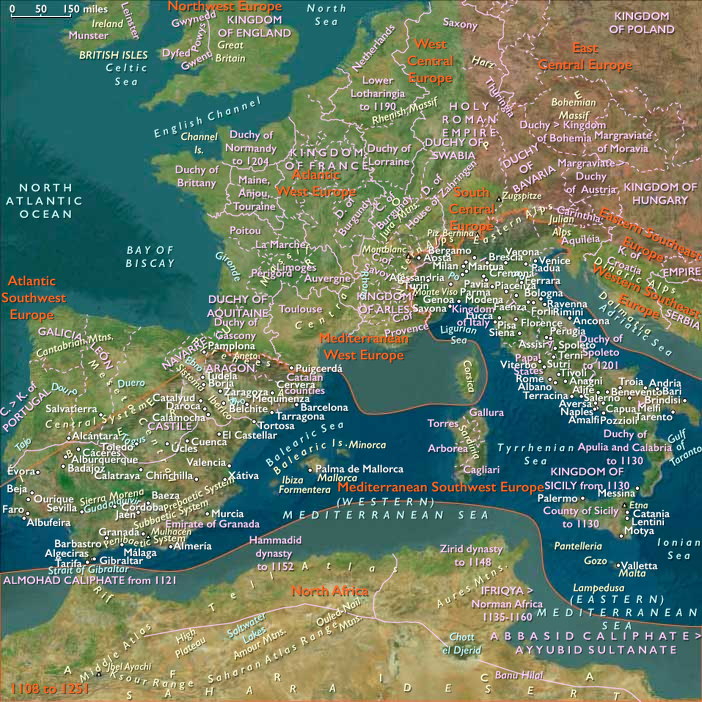
…the cities of Alcántara and …
Locations
People
Groups
Topics
Commodoties
Subjects
Regions
Subregions
Related Events
Filter results
Showing 10 events out of 48478 total
The city of Vladimir, serving its original purpose as a defensive outpost for the Rostov-Suzdal principality, had had little political or military influence throughout the reign of Vladimir Monomakh (1113–1125), or his son Yuri Dolgorukiy ("long arms").
It is only under Dolgoruky's son, Andrey Bogolyubsky ("Andrey the God-Loving"), that it becomes the center of the Vladimir-Suzdal principality.
Andrey had left Vyshhorod in 1155 and moved to Vladimir.
Promoting development of feudal relations, he relies on a team and on Vladimir’s townspeople; he connects Vladimir to the trading and craft industries of Rostov and Suzdal.
After his father’s death in 1157, he has become Knyaz (prince) of Vladimir, Rostov and Suzdal.
Thus begins the city's Golden Age, which will last until the Mongol invasion of Russia in 1237.
During this time Vladimir will enjoy immense growth and prosperity, and Andry will oversee the building of the Golden Gates and the Cathedral of the Assumption.
In 1164, Andrey even attempts to establish a new metropolitanate in Vladimir, separate from that of Kiev, but is rebuffed by the Patriarch of Constantinople.
Uppsala is recognized as the seat of the Swedish metropolitan with the coronation of its first archbishop Stefan by Pope Alexander III.
Nur ad-Din moves north to Antioch, with assistance from his brother Qutb ad-Din in Mosul, his other vassals from Aleppo and Damascus, and the Artuqids of the Jazira, and besieges the fortress of Harim (Harenc) in 1164.
As William of Tyre says, "he stationed his engines around it in the customary manner and began to assault the place with a fury which permitted the inhabitants no rest."
Reginald of Saint Valery, lord of Harim, calls for help, and Raymond III of Tripoli, Bohemond III of Antioch, and Joscelin III of Edessa arrived to relieve the siege.
They are joined by Constantine Kalamanos, the imperial governor of Cilicia, and Thoros, and Mleh of Armenia, as well as Hugh VIII of Lusignan and Geoffrey Martel, brother of William IV of Angoulême, both of whom had recently arrived on pilgrimage.
Nur ad-Din prepares to give up the siege when they arrive, but the crusaders, inspired by the victory at al-Buqaia, and, "regardless of the rules of military discipline ... recklessly dispersed and roved hither and yon in pursuit of the foe."
Nur ad-Din's troops defend against their charge and lead a counterattack, pushing the crusaders into a swamp, and they are massacred "like victims before the altar."
It is possible that Nur ad-Din was only feigning a retreat in order to draw the crusaders into an ambush, but abandoning a siege when a relief army arrived is a standard tactic and Nur ad-Din presumably had no way of knowing the crusaders would follow him.
William's assertion that this was a reckless move is further evidence of this.
"Only the Armenian Thoros, who had foreseen the Turkish maneuver and had not set off in pursuit, escaped from the disaster".
(Oldenbourg, Zoé (1966).
The Crusades.
New York: Pantheon Books.)
Mleh also avoids capture.
Constantine Kalamanos, Hugh, Raymond, Bohemund, and Joscelin are captured and imprisoned in Aleppo.
According to Ibn al-Athir, ten thousand crusaders were killed.
Nur ad-Din resumes the siege and captures Harim a few days later.

Amalric's absence in Egypt leaves all three crusader states without their rulers, but Nur ad-Din does not want to attack Antioch itself for fear of provoking a response from Constantinople, as the Principality is technically an imperial fief.
To his critics he replies, "I would rather have Bohemond as a neighbor than the King of the Greeks!".
Nur ad-Din goes on to besiege and capture Banias.
Amalric abandons Egypt and marches north with Thierry of Flanders to relieve Nur ad-Din's pressure on Antioch.
Nur ad-Din had sent his lieutenant Shirkuh to Egypt accompanied by his own nephew, Saladin, to settle a dispute between Shawar and Dirgham over the Fatimid vizierate.
Shawar is restored and Dirgham killed, but after quarreling with Shirkuh, Shawar allies with Almaic of Jerusalem, who, believing his northern front secure, had taken his army to Egypt, where had found himself in a three-way contest between his Franks, Shirkuh, and Shawar, with the latter trying maintain Egyptian independence.
Because Egypt had never paid the yearly tribute that it had promised Baldwin in 1160, Amalric hopes to gain control of Egypt and break Muslim unity.
He ousts Shirkuh from Egypt in 1164, but the king has had to rapidly abandon Egypt upon the news of a great disaster in the north.
A commercial treaty of 1164 grants access to Almohad-dominated ports to merchants from several European powers, including Marseille and …
…Savona, the latter having acquired independence in the eleventh century after a long struggle against the Saracens, becoming a free municipality allied with the Emperor.
Antipope Victor IV is described by John of Salisbury as eloquent and refined, but petty and parsimonious.
When he was sent with Cardinal Jordan of Santa Susanna as a papal legate to summon Conrad III of Germany to Italy to be crowned Holy Roman Emperor, he had quarreled with his co-legate and, in the words of Salisbury, "made the Church a laughingstock.” (Norwich, John Julius.
The Kingdom in the Sun 1130–1194.
London: Longmans, 1970.)
Victor dies at Lucca on April 20, 1164.
A small number of cardinals who had elected Victor IV meet again in 1164 to vote Paschal III as his successor.
The second of the antipopes to challenge the reign of Pope Alexander III, his real name is Guido of Crema.
Established at Viterbo, Paschal successfully prevents the legitimate pontiff from reaching Rome.
León’s boundary troubles with Castile restart in 1164: Ferdinad then meets at Soria with the Lara family, who represent Alfonso VIII, and a truce is established, allowing him to move against the Muslim Almoravids who still hold much of southern Spain, and to capture …